What Makes a Software Architecture Future-Proof?
- Niotechone Marketing Team
Table of Contents
- Introduction
- Why Future-Proof Architecture Matters in 2026
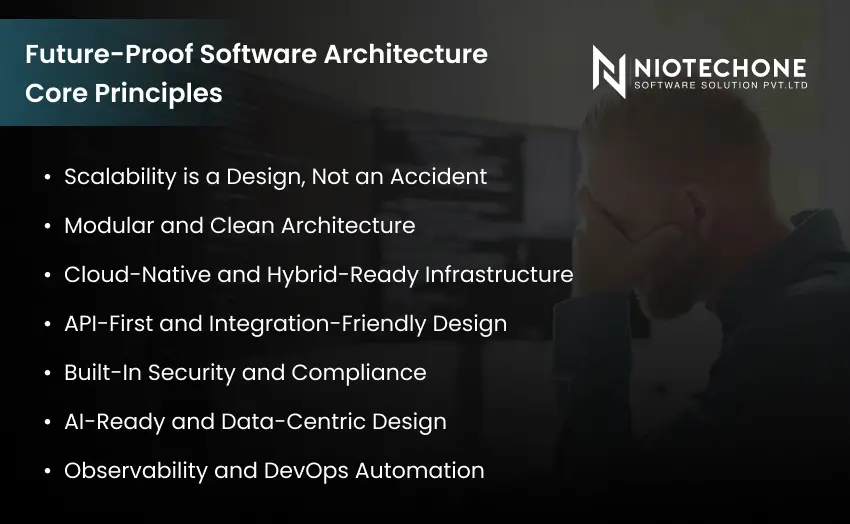
- Future-Proof Software Architecture Core Principles
- 1. Scalability is a Design, Not an Accident
- 2. Modular and Clean Architecture
- 3. Cloud-Native and Hybrid-Ready Infrastructure
- 4. API-First and Integration-Friendly Design
- 5. Built-In Security and Compliance
- 6. AI-Ready and Data-Centric Design
- 7. Observability and DevOps Automation
- Future-Proof vs. Short-Term Architecture: A Comparison
- Real-World Case: Enterprise ERP System Modernization
- Future-Proof Architecture is required by 2026 Trends
- When Do You Reconsider Your Architecture?
- Conclusion: Architecture Is a Strategic Business Asset
Introduction
Software is no longer a support feature in 2026. It is the foundation of business development, customer experience, automation, and competitive advantage. They spend a lot of money on digital transformation, and then they find out that their systems are not scalable, cannot integrate AI, cannot meet the demands of the cloud, and cannot support new business models.
Be it a .NET development company, the actual distinction is not necessarily code quality, but architectural vision. In case you are planning to develop a .NET application, develop a Scalable software application, or invest in cloud application development on Azure cloud architecture, this guide will assist you in knowing what actually makes software architecture future-proof.

Why Future-Proof Architecture Matters in 2026
In 2026, enterprise technology is defined by:
- AI-driven automation
- Cloud-native ecosystems
- API-first integrations
- Cybersecurity regulations
- Remote and hybrid work models
- Quick feature development cycles
In the absence of a flexible and scalable architecture, businesses suffer:
- Performance bottlenecks
- High cloud costs
- Security vulnerabilities
- Slow product innovation
- Costly system rewrites
A future-proof architecture secures your long-term investment and allows innovation.
Future-Proof Software Architecture Core Principles
1. Scalability is a Design, Not an Accident
Scalability should be designed at the beginning.
A Scalable software application must support:
- Rapid user growth
- High transaction volumes
- Multi-location access
- Heavy data processing
- AI workload expansion
The ASP.NET Core application architecture of today enables horizontal scaling, modular service growth, and optimization of performance.
Indications of Scalable Architecture:
- Stateless services
- Load balancing
- Distributed caching
- Database indexing optimization.
- Cloud auto-scaling policies
A skilled ASP.NET Core development company will make sure that scalability is integrated on all levels.
2. Modular and Clean Architecture
Monolithic systems restrict flexibility.
Future-proof systems adhere to the principles of modular design:
- Separation of concerns
- Layered architecture
- Domain-driven design
- Microservices were suitable
This enables the development of individual components without interfering with the whole system.
Professional custom .NET development services are based on clean code standards and organized service layers that make long-term maintenance easier.
3. Cloud-Native and Hybrid-Ready Infrastructure
In 2026, cloud is not optional. However, cloud complexity should be addressed.
Powerful cloud application development encompasses:
- Containerization
- Infrastructure as Code
- Auto-scaling environments
- Secure API gateways
- Disaster recovery planning
Using Azure cloud architecture allows:
- Integrated DevOps
- Enterprise-grade security
- AI services integration
- Global scalability
A trusted software development company does not match infrastructure to technical preferences only, but to business objectives.
4. API-First and Integration-Friendly Design
Modern businesses rely on integrations.
Your architecture should support:
- Third-party services
- Mobile applications
- AI engines
- Payment gateways
- Partner ecosystems
A qualified ASP.NET Core development company guarantees:
- Version-controlled APIs
- Strong authentication levels.
- Consistent data contracts
- Monitoring and observability.
Digital expansion is sluggish and dangerous without a robust API architecture.
5. Built-In Security and Compliance
Security is not retrofittable.
Future-proof architecture consists of:
- Zero-trust security models
- Role-based access control
- Encrypted communication
- Secure identity management
- Regular security audits
A skilled ASP.NET developer in Rajkot or an enterprise team incorporates security on code, API, and infrastructure levels.
Security not only safeguards systems, but also brand reputation.
6. AI-Ready and Data-Centric Design
The 2026 business strategies are being influenced by AI in software development.
However, AI needs clean architecture and structured data pipelines.
Future-ready systems:
- Standardized data models.
- Maintain clean APIs
- Adopt event-driven architecture.
- Support real-time analytics
- Support scalable compute workloads.
Bad architecture is an obstacle to AI. It is facilitated by structured systems.
7. Observability and DevOps Automation
Expansion requires regulated discharges.
Future-proof architecture consists of:
- CI/CD pipelines
- Automated testing
- Blue-green deployments
- Real-time monitoring
- Log aggregation
A formal process of developing an application in .NET minimizes human error and enhances reliability.
Future-Proof vs. Short-Term Architecture: A Comparison
Short-Term Architecture | Future-Proof Architecture |
Monolithic design | Modular, service-oriented design |
Manual deployments | Automated CI/CD pipelines |
On-prem only | Cloud-native or hybrid-ready |
Hardcoded integrations | API-first approach |
Limited scalability | Elastic cloud scaling |
Security after development | Security-first design |
No AI planning | AI-ready infrastructure |
The difference is strategic planning.
Real-World Case: Enterprise ERP System Modernization
Initial Situation
One of the manufacturing enterprises was using a 10-year-old monolithic system. It struggled with:
- Integration delays
- Ineffective operation at peak loads.
- Limited analytics
- Security gaps
Strategic Transformation
In collaboration with a dedicated.NET development company in Rajkot, the business:
- Re-created core services on ASP.NET Core application architecture.
- Moved infrastructure to the Azure cloud platform.
- Implemented modular APIs
- Presented an AI-based prediction.
- Adopted DevOps automation
Business Outcome
- Processing speed increased by 45 percent.
- Lower infrastructure cost.
- Faster feature rollouts
- Multi-location access is secure.
It was not only modernization but future-readiness
Future-Proof Architecture is required by 2026 Trends
Enterprise leaders should be ready to:
- Composable enterprise platforms
- AI-assisted development processes
- Serverless microservices
- Regulations on data sovereignty
- Multi-tenant SaaS ecosystems
- Edge computing expansion
An innovative custom software development company is able to foresee these changes before they are enforced.
When Do You Reconsider Your Architecture?
You might require modernization when:
- Under load, performance decreases
- Scaling is a manual process
- Integration projects are too long
- The cost of clouds is increasing at an alarming rate
- Vulnerabilities are exposed through security audits
To evaluate architectural risks, organizations intending to expand should seek the services of an experienced software development company in Rajkot or an international partner.
Conclusion: Architecture Is a Strategic Business Asset
Software architecture is not a technical detail in 2026. It is a business strategic move. A future-proof system allows quick innovation, AI implementation, cloud scalability, and safe growth. A poor foundation results in technical debt, operational risk, and financial loss.
Organizations can invest in structured ASP.NET core application architecture, secure cloud application development, and scalable .NET application development to be successful in the long term.
When you engage a seasoned .NET development company in Rajkot or an enterprise-oriented partner, you are guaranteed a digital infrastructure that is designed to support tomorrow, not merely today. Customer expectations rise. Future-proof architecture makes sure that your business stays current – without having to start all over.
Categories
Related Articles

Frequently Asked Questions FAQs
It implies creating systems that are scalable, compatible with new technologies, can incorporate AI, and are not vulnerable to the need to be rewritten entirely.
Yes, ASP.NET Core is a modular, cloud-native, and secure API development platform, which is suitable for scalable enterprise systems.
Azure provides worldwide scalability, built-in DevOps, AI services, and enterprise security capabilities that enable long-term digital expansion.
Yes, Unoptimized APIs, inefficient queries, and inappropriate scaling policies add a lot of cost to infrastructure.
AI needs data pipelines, scalable computing resources, and modular services. AI is not compatible with systems that were not originally designed to support it.