The Silent Shift: How AI Is Changing Software Architecture
- Niotechone Marketing Team
Table of Contents
- Introduction: The New Era of Software Architecture
- What is Intelligent about Architecture?
- The Future of AI in Software Architecture
- Modern Application Architecture in 2026
- Scalable AI-Based Architecture Design
- Enterprise AI and Architecture
- Artificial Intelligence-based Architecture and Cloud Integration
- Difficulties in AI-Powered Software Architecture
- The Future of Intelligent System Architecture
- Conclusion: The Silent Shift Is Here
Introduction: The New Era of Software Architecture
A silent but radical change is taking place in the software industry. Software is no longer just a tool, but a smart, dynamic ecosystem by 2026. The trend in AI-driven software architecture is gaining popularity among businesses, enabling the creation of scalable, resilient, and user-friendly applications.
In 2026, enterprises in India and around the world are adopting modern application architecture, using intelligent systems to provide improved user experiences, accelerated innovation, and scalability that is sustainable. The companies, such as .NET development company in Rajkot and custom software development in India, are at the forefront of this change, providing Azure cloud application development, ASP.NET core development in Rajkot and custom Enterprise mobility software solutions that are tailored to the intelligent age.
What is Intelligent about Architecture?
Conventional software architecture is usually concerned with monolithic designs, pre-defined logic, and fixed scalability. Conversely, intelligent system architecture design focuses on flexibility, predictability, and AI integration at the very beginning.
The main features are:
- Self-learning elements that adapt according to data.
- Scalability to predictive workloads.
- Operational efficiency decision-making modules that are automated.
- Connection with cloud-native services, which allows quicker deployment and worldwide availability.
With AI being integrated into the architecture, organisations can make sure that their systems are relevant and responsive in dynamic markets.
The Future of AI in Software Architecture
AI is transforming the conceptualisation, design, and deployment of applications. The transformation of AI in software architecture can be observed on several levels:
Smart Data Processing: AI allows data to be analysed and directed in real-time, which makes systems more responsive and faster.
Adaptive Services: AI-driven microservices are able to scale workloads, prioritise tasks, and optimise resource allocation automatically.
Predictive Maintenance: AI checks the health of applications, forecasts failures, and initiates automatic recovery.
Improved Security: Smart systems identify abnormalities, foresee threats, and act in advance.
This revolution makes software not stagnant anymore- it learns, evolves and intelligently scales. Discover our Custom Software Development Services in India to create AI-based applications that can perform at an enterprise level.
Modern Application Architecture in 2026
Principles of Intelligent Design
Scalable AI-based architecture characterises modern software in 2026. The main principles that will be used in this transformation are:
- Microservices-first: Modular components scale and evolve independently.
- Cloud-native infrastructure: Smooth deployment on platforms such as Azure to develop Azure cloud applications.
- Event-driven architecture: Real-time responses to business events and user actions.
- Ready to integrate design: Seamless integration with third-party systems, legacy applications, and enterprise mobility solutions.
Indian companies like Travel portal software development company in Rajkot are taking advantage of these principles to develop platforms that are not only intelligent but also regional market-oriented.
Scalable AI-Based Architecture Design
Scalability in 2026 is not about serving more users, but about smart growth. Scalable AI-based architecture enables applications to scale, self-optimise, and enhance performance as the system expands.
The main factors to consider when developing scalable AI systems:
- AI-based predictions of dynamic resource allocation.
- AI-based load balancing to avoid bottlenecks.
- Self-healing modules and continuous monitoring.
- International connectivity through cloud-native implementation.
This will guarantee that businesses receive systems capable of supporting millions of users without performance loss, and the development of .NET Core applications and ASP.NET Core development in Rajkot is smarter and more robust than ever.
Enterprise AI and Architecture
Businesses are becoming more and more in need of systems that not only facilitate day-to-day activities but also facilitate strategic decision-making. Enterprise intelligent system architecture design encompasses:
- Faster business processes through automated workflows.
- Market insights predictive analytics.
- Artificial intelligence-driven multi-layered security measures.
- Better user experience through adaptive UI/UX.
Indian companies are developing systems that provide quantifiable ROI and future-proof digital platforms by integrating AI with enterprise-grade infrastructure. Learn about our Enterprise Mobility Solutions that are AI-driven to scale and perform.
Artificial Intelligence-based Architecture and Cloud Integration
In 2026, cloud platforms cannot exist without AI. AI-based architecture uses cloud features to improve reliability, speed, and flexibility.
Benefits include:
- Scalability without on-premise constraints.
- Smart applications through real-time data processing.
- International availability that guarantees performance in geographies.
- Combined AI services such as ML models, analytics, and IoT processing.
Indian companies are also engaging more and more with .NET development companies in Rajkot and other areas to implement AI-based cloud-native applications that suit both local and international markets.
Difficulties in AI-Powered Software Architecture
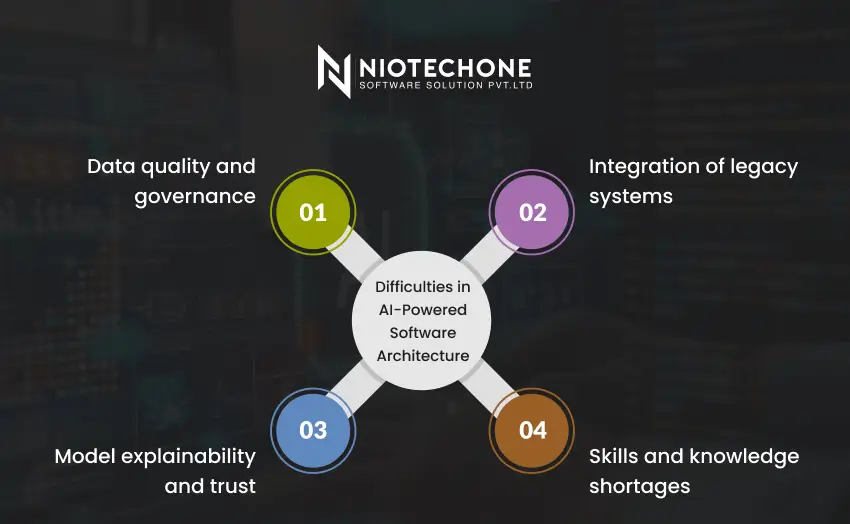
Although AI has a transformative potential, it is associated with distinct challenges. Enterprises must consider:
Data quality and governance: AI depends on high-quality and consistent data to learn and make decisions.
Integration of legacy systems: It may be complicated to bridge intelligent systems with existing software.
Model explainability and trust: Essential to regulated industries and enterprise adoption.
Skills and knowledge shortages: Effective deployment needs talented AI architects.
The solution to these challenges will make AI-driven software architecture sustainable and reliable.
The Future of Intelligent System Architecture
In the future, the application architecture in 2026 will be characterised by flexibility and constant change. AI will have a greater impact on design choices, scalability plans, and operations.
Companies that implement AI-based structures will enjoy:
- Smarter, self-optimising applications.
- Business decision predictive capabilities.
- Less operational overhead and shorter time-to-market.
- Increased resistance to disruptions.
Indian companies that use AI by developing custom software in India and AI in Software Development in Rajkot are establishing the standard of intelligent system architecture in the world.
Conclusion: The Silent Shift Is Here
The 2026 transformation cannot be ignored. The transformation of AI in software architecture is not a temporary phenomenon, but a paradigm shift that affects scalability, design principles, and enterprise performance. Through the use of smart system architecture design, companies are able to develop faster, smarter and future-proof applications.
Indian companies such as Travel portal software development company in Rajkot, .NET development company in Rajkot, and providers of Azure cloud application development are already at the forefront of this change, adopting modern application architecture in 2026 to provide state-of-the-art solutions.
Categories
Related Articles

Frequently Asked Questions FAQs
Scalable AI architecture enables systems to optimise themselves, handle higher workloads, enhance performance, and facilitate intelligent decision-making without a lot of manual intervention.