
The Role of Blockchain in Data Privacy
- Niotechone Marketing Team
Table of Contents
- Introduction
- What is Blockchain in Data Privacy?
- The importance of Blockchain to Data Privacy
- Real-World Applications of Blockchain in Data Privacy
- Advantages of Blockchain in Business Data Privacy
- How Blockchain Enables Secure API and Microservices Architectures
- Modern Technology + Blockchain: A Potent Dynamic
- Difficulties in Adopting Blockchain to Data Privacy
- Conclusion
Introduction
In the current digital age, information has turned out to be the most prized possession of companies and individuals. Nevertheless, the high rates of data breaches, unauthorized access, and centralized system vulnerability have cast grave concerns on data privacy. Conventional data storage systems are centralized databases, which are more vulnerable to cyberattacks. That is where the Blockchain technology comes in – it provides transparency, security, and decentralization.
In the case of businesses in any industry, be it finance, healthcare, travel and e-commerce, blockchain offers a new paradigm of securing sensitive information and allowing secure and traceable access to data. Being one of the most popular organizations are increasingly using blockchain to develop future-proof digital solutions that focus on trust, integrity, and privacy.
What is Blockchain in Data Privacy?
Blockchain is a secure, decentralized method of storing information that uses a series of cryptographically secured digital ledgers to help organizations safeguard sensitive information from unauthorised third-party access, tampering or misuse. With blockchain, all record-keeping records are stored in multiple locations throughout the network instead of at one central location; therefore, it becomes virtually impossible for a hacker and/or an internal threat actor to tamper with and/or gain access to confidential corporate records.
The importance of Blockchain to Data Privacy
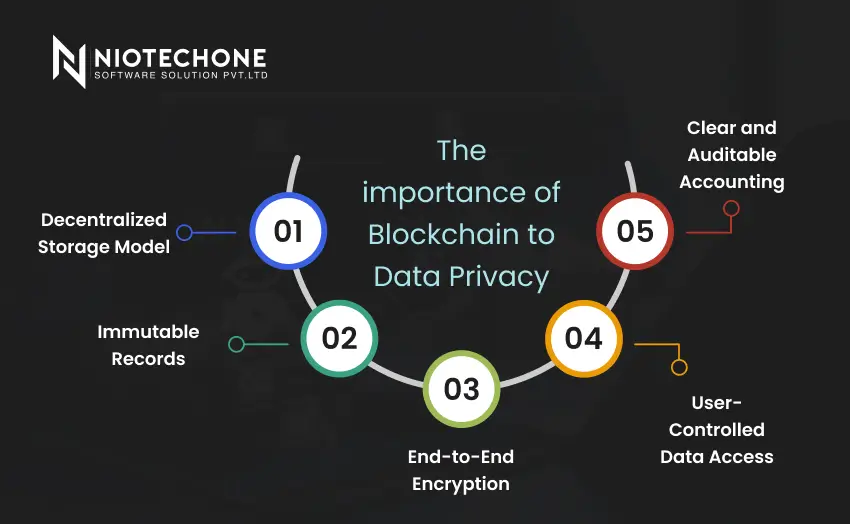
The privacy and data protection of blockchain are guaranteed by the fundamental features of the technology, namely immutability, decentralization, and encrypted transactions. Rather than keeping data at one point of failure, records are replicated on networks and this minimizes security risks.
The way Blockchain improves data privacy:
Decentralized Storage Model
- Blockchain does not store data in a single centralized place but rather spreads it among several nodes. This minimizes the vulnerabilities and eradicates the occurrence of a single massive data breach.
Immutable Records
- Information stored in blockchain is immutable and cannot be altered or erased, which aids in avoiding fraud, manipulation, and unauthorized access.
End-to-End Encryption
- Blockchain is based on sophisticated cryptography to ensure the safety of transactions, and only authorized users can access data with the help of private keys.
User-Controlled Data Access
- Blockchain provides people with the right to own their personal data, and they can provide or deny access accordingly.
Clear and Auditable Accounting
- All transactions within a blockchain ledger are traceable, which provides full visibility to compliance and audits.
Real-World Applications of Blockchain in Data Privacy
Blockchain has the potential to revolutionize how businesses handle sensitive data. The contemporary organizations such as those that specialize in the development of custom software, Azure cloud application development, and AI-driven solutions incorporate blockchain to ensure the security of their environment.
The main real-world applications are:
Healthcare Record Security
Hospitals and insurers share medical reports and personal health records without exposing them to data leaks.
Financial Transactions and Payments
Blockchain is applied in banks and fintech apps to make safe digital payments, prevent fraud, and validate KYC.
Travel & Tourism Platforms
A Travel portal software development firm in Rajkot can use blockchain to develop secure identities of travelers, ticketing history, and loyalty.
Remote Work and Enterprise Mobility
Businesses implement secure access control and encrypted communication through identity management that is enabled by blockchain.
E-business and Online Retail
Secure customer data including payment details, addresses, and order history with non-tamperable security.
Advantages of Blockchain in Business Data Privacy
The use of blockchain has real business benefits that facilitate the digital transformation.
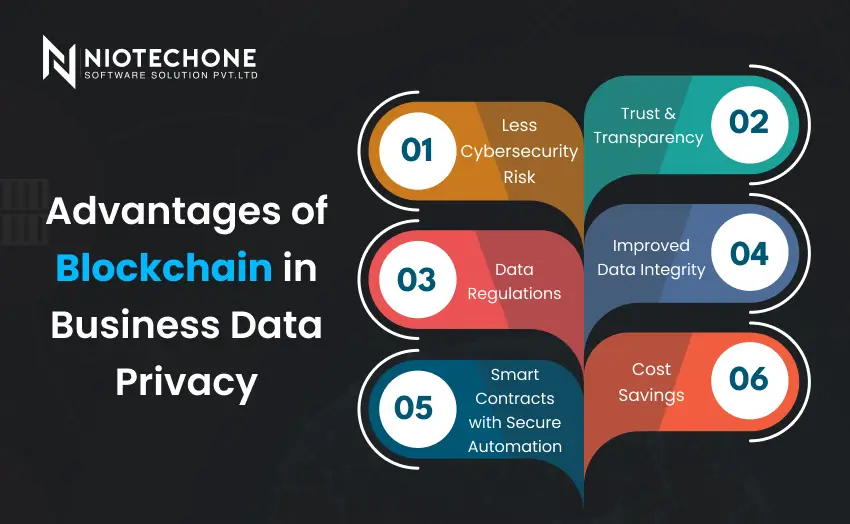
Less Cybersecurity Risk
Decentralized infrastructure does not allow attackers to attack one vulnerable server.
Trust & Transparency
Every transaction can be tracked, which contributes to the development of customer confidence and avoidance of conflicts.
Data Regulations
Supports businesses in achieving such standards as GDPR, HIPAA, and RBI data protection policies.
Improved Data Integrity
Makes all information genuine and verifiable.
Smart Contracts with Secure Automation
Signs contracts automatically without revealing confidential data.
Cost Savings
Reduced reliance on elaborate security systems and external auditing.
How Blockchain Enables Secure API and Microservices Architectures
APIs allow you to connect your services and applications together, but if they are not secure, then your users will be at risk. Blockchain helps you establish trust when connecting your services to one another by offering verifiable identities, encrypted data exchanges, and immutable logs for access requests.
The advantages of using blockchain technology include the following:
- Authentication for API-based systems
- Auditability of logs with compliance requirements
- Secure exchanges of information between different services
This will benefit all web development organizations based in Rajkot who develop distributed cloud-based applications and .NET Core SaaS applications.
Modern Technology + Blockchain: A Potent Dynamic
Nowadays, the most popular technology firms use blockchain and cloud, AI, and .NET to develop safe digital ecosystems. As an example, a .NET development company in Rajkot or web development company in Rajkot applies .NET Core application development and ASP.NET Core development in Rajkot with blockchain to create very secure enterprise platforms.
Combined strategies involve:
- Identity and authentication systems based on blockchain.
- Fraud prediction and anomaly detection using AI.
- Azure blockchain and hybrid cloud implementations.
- Mobility solutions secure API and microservices architecture.
This integration enhances security and minimizes reliance on old legacy systems.
Difficulties in Adopting Blockchain to Data Privacy
Although blockchain provides powerful benefits in securing and managing sensitive data, it also presents a number of practical challenges that organizations should consider before adopting it. Unless these challenges are dealt with using the right strategy and planning, they may impact the rate of adoption, integration preparedness, and the overall ROI.
Key Challenges Include:
Integration with Existing Systems
A lot of businesses continue to use the old-fashioned centralized databases and legacy architecture.
Scalability Limitations
The speed at which blockchain networks handle transactions is usually lower than centralized models since every record has to be authenticated by several nodes.
Uncertainty in Regulatory and Compliance
International data privacy regulations (such as GDPR, CCPA, or the DPDP Act in India) are changing fast. In certain areas, blockchain-based data storage has no legal guidelines, and it is more difficult to plan compliance.
Increased Preliminary Implementation Cost
Even though blockchain lowers the long-term security and operational expenses, organizations can experience increased initial investment in infrastructure, skilled developers, and integration.
Technical Skill Gaps
The development of blockchain requires specialized skills in the field of distributed systems, cryptography, and smart contracts.
Energy Consumption Issues
Certain blockchain designs demand a lot of computing power, making them unsustainable and expensive to deploy at scale.
Conclusion
Blockchain is not only about cryptocurrency, it is an effective technology that reinvents data privacy, security, and digital trust. Blockchain is changing the way businesses store customer data and adhere to data regulations by allowing decentralized storage, immutable auditing, and validation supported by encryption.
As cybersecurity threats continue to rise, companies should implement secure technologies, including blockchain, artificial intelligence, and .NET Core application development to create resilient digital ecosystems.
Categories
Related Articles

Frequently Asked Questions FAQs
The protection provided by blockchain is very high, yet configuration, smart contract validation, and network management are also important to security.
Yes, Azure cloud application development is compatible with blockchain frameworks, which allow scalable and secure enterprise deployments.
Initial configuration might be costly, but long-term savings and less risk of breach make it worth the price.
The healthcare, financial, cybersecurity, logistics, travel, and government sectors are greatly benefited.
The development of blockchain and .NET Core is compatible with APIs and smart contract frameworks.


