
The Hidden Risks of SaaS
- Niotechone Marketing Team
Table of Contents
- Introduction
- Why SaaS Seems Easy — But It Isn’t
- Hidden Risk #1: Weak Multi-Tenant Architecture
- Hidden Risk #2: Underestimated Infrastructure Costs
- Hidden Risk #3: Scale Security Vulnerabilities
- Hidden Risk #4: Compounding Technical Debt
- Hidden Risk #5: Weak API Governance
- Hidden Risk #6: Scalability Assumptions Untested
- Hidden Risk #7: AI Implementation Lacking Strategy
- Real-World Example
- 2026 Trends: Growing SaaS Risk Complexity
- Reducing SaaS risks before scaling
- Conclusion
Introduction
The default model of delivering modern digital products has become Software-as-a-Service (SaaS). Since startups are starting with subscription-based platforms and businesses are converting their legacy systems, SaaS provides flexibility, recurring revenue, and global access.
However, behind its scalability and convenience lie hidden risks that many founders and CTOs overlook.
In 2026, it will take more than a simple deployment of code to the cloud to build a SaaS platform. It requires well-organized ASP.NET Core application architecture, strong cloud application development, secure APIs, and long-term engineering discipline. Whether you are collaborating with a .NET development company in Rajkot or a multinational custom software development company, it is important to know these risks prior to scaling.
This guide discusses the latent dangers of SaaS, their effects on business development, and how they can be addressed using the appropriate technical approach.
Why SaaS Seems Easy — But It Isn’t
SaaS is easy to use at first sight. You subscribe, log in, set a few settings, and your system is up. No infrastructure to maintain and no complex installation procedure. This simplicity is very appealing to startups and expanding businesses since it minimizes initial investment and accelerates deployment.
As your business expands, you might face the following challenges:
- Little deep customization past simple configuration.
- Reliance on the update cycle and roadmap of the vendor.
- Integration rate limits.
- Scaling subscription costs with user scale.
- Limitations on changing core processes.
Customization is a misconception. SaaS can be configured, e.g., by adding fields or changing workflows, but seldom by changing application logic. Another hidden factor is cost. Monthly subscriptions seem cheap initially. However, as time goes by, costs rise with the number of additional users, storage capacity, premium features, and integration requirements.
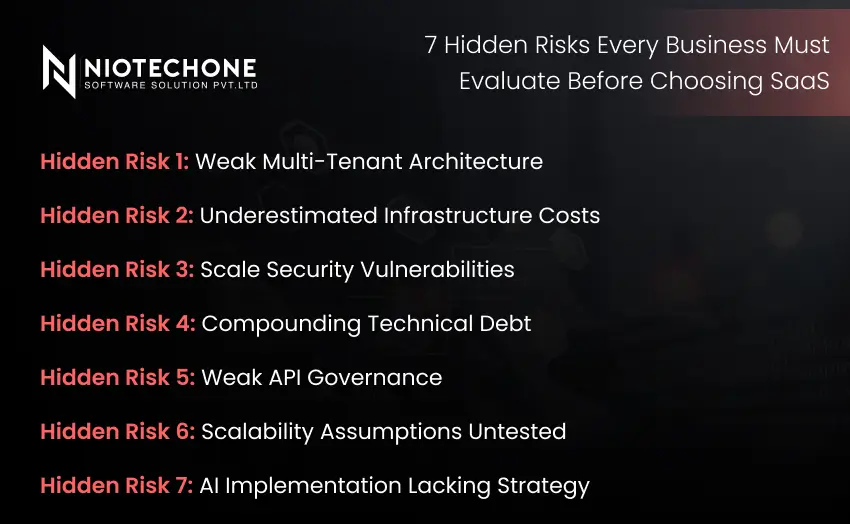
7 Hidden Risks Every Business Must Evaluate Before Choosing SaaS
Hidden Risk #1: Weak Multi-Tenant Architecture
SaaS is based on multi-tenancy. It enables the sharing of application infrastructure by several customers with data isolation.
When not well designed, it may produce:
- Data leakage risks
- Performance bottlenecks
- Scaling limitations
- Complex database management.
A skilled ASP.NET Core development company will design tenant isolation with due care, including appropriate data partitioning, identity management, and access control layers.
Security expectations are more stringent in 2026. Brand trust can be destroyed immediately by a poor architecture.
Hidden Risk #2: Underestimated Infrastructure Costs
SaaS companies tend to underestimate the long-term cloud costs.
Common cost drivers include:
- Oversized virtual machines.
- Unoptimized databases
- High storage usage
- Inefficient CI/CD pipelines
- AI model computation costs
Profitability is lost without cost-conscious cloud application development.
An established software development company in Rajkot will make sure that infrastructure planning is in line with the estimated user growth and operational budgets.
Hidden Risk #3: Scale Security Vulnerabilities
Cyber threats are always after SaaS platforms.
Risk areas include:
- API vulnerabilities
- Poor authentication systems.
- Improper encryption
- Poor logging and monitoring
- Weak third-party integrations.
An organized ASP.NET Core API development company focuses on API security at the outset. In 2026, strong access control, encrypted data transmission, and compliance frameworks are not optional.
SaaS security breaches are costly, both in terms of money and reputation.
Hidden Risk #4: Compounding Technical Debt
Most startups are focused on speed of launch rather than architecture.
Initially, this works. But as user numbers grow:
- Performance degrades
- Feature updates slow down
- Bug fixes increase
- Refactoring becomes costly
A scalable software application needs clean architecture, modular design, and frequent refactoring.
Collaboration with a disciplined custom software developer in Rajkot can be used to avoid compounding technical debt.
Hidden Risk #5: Weak API Governance
Modern SaaS systems are dependent on APIs to:
- Mobile app integrations
- Third-party services
- Payment gateways
- Analytics tools
Connection of enterprise systems.
In the absence of structured API governance:
- Version conflicts occur
- There is an increase in data inconsistencies.
- Integration failures rise
A professional ASP.NET Core API development company adopts version control, adequate documentation, and monitoring plans to maintain stable API ecosystems.
Hidden Risk #6: Scalability Assumptions Untested
Most SaaS founders believe that cloud scalability is the answer to all.
But scalability requires:
- Load testing
- Performance benchmarking
- Auto-scaling configuration
- Database optimization
- Microservices readiness
Scaling may cause outages without structured validation.
An efficient .NET development company in Rajkot performs performance audits before significant growth stages.
Hidden Risk #7: AI Implementation Lacking Strategy
By 2026, AI will be more and more integrated in software development in SaaS platforms:
- Recommendation engines
- Predictive analytics
- Automated customer support
- Intelligent dashboards
Nevertheless, AI brings about new risks:
- High computational costs
- Data bias issues
- Model drift
- Compliance concerns
AI should be designed as a strategic component, not as a feature fad.
Real-World Example
A SaaS startup has approached a software development company in Rajkot following growth issues.
Their issues included:
- API timeouts
- Slow dashboard performance
- Rising cloud bills
- Challenging onboarding of enterprise clients.
An organized audit identified architectural vulnerabilities in tenant isolation and ineffective database queries.
Following the cooperation with Niotechone Software Solution Pvt. Ltd.:
- Performance improved by 35%
- Cost of infrastructure minimized.
- API stability increased
- Onboarding of enterprises was made easier.
The most important transformation was architectural restructuring- not scaling hardware.
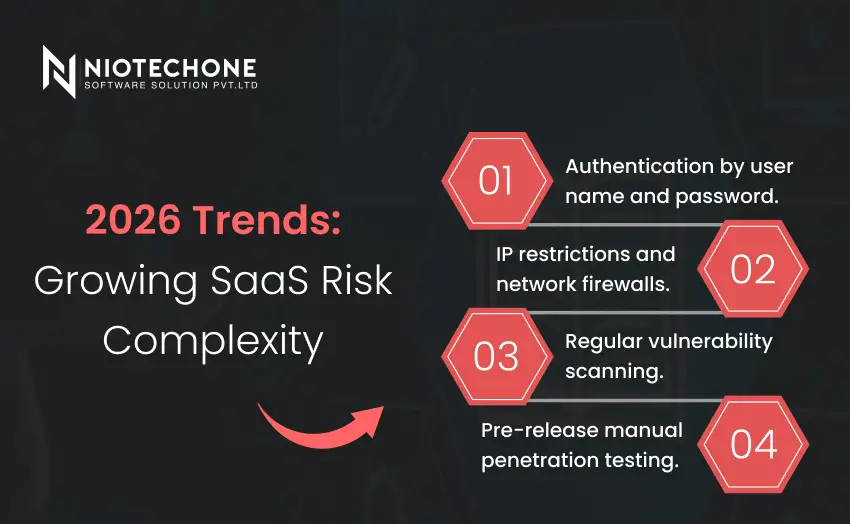
2026 Trends: Growing SaaS Risk Complexity
The complexity of SaaS risk management is greater than ever because of:
1. Stricter Data Regulations
International compliance requirements require more robust encryption and audit records.
2. Cross-Platform Ecosystems
SaaS products have become the bridge between web, mobile, IoT, and enterprise systems.
3. Real-Time Data Processing
Users demand real-time analytics and insights.
4. AI-Driven Features
AI is value-adding but raises the complexity of computations and governance.
These trends demand rigorous custom .NET development services and progressive architecture.
Reducing SaaS risks before scaling
Business leaders must act proactively:
- Carry out architectural audits.
- Strengthen API governance
- Streamline cloud cost designs.
- Install modern surveillance.
- Ensure secure authentication is a priority.
- Design AI infrastructure thoughtfully.
By collaborating with an experienced ASP.NET development company, risk mitigation will be included in your growth strategy.
Conclusion
SaaS is powerful. It provides recurring revenue, global scalability, and constant innovation. But it is not risk-free.
The latent dangers of SaaS, such as poor architecture, inadequate API governance, uncontrolled cloud expenses, security risks, and uncontrolled AI integration, can silently erode growth.
In 2026, the companies that will be successful are those that integrate vision and engineering discipline.
By collaborating with an established custom software development company or reputable software development company in Rajkot, you can be sure that your SaaS platform is developed not only to launch but to scale in a responsible, secure, and profitable manner.
Categories
Related Articles


Related Tags
Frequently Asked Questions FAQs
Cloud resources that are not optimized are very expensive to operate.
APIs bridge various systems. Weak governance results in instability and failure of integration.
Yes, unless handled appropriately, AI modules raise the cost of computation and the complexity of compliance.
Carry out architectural audits, enhance security levels, streamline infrastructure, and collaborate with seasoned developers.
Yes, however, it can only be supported by organized engineering and cost-conscious cloud planning.