The Hidden Cost of Skipping Code Reviews
- Niotechone Marketing Team
Table of Contents
- Introduction: Why Code Review Is a Business Choice, Not a Technical Process
- The Real Meaning of Skipping Code Reviews
- The Short-term Operational Effect
- The Long-Term Financial Cost
- Scalability Problems Start Small
- AI in Software Development introduces New Risk Layers
- Real-World Scenario
- Why Mature Software Teams Prioritize Reviews
- Warning Signs Your Project Is Suffering
- 2026 Trend: Hybrid Review Models
- Conclusion: Code Review Defends Your Investment
Introduction: Why Code Review Is a Business Choice, Not a Technical Process
Businesses are more reliant on software than ever in 2026. Your application is directly connected to revenue, customer trust, and operational efficiency, whether it is AI-driven automation or scalable cloud platforms. Code quality is not a luxury, whether you are dealing with a .NET development company or an internal tech team.
However, most organizations do not conduct formal code reviews.
Startups rush to launch. Businesses demand quicker releases. Expanding companies believe that seasoned developers do not require peer approval. At first glance, it seems that skipping reviews saves time. In fact, it generates hidden expenses that silently harm long-term growth.
Being a professional custom software development company, we have observed the instability, technical debt, and scaling failures caused by the lack of review discipline. Code reviews don’t slow down development; they safeguard your investment.
The Real Meaning of Skipping Code Reviews
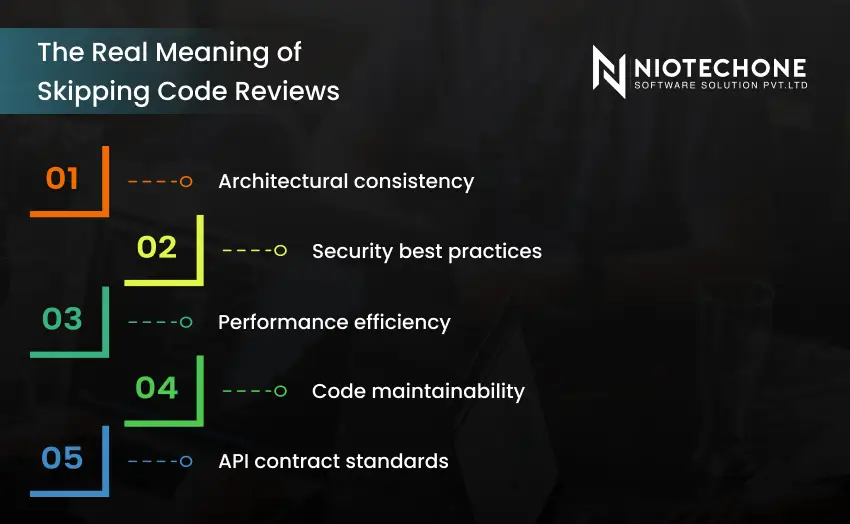
In the absence of code reviews, no formal validation of:
- Architectural consistency
- Security best practices
- Performance efficiency
- Code maintainability
- API contract standards
Even minor inconsistencies in the modern ASP.NET Core application architecture can form massive bottlenecks when scaled.
Skipping reviews doesn’t necessarily lead to immediate failure. The threat is in concentration. Minor problems accumulate until the system is weak.
The Short-term Operational Effect
1. More Production Bugs
Unreviewed code tends to introduce:
- Edge-case failures
- Unhandled exceptions
- Poor database queries
- Improper API validation
- Memory leaks
In the development of ASP.NET Core API, small validation errors may open endpoints or produce unstable integrations.
It is much more expensive to fix a bug in production than to avoid it in review. It influences customer experience, brand reputation, and internal morale.
2. Security Vulnerabilities
In 2026, cybersecurity threats are advanced and frequently AI-assisted. Security gaps are not noticed without peer validation.
Common risks include:
- Weak authentication processes.
- Inappropriate role-based access control.
- SQL injection vulnerabilities.
- Weak encryption handling
- Improperly configured Azure cloud architecture permissions.
In the case of companies that are in regulated industries, such vulnerabilities may lead to compliance breaches and fines.
A safe system is not created by chance. It is checked, approved, and tested.
The Long-Term Financial Cost
Skipping code reviews may save a few hours today. It costs months later.
Here’s the difference:
With Structured Code Review | Without Code Review |
Clean, consistent architecture | Growing technical debt |
Fewer emergency fixes | Frequent production patches |
Predictable release cycles | Unstable deployments |
Easier onboarding | Knowledge silos |
Lower maintenance cost | Rising operational expense |
When businesses attempt to hire .NET developers in Rajkot or expand their teams, messy, unreviewed code slows onboarding and increases dependence on the original developers.
Clean code scales. Chaotic code traps.
Scalability Problems Start Small
A scalable software application relies on architectural discipline.
In the absence of review processes, typical problems are:
- Close interdependence of services.
- Inadequate dependency injection.
- Poor indexing of databases.
- Unstable API response formats.
- Poor caching design.
These issues might not be evident during light traffic. However, when growth accelerates, performance declines, cloud costs rise, and debugging becomes more complex.
A skilled ASP.NET Core development company realizes that scalability starts with consistency.
AI in Software Development introduces New Risk Layers
By 2026, AI in software development will be ubiquitous in platforms, from recommendation engines to predictive analytics.
AI modules require:
- Clean data pipelines
- Secure API endpoints
- Resource optimization
- Compliance monitoring
AI features can:
- Wastes cloud resources
- Bring in random reasoning
- Compromise data security
- Increase operational cost
The power of AI integration can be effective, yet it must be regulated by rigorous engineering principles.
Real-World Scenario
One of the mid-sized B2B SaaS companies came to us with the problem of system crashes that were recurring. Their former supplier did not have systematic review procedures.
We identified:
- Redundant business logic between modules.
- Poor API error management.
- Unproductive database queries.
- Poorly configured cloud resources.
Once they reorganized their approach to developing their .NET applications and introduced formal review processes, the number of production incidents decreased, and deployment stability increased.
It was not talent, but process.
Why Mature Software Teams Prioritize Reviews
Code review is risk management by professional development teams.
At Niotechone Software Solution Pvt. Ltd., review is integrated into the entire project lifecycle. As a reliable .NET development company in Rajkot and a software development company in Rajkot, we are interested in long-term stability.
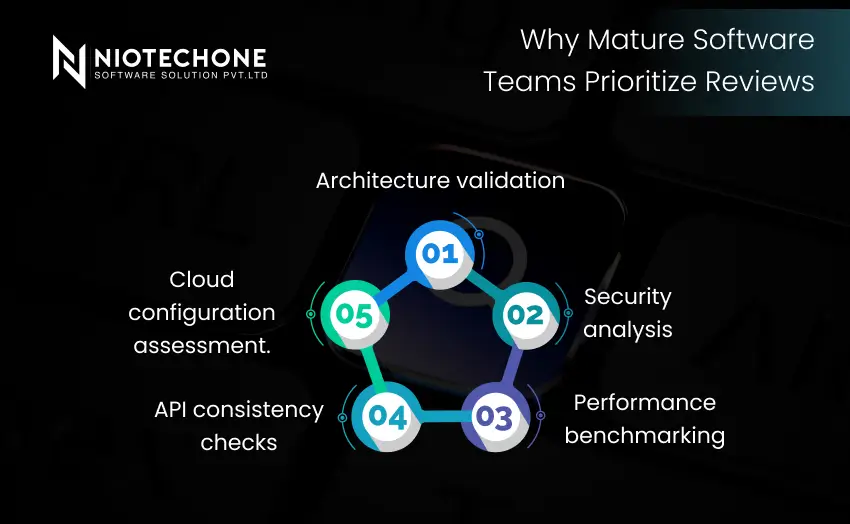
Our discipline of review encompasses:
- Architecture validation
- Security analysis
- Performance benchmarking
- API consistency checks
- Cloud configuration assessment.
This makes all our systems maintainable and expansion-capable.
Warning Signs Your Project Is Suffering
In case your system has the following, the root cause could be code review gaps:
- Regular emergency discharges.
- Increasing cloud expenses with no traffic increase.
- Inconsistent API responses
- Challenges in onboarding new developers.
- Increasing number of technical fixes.
These are not accidental technical failures but architectural symptoms.
2026 Trend: Hybrid Review Models
The top custom .NET development services now include:
- Automated code inspection
- Security scanning with AI
- Manual peer reviews
- Architectural audits
Automation identifies superficial problems. Long-term design integrity is safeguarded by human reviewers.
They are both necessary in the current cloud application development.
Conclusion: Code Review Defends Your Investment
It is efficient in the short run to skip code reviews. However, in practice, it brings silent risks that accumulate with time.
Structured review processes are no longer optional in 2026, as the complexity of the system, the need to integrate AI, and the need to scale to the cloud increase. They are tactical protection.
When you are considering building or expanding your platform, collaborating with a trusted custom software developer in Rajkot will make sure that quality, security, and scalability are designed into your base, rather than fixed on afterwards.
The actual cost of not doing code reviews is not apparent today.
Categories
Related Articles


Related Tags
Frequently Asked Questions FAQs
Yes, Discipline at an early stage avoids technical debt on a large scale.
No. Behavior is validated by testing. Structure and sustainability are validated by reviews.
Absolutely. Reviews eliminate blind spots and provide architectural alignment.
Usually, 10-20 percent of development time - much less than post-release recovery time.
Yes, Poor code and configuration of the Azure cloud architecture consume more resources.