The Hidden Business Cost of Poor API Design
- Niotechone Marketing Team
Table of Contents
- Introduction
- Why API Design Is a Business Decision — Not Just a Technical One
- The Actual Business Costs of Poor API Design
- What Good API Design Will Be in 2026
- Real-Life Case Study: API Failure in a FinTech Platform
- When Should You Rebuild or Redesign Your APIs?
- The Strategic Value of a Technology Partner
- Conclusion
Introduction
APIs are no longer technical elements in 2026. They are a business infrastructure.
All mobile applications, SaaS, enterprise dashboards, AI, and cloud integrations rely on APIs. When such APIs are not well designed, the cost is not only technical but also has a direct impact on revenue, scalability, security, and future growth.
For decision-makers at a .NET development company, an ASP.NET development company, or a custom software development company, API design must be treated as a strategic investment, not a back-end consideration.
Regardless of whether you are developing a scalable enterprise platform, developing a cloud application, or modernizing your systems with ASP.NET Core application architecture, this guide describes the actual business cost of poor API design – and how to prevent it.
Why API Design Is a Business Decision — Not Just a Technical One
APIs connect:
- Mobile applications to back-end systems.
- AI engines to data layers
- Outsourcing to internal services.
- Customer dashboards to enterprise databases.
In case APIs are volatile, unreliable, or insecure, the whole system is affected.
In enterprise settings, poor API design affects:
- Customer experience
- System performance
- Cloud costs
- Development timelines
- Data security
- Partner integrations
This is the reason why major organizations engage the services of an established ASP.NET Core API development company rather than viewing APIs as add-ons.
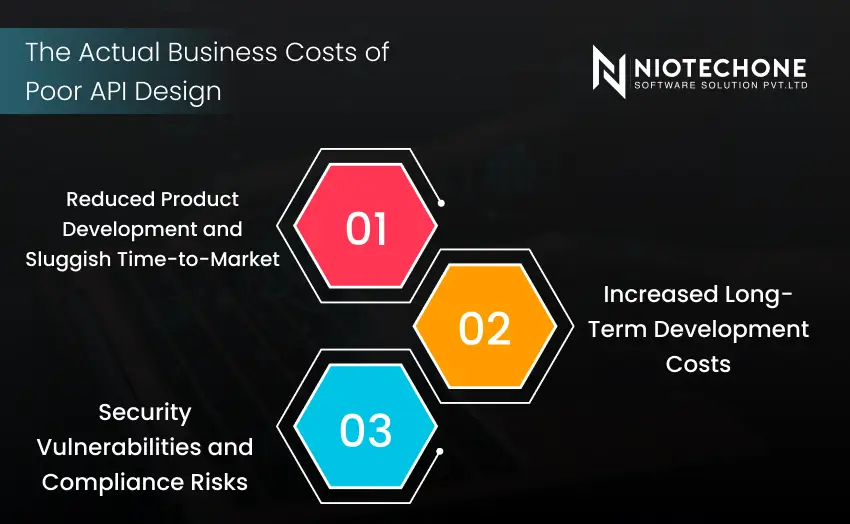
The Actual Business Costs of Poor API Design
1. Reduced Product Development and Sluggish Time-to-Market
Badly designed APIs compel developers to:
- Write workaround code
- Duplicate logic
- Deal with inconsistent responses
- Rebuild integration layers
Late launches in competitive industries translate to lost revenue.
2. Increased Long-Term Development Costs
Most companies attempt to save on initial expenses by omitting architectural planning.
But poor API design creates:
- Technical debt
- Frequent refactoring
- Greater maintenance effort.
- Dependency conflicts
These financial risks are mitigated by investing in structured custom .NET development services.
3. Security Vulnerabilities and Compliance Risks
APIs expose data. It is put at risk by poorly designed APIs.
Typical API security breaches:
- Lack of authentication layers.
- Weak authorization rules
- Unvalidated inputs
- Overexposed endpoints
- Lack of encryption
The cybersecurity regulations are more stringent than ever in 2026. A breach of security destroys trust and brand reputation.
A skilled ASP.NET developer in Rajkot or an enterprise team ought to execute:
- OAuth/JWT authentication
- Role-based access control
- Input validation
- Rate limiting
- Secure logging
Security should be included in the architecture – not an afterthought.
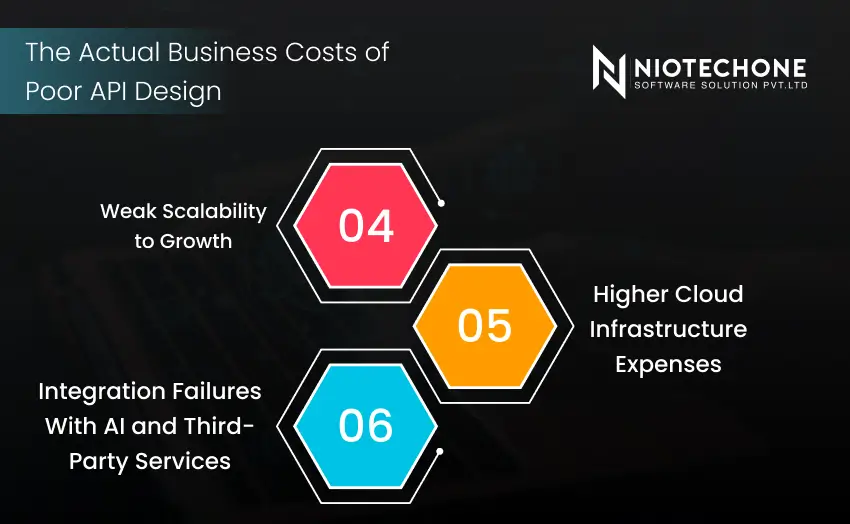
4. Weak Scalability to Growth
An application software should be able to manage:
- Traffic spikes
- Several client applications.
- Global user bases
- High data loads
Poor APIs often:
- Return excessive data
- Lack pagination
- Make inefficient database queries.
- Ignore caching strategies
The system collapses when growth ensues.
5. Higher Cloud Infrastructure Expenses
Inefficient APIs increase:
- Server load
- Database usage
- Bandwidth consumption
- Cloud compute costs
In platforms that apply cloud application development strategies, each request that is inefficient is translated into financial waste.
6. Integration Failures With AI and Third-Party Services
However, AI in software development relies on clean and structured data streams.
Poor APIs create:
- Inconsistent data formats
- Missing metadata
- Incomplete response objects
- Integration complexity
AI modules do not work when the API base is weak.
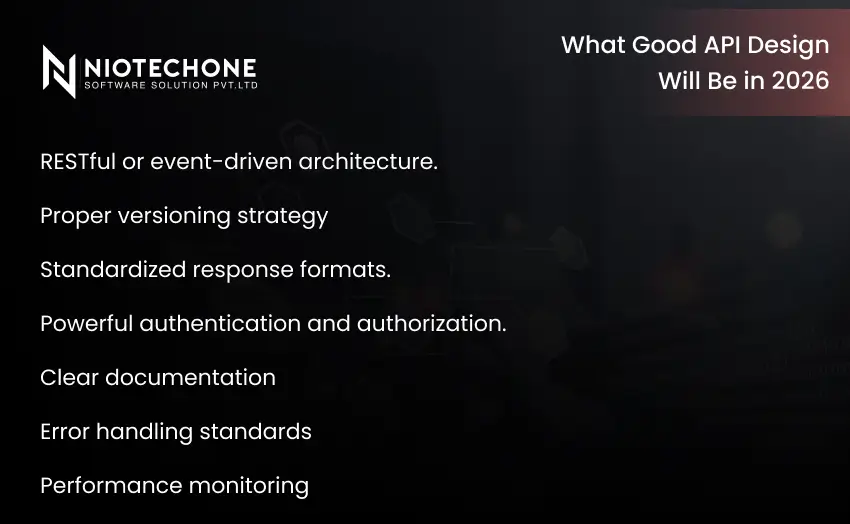
What Good API Design Will Be in 2026
An enterprise-level API must contain:
- RESTful or event-driven architecture.
- Proper versioning strategy
- Standardized response formats.
- Powerful authentication and authorization.
- Clear documentation
- Error handling standards
- Performance monitoring
Here’s a comparison:
Poor API Design | Well-Architected API |
No versioning | Version-controlled endpoints |
Large response payloads | Optimized & paginated responses |
Weak security | OAuth + JWT authentication |
Tight coupling | Modular microservices |
Hard-coded logic | Clean service-layer architecture |
No monitoring | Observability & analytics |
An effective software development company is interested in long-term API sustainability, rather than in the creation of endpoints quickly.
Real-Life Case Study: API Failure in a FinTech Platform
Situation
An emerging FinTech company released a mobile application that was linked to old APIs.
Problems
- Unstable JSON responses.
- No API versioning
- Poor error handling
- No rate limiting
As user traffic increased:
- App crashes rose
- Server costs doubled
- Security vulnerabilities emerged.
Solution
They collaborated with a dedicated ASP.NET Core development company to:
- Redesign API architecture
- Implement version control
- Add secure authentication layers.
- Optimize database queries
Implement in an organized Azure cloud system
Results
- 60% performance improvement
- Reduced cloud cost by 30%
- Improved uptime to 99.9%
- Quickened AI analytics integration.
The price of correcting poor API design was high – but the price of not doing so would have been disastrous.
When Should You Rebuild or Redesign Your APIs?
You might require API modernization when:
- Integration projects continue to fail.
- Your cloud expenses continue to rise.
- Scaling is a manual process.
- Endpoints are hard to comprehend for developers.
- Vulnerabilities are exposed through security audits.
In this situation, the operational risk can be mitigated by engaging a reputable .NET development company in Rajkot or a global partner.
The Strategic Value of a Technology Partner
API architecture impacts:
- Product scalability
- Business agility
- AI readiness
- Cloud efficiency
- Partner ecosystems
Being a professional custom software developer in Rajkot, it is not only about coding, but about creating stable, secure, and scalable digital ecosystems. In the case of companies that want to recruit a .NET developer in Rajkot, the knowledge of API architecture must be among the key assessment criteria.
Conclusion
APIs are not technical connectors or backend utilities in 2026. They form the digital backbone of modern enterprises. The quality of your APIs is determined by every customer interaction, AI workflow, mobile application, cloud integration, and data exchange.
Poor API design silently consumes business value. It raises the cost of clouds, reduces innovation, introduces security risks, and reduces scalability. Most importantly, it limits the growth of your organization in a competitive digital environment with confidence.
The API architecture is designed in a well-structured manner and developed using disciplined application development of the .NET, secure application architecture of ASP.NET Core, and strategic application development of the cloud to ensure long term stability. With the help of skilled specialists of a reputable.NET development company in Rajkot or a company of ASP.NET Core API development of enterprise scale, your digital ecosystem will be resilient, scalable, and AI-ready.
Categories
Related Articles

Related Tags
Frequently Asked Questions FAQs
Scalability failure. Poorly designed APIs fail under load as user traffic grows, causing downtime and loss of revenue.
Unproductive APIs add to server load, database load, and bandwidth - escalating the cost of Azure hosting.
ASP.NET Core is high-performance and cloud-compatible, which makes it suitable for enterprise API systems.
AI systems need structured and consistent data. Poor APIs generate unreliable results that disrupt AI processes.
Yes, Slow response time, data errors, and crashes of the app directly affect user satisfaction and retention.