The Future of Software: Autonomous, Composable, and AI-Driven

Introduction:

The software industry is undergoing a metamorphosis. It has come from basic coding tasks being done automatically to the development of intelligent systems that are even capable of learning, adapting, and managing themselves completely without any human intervention. The future of digital solutions is characterized by the automating, the combining, and the AI-infused means, which is a significant progression from non-interactive very simple applications to very interactive and intelligent ecosystems where the user has the additional benefit of choosing their preferred method of interaction and application.

This transformation challenges software development companies to create intelligent systems that will not only serve the user but also think, adapt, and improve under minimum human control. In the race for agility and innovation, enterprises will have to build their software around three main pillars — autonomy, composability, and artificial intelligence.

What Is Autonomous Software?

Autonomous software is basically AI-based systems that are able to operate, make decisions, and change their ways without any human help. These applications utilize AI, ML, and predictive analytics to gain knowledge from data, make workflows more efficient, and even self-correct in real time.

In less technical terms, autonomous software is self-managing — it detects issues, resolves problems, and takes actions without delay.

Why It Matters

For big companies, the use of automated systems is associated with less downtime, quicker decision-making, and human errors becoming less. For a company specializing in custom software development, it equates to building solutions that work non-stop, adapt to the users, and keep on getting better performance.

Composable Architecture: Building the Modular Future

The Concept of Composability

Composable architecture is a reflection of the change of classic monolithic systems to modular and interchangeable units. It enables the developers to create software by fusing together the pre-built parts that can be reused — these are referred to as “composable blocks” or “micro frontends.”

Such a method fosters flexibility, scalability, and speed — which are all crucial for today’s enterprises that need to quickly respond to changes in the market.

Composable Software in Action

E-commerce Platforms are making use of composable commerce systems (such as Shopify Hydrogen or CommerceTools) to swiftly add or take away features.

Companies are making modular business apps using APIs and microservices.

Digital Experience Platforms (DXPs) combine different elements like analytics, CMS, and CRM into one composable framework.

For a cutting-edge software development company, ASP.NET Core development in Rajkot, composable architecture equates to faster iterations, lower maintenance costs, and the capability to adapt to client needs.

Advantages of Composable Architecture

  • Agility: Business quickly adapts to the new environment.
  • Scalability: Every part can be increased or decreased in size independently.
  • Reusability: Time is saved by using the same modules in different projects.
  • Technology Independence: Different stacks and APIs can be used.
  • Future-Readiness: Continuous innovation and upgrades are cycle supported.
  • Composable + Cloud: A Winning Combination

Composable systems depend on cloud infrastructure. Cloud-native environments allow for the seamless deployment, scaling, and management of microservices. This partnership allows custom software development services to create lightweight, distributed applications that are optimized for performance and cost-effectiveness.

The AI-Driven Software Revolution

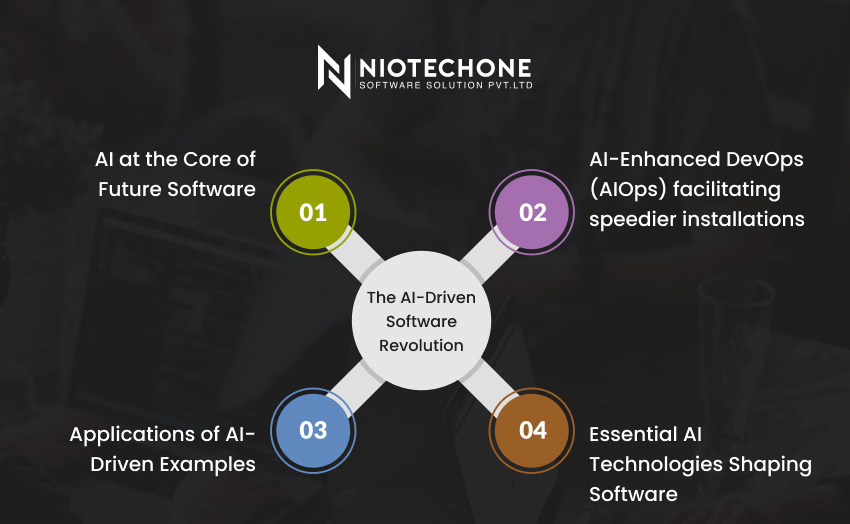
AI at the Core of Future Software

Artificial Intelligence is not just an extra feature that modern software has to offer, it is the main intelligence layer in future software. AI-native is the term used for these future systems, which will be constantly learning, reasoning, and changing according to user actions and context data.

AI-driven development is a catalyst for the entire process by bringing in copious amounts of decision-making and increasing automation in various sectors.

Applications of AI-Driven Examples

  • AI Analytics Platforms that are user needs forecasters are one of the applications.
  • Chatbots and virtual assistants are a part of enterprise software and have been integrated with it.

AI-Enhanced DevOps (AIOps) facilitating speedier installations

  • ML-Powered CRM systems that predict customer moves.
  • An elite custom software development company has made enterprise systems using AI that can tell the future, learn, and adapt.

Essential AI Technologies Shaping Software

  • Natural Language Processing (NLP) for creating human-like interaction.
  • Predictive Analytics for interpreting and forecasting business trends.
  • Machine Learning Models for optimizing processes.
  • Generative AI for the creation of code, design, and automation.

The Fusion: Independent + Composable + AI-Powered

The merging of these three characteristics—independence, composability, and intelligence—results in the transformation of software from mere technical systems to animated biological habitats living through software.

Their Mutual Cooperation

  • Autonomy is an outcome of AI since it allows the software to make decisions.
  • The architecture that is composed adds to the power of the system by letting the components develop separately.
  • The systems that work on their own employ the feedback and that is the reason they do the best in their field.

The merging of the above-mentioned forces is what characterizes the next period of enterprise software development, .NET Core application development thus, it can be said that businesses will not only be deploying applications but rather they will be orchestrating intelligent, adaptive digital ecosystems.

How Software Development Companies Are Adapting

The new trend is forcing software development companies to rethink the whole thing. The change is taking place from Static to Smart companies which are going to follow fixed rules; modern companies are going to be the ones being flexible, and, of course, getting the intelligence of the information continuously.

Modern development practices include:

  • Microservices-based architectures
  • AI and ML integrated into the DevOps pipelines (AIOps)
  • Low-code and no-code platforms usage
  • API-first and headless development facilitation


Custom Software Development Services Role

Custom software development companies are the ones who have to make a piece of software that is:

  • Modular for easy updates
  • Self-healing through predictive maintenance
  • Smart through AI-based decision-making


Such a company creating custom software for its clients operates like a creator and a consultant at the same time — necessitating that the enterprise shift from outdated systems to intelligent, flexible, digitally eco-friendly ones.

Challenges and Best Practices

Challenges

  • Integration complexity among modular systems
  • AI model accuracy and bias concerns
  • Data privacy and compliance
  • Skill gaps in AI and automation technologies
  • Transitioning from legacy monoliths to composable models

Best Practices

  • Start with modular modernization of existing software.
  • Implement AI for automation, not just analytics.
  • Prioritize data security and ethical AI.
  • Partner with a custom software development company skilled in composable and AI architectures.
  • Adopt continuous learning frameworks to evolve systems post-deployment.

Conclusion

Software’s upcoming journey isn’t merely about having the best code — but rather with being smart, adaptable, and self-operating. 

Autonomous systems, composable architecture, and AI-driven intelligence together will take enterprises’ innovation, scalability, and efficiency to new heights.

Particularly for the businesses that partner with a custom software development company, it is a great time for this change since it will bring in intelligent, evolving, and innovative software rather than just servile ones.

Whoever takes these technologies on today will be the ones that shape tomorrow’s intelligent enterprises — ones that are agile, composable, and ready for the future.

Frequently Asked Questions FAQs

Such software combines AI and automation to act without human intervention, making decisions, carrying out tasks, and self-managing. 

A modular strategy that permits applications to be formed from exchangeable units making it easier and more scalable is called composable architecture. 

AI takes over testing, upturns performance, and through predictive and adaptive learning, also improves the user's experience.

They are the ones that secure market agility, quicker innovation, and scalability that is not limited to the future amongst other competitors in the digital sphere. 

To do so, the most advisable partner would be a software development company that specializes in AI and composable design for custom software development services.