The 10 Best No-Code Development Platforms in 2026
- Niotechone Marketing Team
Introduction
In 2026, No-code development platforms are transforming the way applications are developed. Companies do not rely solely on lengthy development processes to introduce digital products. These tools enable teams to develop web and mobile applications more quickly, at a lower cost, and in response to market demands.
These platforms are used by startups to test ideas. They are used by enterprises to develop internal tools and automate workflows. Even companies that collaborate with a custom software development company in Rajkot today combine No-code tools with tailor-made software development to achieve enhanced speed and flexibility.
In 2026 is not about the replacement of developers. It is concerned with assisting businesses to be smarter and faster.
Why No-Code Platforms are expanding at a fast rate in 2026
No-code platforms are increasingly in demand as companies seek fast outcomes without extensive technical work. This shift is being caused by digital transformation, remote work, and rapid user expectations.
The major causes of this growth are:
- Quick application development without protracted schedules.
- Reduced development and maintenance expenses.
- Simple connectivity with web and enterprise systems.
- Improved business-IT teamwork.
Most organizations integrate No-code tools with enterprise application development and backend systems developed with modern technologies such as .NET.
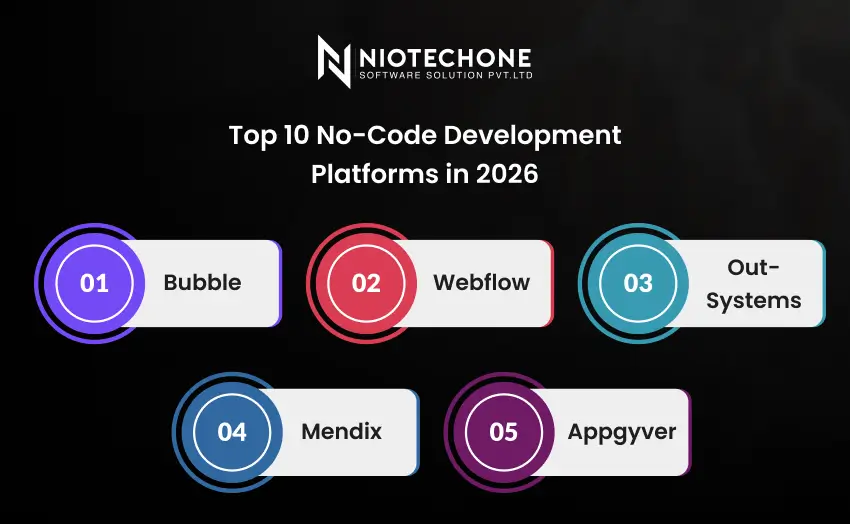
Top 10 No-Code Development Platforms in 2026
In 2026, No-code platforms are stronger than ever. They are not restricted to mere applications or in-house tools anymore. Most of these platforms are now workflow-enabled, database-enabled, integration-enabled, and even scalable business applications.
1. Bubble
In 2026, Bubble remains the leader in the No-code space. It enables users to create entire web applications that have logic, workflows, and database support. Bubble is used by many startups to create MVPs fast and test business ideas without investing in their development.
Bubble is suitable for the initial stage products. To achieve long-term scalability, businesses may combine Bubble apps with backend services built by a software development company in India.
2. Webflow
Webflow is popular in the creation of rapid, search engine-optimized websites without code. It provides designers and marketers with complete control over layout, content, and performance. Webflow is typically applied to landing pages, business websites, and content platforms in 2026.
A lot of companies integrate Webflow with their own APIs and backends to enable dynamic functionality.
3. OutSystems
OutSystems is an enterprise-level No-code and low-code development platform. It helps in secure applications, system integrations, and high user bases. Businesses use OutSystems when they require control, scalability, and governance.
OutSystems is frequently combined with enterprise application development strategies for mission-critical systems.
4. Mendix
Mendix is a structured application development platform that has built-in governance. It assists companies in developing process-based applications without losing control over security and compliance.
Mendix is used in large organizations to modernize internal systems and minimize manual workflows.
5. Appgyver
Appgyver is used to create business applications using logic-based workflows. It also facilitates API connections and backend integration, which is why it applies to internal tools and operational apps.
It is a suitable choice when the team requires flexibility without coding.
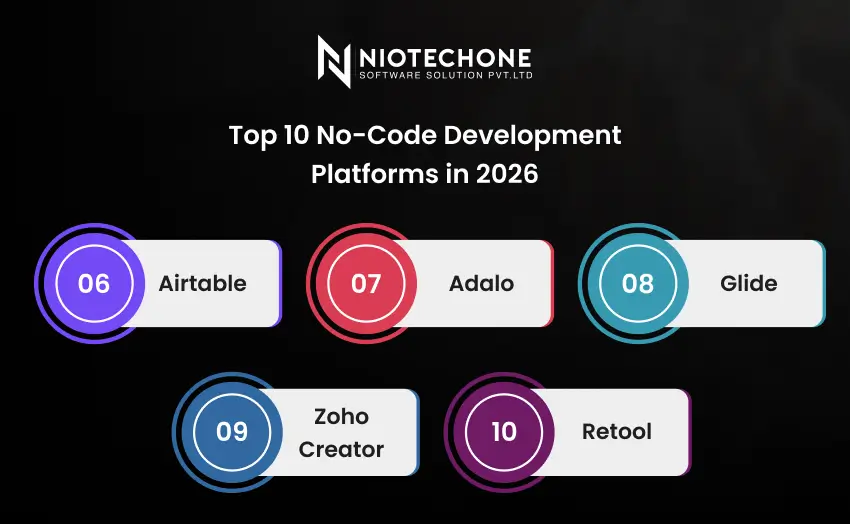
6. Airtable
Airtable works as a database with app-building capabilities. Teams use it to develop tools such as CRMs, project trackers, and reporting dashboards.
Airtable performs best when teams combine it with automation or custom software to support more complex logic.
7. Adalo
Adalo specializes in no-code mobile app development. It enables companies to create Android and iOS applications quickly using visual elements.
Startups and small businesses use Adalo to build mobile apps with minimal effort.
8. Glide
Glide transforms spreadsheets into applications. Teams commonly use it for internal tools, field applications, and lightweight business solutions.
Glide stands out for its speed and convenience.
9. Zoho Creator
Companies that already use Zoho products rely on Zoho Creator. It helps teams develop custom applications for operations, finance, and customer management.
Zoho Creator functions as an automation and integration tool within the Zoho ecosystem.
10. Retool
Retool helps teams build internal tools and administrative panels. It integrates easily with databases, APIs, and third-party services.
Enterprises use Retool to improve internal processes and reduce manual work.
The way No-Code Platforms help businesses grow
No-code platforms assist companies in saving time on development and enhancing efficiency. They enable teams to experiment and make changes without having to wait through lengthy release cycles.
Main advantages include:
- Faster time to market
- Lower initial investment
- Simple updates and maintenance.
- Improved business-software fit.
These platforms are best supported by custom software development and robust backend architecture to achieve long-term scalability.
No-Code Development Future After 2026
No-code has a bright future. AI-powered automation, improved integrations, and smarter workflows will make these platforms even more helpful. A growing trend will emerge where businesses use hybrid models in which teams use no-code to manage workflows, and developers focus on core systems and scalability.
The trend will move toward businesses adopting hybrid models in which teams use no-code to manage workflows, and developers focus on core systems and scalability.
Conclusion
In 2026, No-code development platforms will be a critical component of contemporary software development. They assist businesses to operate at a higher speed, save money, and embrace change. Nevertheless, No-code tools are most effective when used with enterprise application development and professional advice.
The collaboration with a seasoned software development company in India will make sure that No-code solutions are scalable, secure, and future-proof.
Categories
Related Articles


Frequently Asked Questions FAQs
No-code platforms are less expensive because they take a shorter time to develop, require fewer resources, and have less maintenance. It also saves businesses money by trying out ideas before investing in them.
The most beneficial industries are startups, education, healthcare, real estate, logistics, and internal enterprise teams. No-code platforms assist them in creating tools more quickly and responding to evolving requirements.
Yes, numerous No-code platforms facilitate the development of mobile apps. They enable companies to create Android and iOS applications in a short time with visual tools and pre-built components.
The majority of contemporary No-code systems have APIs and connectors. It is easy to integrate CRM systems, payment gateways, and third-party tools.
No-code platforms are not limited in terms of customization, performance optimization, and sophisticated business logic. In case of more complex requirements, it is necessary to develop custom software.