Cloud computing has turned out to be the foundation of the digital transformation as it allows enterprises to grow quickly, reduce expenses, and innovate more quickly. However, there is a cost that goes hand in hand with this development, which is energy consumption and carbon emission. Cloud platforms that are run on data centers consume a large percentage of electricity in the world, and this has led to concerns on sustainability.
Sustainable cloud computing in india comes in at this point. It is concerned with the design and deployment of applications in a manner that has the least impact on the environment and yet attains performance and scalability. In the case of enterprises, it is not only a matter of corporate social responsibility but also a matter of cost efficiency in the long term, compliance, and fulfilling consumer expectations of greener digital services.
Rising Energy Consumption
Data centers are very energy-intensive and in many cases, the energy source is non-renewable. Switching to the green cloud solutions will minimize this footprint.
Customer Expectations
The contemporary consumer is becoming eco-friendly, and they want brands that invest in green technologies.
Regulatory Compliance
International organizations and governments are implementing more stringent sustainability policies. Companies that embrace green cloud solutions will have an upper hand in compliance.
Cost Efficiency
Reducing the use of resources by optimizing applications reduces the costs of infrastructure, which is beneficial to the business and the planet.
Read more: Self-Healing Applications: The Future Of Autonomous Software Systems
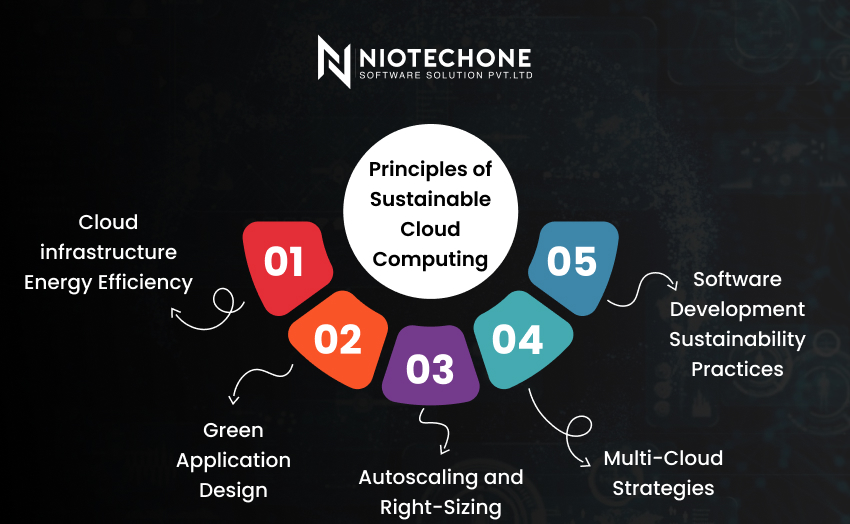
1. Cloud infrastructure Energy Efficiency
Cloud encroachers such as Microsoft Azure, AWS, and Google Cloud will be spending on renewable energy sources and effective cooling systems. Companies ought to adopt the use of cloud solutions that are environmentally friendly.
2. Green Application Design
Frameworks such as .NET Development company in india can be compiled into applications that are optimized to resource usage. Such practices as serverless computing and containerization use less energy as well.
3. Autoscaling and Right-Sizing
Avoid overprovisioning. Auto-scaling soon provides that only the necessary resources are used by applications which reduces wastage and creates efficiency.
4. Multi-Cloud Strategies
Workloads can be distributed among various cloud providers and thus minimize energy consumption by selecting areas managed by renewable energy.
5. Software Development Sustainability Practices
The implementation of the principles of clean coding, efficient algorithms, and lightweight architecture contributes to the consumption of the computing power input needed to execute the programs.
Lower Operational Costs
Green apps use less resources, which translate to lower infrastructure costs.
Brand Differentiation
Sustainability programs increase brand image and customer confidence.
Regulatory Preparedness
Adoption of green clouds will guarantee adherence to the changing environmental standards.
Scalability Without Waste
Scalable apps are efficient and do not waste energy.
Initial Investment: A green cloud infrastructure migration can cost a lot in the beginning.
Skill Shortages: The developers should be trained on sustainable software.
Transparency Of The Vendors: Not every vendor reports about their carbon footprint or the use of renewable energy.
Multiple-Cloud Management-Complex: To maintain a balance between performance and sustainability, the workloads cannot be balanced without powerful strategies.
The concept of sustainable cloud computing is not a technological fad, but it will be the future of enterprise IT. Organizations can also create digital systems that are not only scalable, but also environmentally friendly by integrating cloud-native architectures, Azure cloud application development, and custom enterprise mobility solutions.
To illustrate, one of the travel portal software development firms in india can use the green data centers of Azure to provide sustainable booking solutions that minimize carbon emissions and yet comply with the international standards. Likewise, companies that have a custom software development option can implement green practices into their DevOps pipelines.
Sustainable cloud computing is a relatively new development that has yet to reach its peak in the future.
Looking ahead, we can expect:
The future of cloud computing is green, scalable and intelligent and those businesses that adopt it now will flourish tomorrow.
| Feature | Traditional Cloud | Sustainable Cloud |
| Resource Allocation | Often over-provisioned | Optimized and dynamic |
| Energy Consumption | Higher | Lower |
| Carbon Emissions | Less visibility | Actively managed |
| Cost Efficiency | Moderate | Typically higher |
| Environmental Focus | Secondary concern | Core design principle |
| Infrastructure Utilization | Variable | Maximized |
Organizations adopting sustainable cloud strategies often discover that environmental responsibility and operational excellence reinforce one another.
Cloud sustainability is no longer a choice but a strategic value. Companies that are adopting sustainable cloud computing have a competitive edge because the cloud computing reduces the cost, enhances the brand value and aligns with the environmental objectives.
The way to go is embracing green technology measures, codes that are environmentally friendly, and infrastructure that is energy efficient. As cloud providers strive to be carbon neutral, early adopters will be first to innovate and be responsible.
Sustainable cloud computing is the practice of designing, operating, and optimizing cloud infrastructure and applications to minimize energy consumption, reduce carbon emissions, and improve resource efficiency while maintaining performance and reliability.
Cloud computing can improve sustainability by enabling shared infrastructure, higher resource utilization, automatic scaling, and access to energy-efficient data centers powered by renewable energy sources.
In many cases, yes. Serverless applications execute only when needed, reducing idle resource consumption and improving infrastructure efficiency compared to always-on server environments.
Common challenges include over-provisioned infrastructure, inefficient software design, excessive data storage growth, lack of visibility into carbon emissions, and poorly optimized workloads.
Developers can create greener applications by optimizing code, using auto-scaling, adopting serverless technologies, minimizing unnecessary data transfers, improving caching strategies, and continuously monitoring resource utilization.
3rd Floor, Aval Complex, University Road, above Balaji Super Market, Panchayat Nagar Chowk, Indira Circle, Rajkot, Gujarat 360005.
Abbotsford, BC
15th B Street 103, al Otaiba Dubai DU 00000, United Arab Emirates
3rd Floor, Aval Complex, University Road, above Balaji Super Market, Panchayat Nagar Chowk, Indira Circle, Rajkot, Gujarat 360005.
Abbotsford, BC.
15th B Street 103, al Otaiba Dubai DU 00000, United Arab Emirates.
Copyright © 2026 Niotechone Software Solution Pvt. Ltd. All Rights Reserved.