
Security Is Everyone’s Responsibility
- Niotechone Marketing Team
Table of Contents
- Introduction
- Why Security is no longer an IT Responsibility
- Typical Security Threats to Contemporary Businesses
- Role of Developers in Building Secure Software
- The importance of Employees in Security
- Significance of Security Awareness and Training
- The way a Software Development Company in India helps in secure solutions
- The Modern Software Security Shared Responsibility Model
- The Future of Security in Software Development
- Conclusion
Introduction
Security no longer remains a technical issue discussed only within IT departments. It affects every individual who uses digital tools, software systems, or online platforms today.
Modern companies rely on tailor-made software development, cloud computing, and enterprise software to run daily operations. This reliance creates more entry points for security threats. A single weak password, an untrained employee, or poorly written code can expose an entire system. For this reason, organizations can no longer treat security as optional or isolated.
Companies that engage a software development company in Rajkot or India are now finding that effective security practices should include developers, employees, management, and even end users. By making security a collective responsibility, businesses minimize risks, safeguard customer trust, and develop trustworthy digital systems that can sustain long-term growth.
Why Security is no longer an IT Responsibility
Earlier, IT departments handled security by managing firewalls, servers, and antivirus software. That model no longer works. Businesses now use cloud-based platforms, mobile applications, remote access tools, and third-party software. This expansion has pushed security concerns into every department.
Employees access sensitive data from multiple devices and locations. Developers write code that directly affects system security. Customers interact with applications that store personal information. Any of these groups can make a mistake that leads to serious security issues.
Security now forms a core part of daily business operations. Companies that treat security as a shared responsibility can better prevent data breaches, reduce downtime, and protect their brand image in an increasingly interconnected digital world.
Typical Security Threats to Contemporary Businesses
The security threats that modern businesses are exposed to are more common and advanced than ever. These threats are directed at technical systems and human behavior. Most security breaches are not the result of sophisticated hacking, but rather the result of minor mistakes or ignorance.
Some common threats include:
- Phishing schemes that deceive employees into providing credentials.
- Weak access controls led to data breaches.
- Unsecured downloads of malware.
- Misuse or negligence by insiders.
- Weaknesses in software applications that are not well secured.
These risks impact both large and small companies. In a startup or a big business, neglecting security duties may result in loss of money, legal problems, and loss of customer confidence.
Role of Developers in Building Secure Software
Developers strongly influence the security of modern software solutions. Secure software does not happen by chance. It starts with how developers write, test, and maintain code. Coding flaws can create loopholes that attackers easily exploit.
During custom software development and enterprise application development, developers must follow secure coding practices, validate user input, and control data access. Teams should integrate security testing into the development lifecycle instead of treating it as an afterthought. When developers understand security risks, they can build safer and more resilient applications.
Collaborating with an experienced software development company in India helps businesses ensure that their applications meet current security standards. Skilled teams know how to balance functionality, performance, and protection in real-world projects.
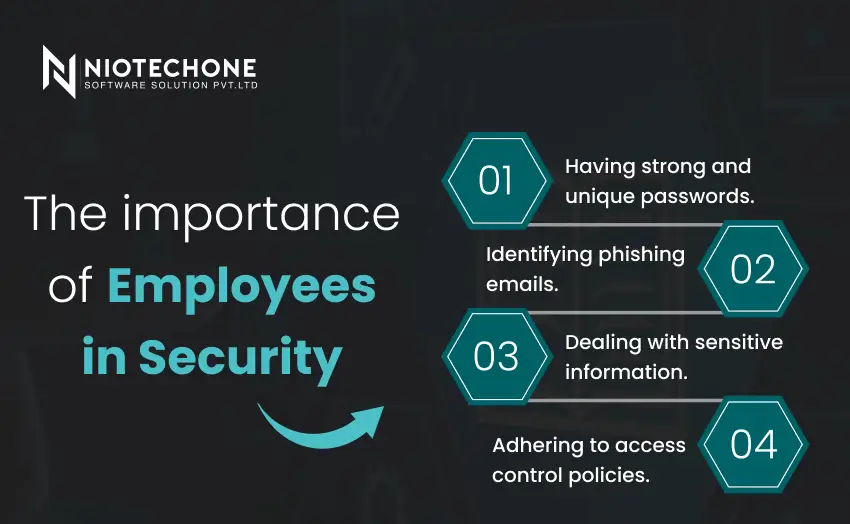
The importance of Employees in Security
Security threats are usually met by employees. Meanwhile, they may also be the greatest threat in the case of a lack of security awareness. A lot of breaches occur because of mere human mistakes, like clicking on unsafe links or having weak passwords.
Employees should be aware of their contribution to the security of the company’s systems and data. Security awareness is not a matter of fear, but a matter of responsibility. Basic habits can greatly minimize risks, including:
- Having strong and unique passwords.
- Identifying phishing emails.
- Dealing with sensitive information.
- Adhering to access control policies.
Training and informing employees make them active participants in the protection of the organization instead of accidental vulnerabilities.
Significance of Security Awareness and Training
An organization cannot be secured by security tools alone. Training and awareness are also crucial. Once teams know how threats operate and how to react, the chances of incidents are reduced to a minimum. Training assists employees in identifying suspicious behavior and adhering to safe practices in their day-to-day work.
Security awareness programs must be continuous and not a one-time event. Businesses need to revise their knowledge and policies as threats change. Awareness also creates a culture in which individuals become responsible rather than expecting someone to take care of security.
Companies investing in security education not only secure their systems, but also their reputation and relationships with customers.
The way a Software Development Company in India helps in secure solutions
An Indian software development company is a professional company that introduces organized security practices at all levels of development. Security considerations inform technical decisions between requirement analysis and deployment. These companies adhere to safe development cycles, testing, and compliance criteria.
They also assist businesses in risk management by ensuring that they are well documented, audited, and maintained. Through collaborating with established teams, organizations can access established frameworks, tools, and expertise that minimize vulnerabilities.
This partnership enables companies to concentrate on expansion without worrying that their online platforms are established on safe platforms.
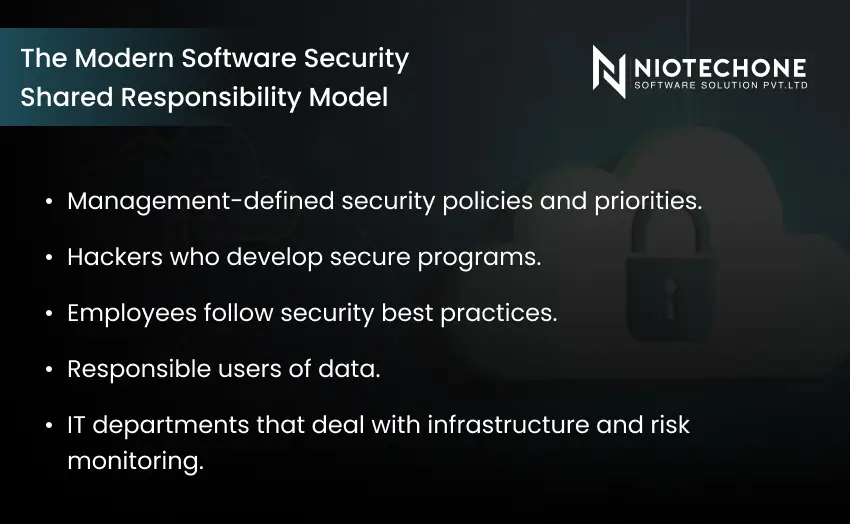
The Modern Software Security Shared Responsibility Model
Modern security is founded on a shared responsibility model. This means that security is not the prerogative of any role or department. Every individual has his or her role to play based on his or her responsibilities.
Key roles include:
- Management-defined security policies and priorities.
- Hackers who develop secure programs.
- IT departments that deal with infrastructure and risk monitoring.
- Employees follow security best practices.
- Responsible users of data.
When these roles work together, security is proactive and not reactive.
The Future of Security in Software Development
The future of security is focused on prevention, automation, and flexibility. The technologies that are gaining popularity are zero-trust models, automated monitoring, and AI-based threat detection. Security will continue to evolve with cloud computing and advanced software systems.
Those companies that consider security-first today will be better placed to meet the challenges of tomorrow. Security will no longer be a separate operation but a part of modern software development and business strategy.
Conclusion
Security is not a technical requirement alone. It is a shared duty that affects every facet of an organization. The role of securing systems and data is played by developers and employees, management, and users.
By implementing safety precautions, awareness investment, and cooperation with a well-known custom software development company in Rajkot, businesses can reduce risks and create reliable digital solutions. Security is the responsibility of every individual in the contemporary globalized society, and it should be taken seriously in order to succeed in the long run.
Categories
Related Articles

Frequently Asked Questions FAQs
It means that every person who is involved in the use or management of digital systems is involved in their security.
Secure software protects data, users, and business operations against threats and breaches.
By following security policies, threat detection, and data handling.
Developers develop and implement secure coding practices and testing to develop applications.
Indian companies offer skilled teams, affordability, and knowledge in safe software development.


