Scaling Your Codebase Beyond the MVP

Introduction

The release of an MVP is a milestone. The real challenge is to scale it to a scalable software application that can support thousands or millions of users.

In 2026, companies are not posing the question, Can we build this? They are questioning, can this sustain itself in fast growth without falling?

Regardless of whether you are engaging a .NET development company, an ASP.NET Core development company, or an internal technology team, to scale past MVP, you need an architecturally mature system, performance engineering, and future-oriented cloud application development.

Why most MVPs fail when growth starts

MVP is created to be fast, not big. It validates an idea quickly. However, when the number of users grows, technical cracks emerge.

The typical scaling issues are:

  • Monolithic code closely bound to UI
  • Bad database indexing and schema design
  • Hard-coded business logic
  • No API versioning strategy
  • Manual deployments
  • Poor planning of the Azure cloud architecture

When you are operating a SaaS platform or enterprise solution, this technical debt grows exponentially.

This is why seasoned CTOs engage a custom software development company early on that builds growth-ready systems on the first day.

What Does Scaling Beyond MVP Mean?

Scaling does not simply involve the addition of servers.

It implies that your .NET application development must support:

  • Higher user concurrency
  • Larger data volumes
  • Multiple integrations
  • Faster deployments
  • Global access
  • AI-driven automation

Scalable architecture should also incorporate AI in software development, predictive analytics, and API-driven ecosystems in 2026.

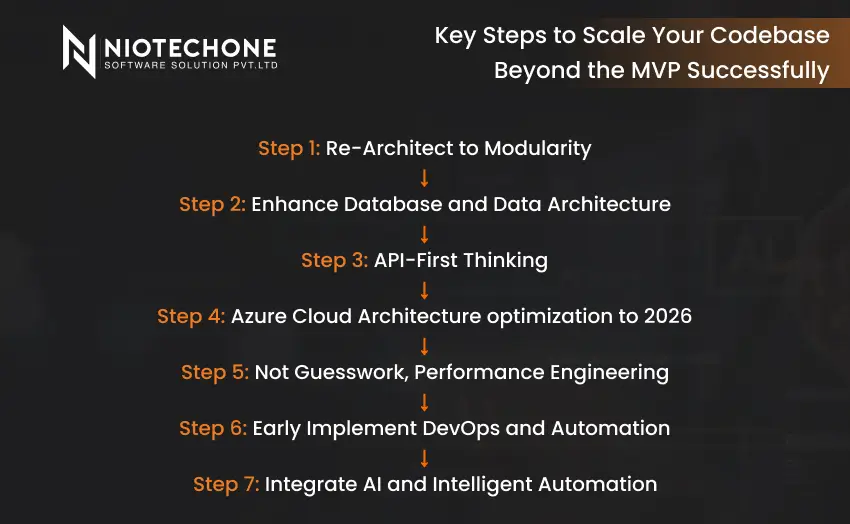
Key steps to scale your codebase beyond MVP including modular architecture, API-first design, DevOps, and cloud optimization

Key Steps to Scale Your Codebase Beyond the MVP Successfully

Step 1: Re-Architect to Modularity

In case your MVP was created as a monolith, it might be time to refactor to a modular or microservices-based architecture. The importance of Modular Architecture.

An effective ASP.NET Core application architecture isolates:

  • Presentation layer
  • Business logic layer
  • Data access layer
  • API layer
  • Infrastructure layer

This guarantees autonomous scaling and simpler maintenance.

Monolith vs Modular Approach

Feature

MVP Monolith

Scalable Modular Architecture

Deployment

Single unit

Independent services

Scalability

Limited

Horizontal scaling

Maintenance

Complex over time

Easier updates

Performance tuning

Global

Per-service optimization

Tech upgrades

Risky

Incremental

A skilled ASP.NET Core development company can assist in refactoring rather than rewriting.

Step 2: Enhance Database and Data Architecture

The first bottleneck is often data.

When user traffic increases:

  • Queries slow down
  • Transactions are mutually exclusive.
  • Reports crash the system
  • Scaling Database Smartly

You should consider:

  • Optimization of database indexing.
  • Monitoring query performance.
  • Read replicas
  • Partitioning large tables
  • Caching (Redis or memory cache)
  • Event-driven updates

You can take advantage of:

  • Azure SQL Elastic Pools
  • Cosmos DB distributed workloads.
  • Managed caching services

An innovative cloud application development plan will avoid performance breakdown when the number of users is increasing at a high rate.

Step 3: API-First Thinking

MVPs tend to combine frontend logic and backend logic.

For scale, shift to:

  • RESTful APIs
  • API versioning
  • Rate limiting
  • Authentication tokens
  • API gateway management

Structured API approach facilitates:

  • Mobile app expansion
  • Third-party integrations
  • Partner ecosystems
  • AI model integration

That is where the collaboration with an ASP.NET development company comes in.

Step 4: Azure Cloud Architecture optimization to 2026

Cloud optimization is not a choice in 2026.

You require architecture that supports:

  • Auto-scaling
  • Load balancing
  • Distributed caching
  • Containerization (Docker + Kubernetes)
  • CI/CD pipelines

Key Azure Scaling Components

  • Azure App Services
  • Azure Kubernetes Service (AKS)
  • Azure DevOps pipelines
  • Application Insights monitoring.
  • Azure CDN for global performance.

An effective .NET development company is capable of developing cost-effective and scalable cloud solutions that suit startups and businesses.

Step 5: Not Guesswork, Performance Engineering

Performance testing should be ongoing.

What to Implement

  • Pre-feature load testing.
  • Infrastructure stress testing.
  • Live monitoring dashboards.
  • Automated scaling triggers
  • Code profiling tools

Scaling is not reactive. It’s proactive.

This is where tailor-made .NET development services can be of quantifiable business value.

Step 6: Early Implement DevOps and Automation

Scalability is killed by manual deployments.

You need:

  • Automated build pipelines
  • Zero-downtime deployments
  • Infrastructure as Code (IaC)
  • Continuous integration
  • Rollback mechanisms

DevOps maturity reduces:

  • Downtime risk
  • Deployment delays
  • Human error


If you plan to
hire a .NET developer, ensure they understand CI/CD pipelines and Azure DevOps workflows.

Step 7: Integrate AI and Intelligent Automation

Scalable systems incorporate intelligence in 2026.

AI in software development is not experimental anymore. It improves:

  • User personalization
  • Predictive analytics
  • Fraud detection
  • Automated testing
  • Code optimization recommendations.

Modern businesses demand AI-powered platforms on the first day.

A high-tech software development company can add AI modules to your current .NET ecosystem without affecting performance.

Real-World Case: SaaS Logistics Platform Scaling

A startup was started with 500 active users.

It increased to 40,000 users within 8 months.

Initial problems:

  • API timeouts
  • Database locking
  • Slow reporting dashboards

Solution implemented:

  • Moved to a modular ASP.NET Core platform.
  • Introduced a caching layer
  • Implemented read replicas
  • Deployed Azure auto-scaling
  • Background job queues are optimized.

Results:

  • 70% faster response times
  • 99.98% uptime
  • The cost of infrastructure was cut by 22%.

This conversion was done by a dedicated custom software developer who has experience in scalable .NET systems.

Conclusion

The 2026 winners are the companies that establish scalable foundations early. The powerful ASP.NET Core application architecture, optimized Azure cloud architecture, AI-based automation, and modular development of the .NET application make it sustainable in the long term.

When your platform is expanding and your architecture is starting to shake, then it is time to take action.

A strategic alliance with a well-established custom software development company or a reputable .NET development company can assist in turning your MVP into a robust, high-performance enterprise platform.

Frequently Asked Questions FAQs

They postpone architectural restructuring and amass technical debt.

Refactoring tends to be cheaper unless the architecture is in a state of complete failure.

Yes, ASP.NET Core can be used to support high concurrency, cloud deployments, and AI integrations with proper architecture.

Azure offers auto-scaling, distributed databases, monitoring tools, and global content delivery support.

AI enhances automation, performance forecasting, and user experience- your system gets smarter as it expands.