To keep pace with rapid change in today’s high-tech commercial environment, businesses must quickly adjust to shifting demands in the marketplace, increasing consumer expectations, or the rapid evolution of technological capabilities. Investing in scalable end-to-end software systems is one of the most effective ways to achieve sustainable business success.
Whether you’re a startup aiming for rapid expansion or an enterprise modernizing legacy systems, partnering with the right custom software development company can make all the difference. If you are a new company preparing to grow your business or an existing company looking for ways to improve your productivity, scalability will be the foundation for continuing success in an increasingly digital world.
Scalable software architecture is a system design that enables applications to support more users, more data, and more workloads without compromising performance, security, or stability.
Simply, a scalable architecture expands as your business does.
A well-designed architecture enables you to add resources, add features, and handle more traffic effectively instead of rebuilding systems each time demand rises.
A robust, scalable architecture usually consists of:
1) Clear Requirement Analysis- Knowledge of long-term business objectives and anticipated growth.
2) Modular System Design – The application is divided into manageable parts.
3) Microservices or Layered Architecture – Enabling services to scale.
4) Cloud Infrastructure Integration – Scaling resources on demand.
5) Database Optimization – Supporting high amounts of structured and unstructured data.
6) Performance Monitoring & Load Testing – Stability under peak traffic.
Scalable software architecture is the technical base that enables a business to grow over time when properly constructed, and the system does not need to be rewritten every few years.
1. Enhances Business Growth
As your company expands, your application must also be able to support: additional users, increased web traffic, expanded data storage, and an increase in transactions.
The software you choose should be scalable to guarantee that your entire system will remain functional, fast, and operationally viable regardless of how much usage increases.
2. Decreased Long-Term Costs
A scalable solution requires the organization to invest in more than one replacement for its existing system. Rather than having to recreate an entire platform, the organization will have the ability to add on or enhance its current platform.
This provides several benefits, including, but not limited to:
3. Improved Customer Experience.
An organization’s slow or downtime due to a slow/crashing Application results in a loss of customers.
When you have scalable applications, this ensures: speed to load pages, the user has a smooth navigational experience, and the user will receive reliable support and service.
The combination of these items improves the user experience and leads to an increase in customer engagement, loyalty, and conversions.
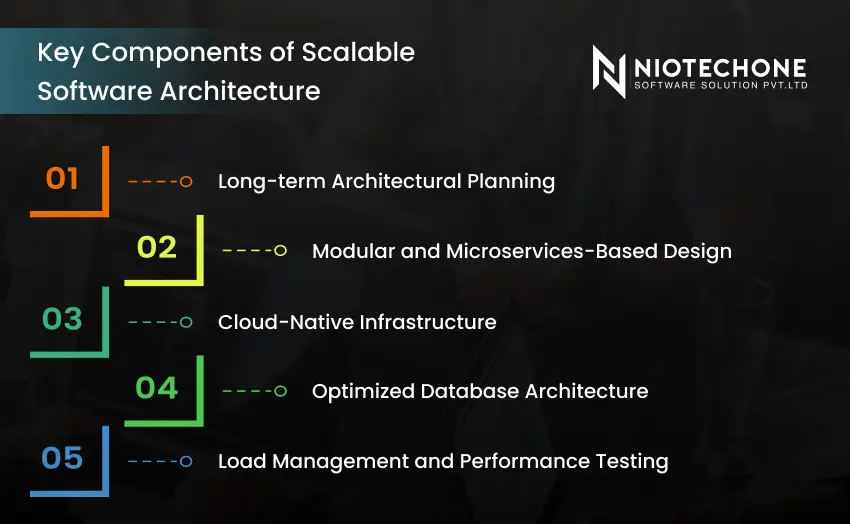
1. Long-term Architectural Planning
Scalability starts at the design phase.
Businesses should consider:
Â
Early growth planning avoids costly system redesigns in the future.
2. Modular and Microservices-Based Design
Scalable architecture in the modern world does not use monolithic systems.
Instead, it uses:
Modular design – Decomposing applications into autonomous parts.
Microservices architecture – Scaling services separately.
Loose coupling – Minimizing system-wide effects on updates.
This will make sure that the demand in one region does not strain the whole system.
3. Cloud-Native Infrastructure
Cloud platforms contribute significantly to scalable architecture.
Cloud-native systems enable businesses to:
Â
In a cloud environment, horizontal scaling is much easier.
4. Optimized Database Architecture
Data increases exponentially as businesses expand.
Scalable systems use:
Â
This guarantees high performance despite high data loads.
5. Load Management and Performance Testing
Scalable architecture should be stress tested.
Key practices include:
Â
Testing will make sure that the system is stable at the peak traffic times.
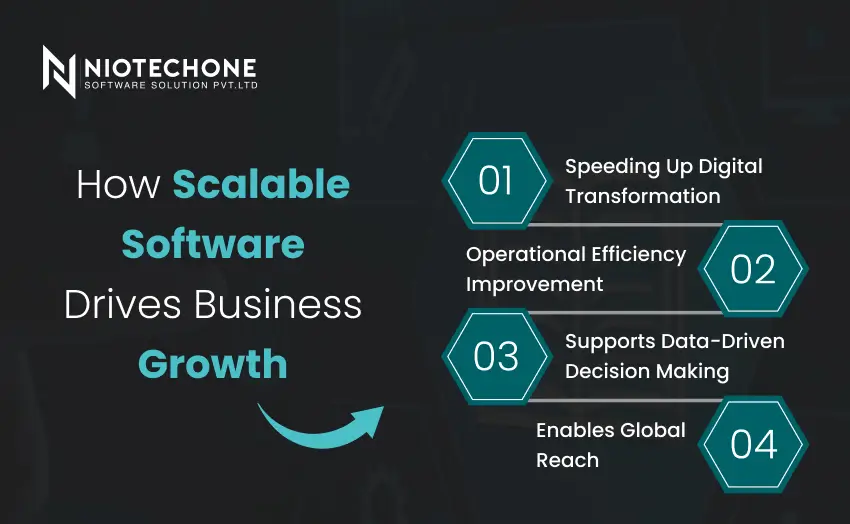
Speeding Up Digital Transformation
Digital transformation is an end-to-end business-to-business need. Software that scales allows companies to automate their processes.Â
Here is how this can help:
Operational Efficiency Improvement
Scalability allows businesses to manage their resources more efficiently. Automation eliminates manual work and prevents errors from occurring.
Benefits of this include:
Supports Data-Driven Decision Making
Scalable systems can deal with vast amounts of data. Advanced analytics provide businesses with critical knowledge about:
Using data as the basis for decision-making will give you a more informed approach to doing business.
Enables Global Reach
Scalable Software allows businesses to be able to operate globally through various regions and remove any technological restraints. Features of these systems include:
This will provide an opportunity for businesses to operate in a seamless manner in the International Marketplace.
The following technologies are likely to shape the future of scalable software:
Niotechone Software Solution Pvt. Ltd. is at the forefront of these trends and is committed to providing future-ready solutions.
Having scalable software solutions is critical for businesses to achieve sustainable growth and allows businesses to scale and successfully compete in fast-changing global markets.
Choosing an experienced software development company ensures that your systems are designed with scalability at their core, reducing risks and optimizing performance. Ultimately, the right architectural decisions today will define how successfully your business scales tomorrow.
The goal of scalable software development is to create applications that can support a growing number of users, an increasing amount of data/code, and increasing workloads without experiencing performance degradation.
Scalability helps ensure performance will continue to be stable, reducing expenses associated with future growth.
Methods used by Niotechone Software Solution Pvt. Ltd. to develop scalable solutions include modern architecture and cloud-based technologies.
Scalable applications can assist small businesses/startups in growing without requiring them to recreate their systems later.
The development timeline provides an estimate of how long it will take to complete the project; on average, 3-6 months, depending on the level of complexity.
3rd Floor, Aval Complex, University Road, above Balaji Super Market, Panchayat Nagar Chowk, Indira Circle, Rajkot, Gujarat 360005.
Abbotsford, BC
15th B Street 103, al Otaiba Dubai DU 00000, United Arab Emirates
3rd Floor, Aval Complex, University Road, above Balaji Super Market, Panchayat Nagar Chowk, Indira Circle, Rajkot, Gujarat 360005.
Abbotsford, BC
15th B Street 103, al Otaiba Dubai DU 00000, United Arab Emirates
Copyright © 2026 Niotechone Software Solution Pvt. Ltd. All Rights Reserved.