Safe Deployment Strategies for Large Projects
- Niotechone Marketing Team
Table of Contents
- Introduction
- Why Large Projects Fail During Deployment
- Strategy 1: Blue-Green Deployment
- Strategy 2: Canary Releases
- Strategy 3: Controlled Rollouts with Feature Flags
- Strategy 4: Automated CI/CD Pipelines
- Strategy 5: Infrastructure as Code (IaC)
- Strategy 6: Database Migration Planning
- Strategy 7: Real-Time Monitoring and Observability
- Comparison of Deployment Strategies
- Real-World Example
- 2026 Trends in Safe Deployment
- Why the deployment strategy should affect Vendor Selection
- Conclusion
Introduction
Software failure during deployment is not only a technical problem in 2026, but also a financial and reputational risk. Unsafe deployments can lead to downtime, customer loss, and operational chaos—whether you’re launching a new SaaS platform, upgrading enterprise systems, or scaling a cloud-native product.
To business owners and CTOs who engage a .NET development company, an ASP.NET development company, or an internal engineering team, the deployment strategy should be proactive, not reactive.
As a long-time custom software development company, we have witnessed projects that have succeeded or failed depending on a single factor: the safety of their deployment.
Why Large Projects Fail During Deployment
It is essential to understand the typical risks before discussing solutions.
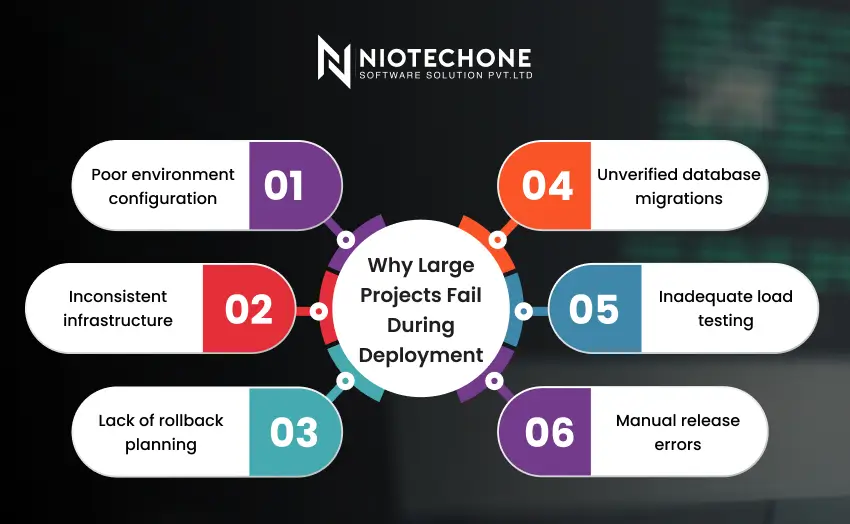
Mass deployments usually fail because of:
- Poor environment configuration
- Inconsistent infrastructure
- Lack of rollback planning
- Unverified database migrations
- Inadequate load testing
- Manual release errors
The complexity of infrastructure has grown in modern cloud application development. Containers, microservices, AI modules, APIs, and distributed databases should all be perfectly aligned.
Even well-constructed applications may fail at release without a structured deployment strategy.
Core Deployment Strategies for Large Projects
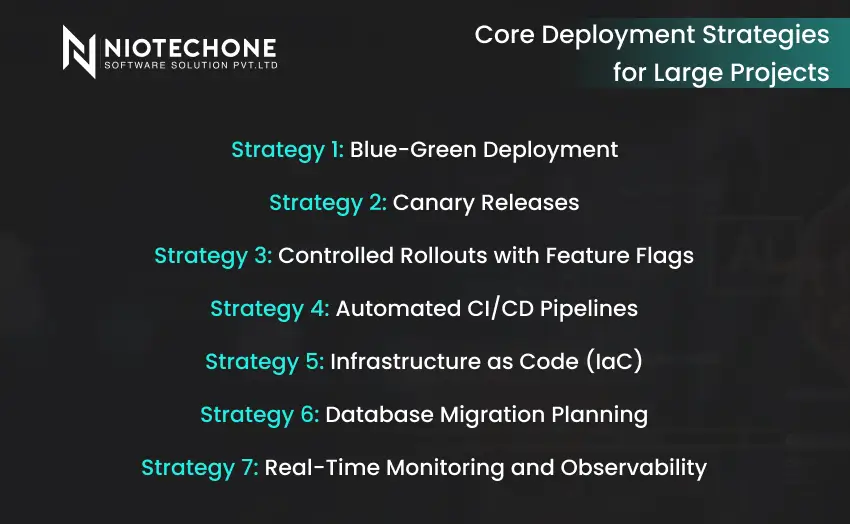
Strategy 1: Blue-Green Deployment
One of the safest enterprise systems strategies is blue-green deployment.
How It Works
Two identical production environments are kept:
- Blue Environment → Live version at present.
- Green Environment → New release version
After testing in the Green environment, the traffic is immediately redirected to Green.
Benefits
- Zero downtime
- On-the-fly rollback
- Reduced deployment risk
- Minimal customer impact
This is a very effective strategy in the case of large-scale development of .NET applications with the help of a well-configured Azure cloud architecture.
Strategy 2: Canary Releases
Canary deployment is a release that updates a small percentage of users before a complete rollout.
Why It Works
Rather than putting all users at risk, a small number of users are given the new version.
If issues appear:
- Rollback is limited
- Impact is contained
- Bugs are detected early
This method is especially useful in AI-enabled systems where behavior can vary depending on real-world usage patterns.
The workflow of modern ASP.NET Core API development companies frequently incorporates automated monitoring to monitor canary performance in real time.
Strategy 3: Controlled Rollouts with Feature Flags
Feature flags (feature toggles) enable teams to release code without turning it on.
This means:
- Code is deployed safely
- Features are turned on one by one.
- Risk exposure is minimized
- Rollbacks do not need redeployment.
In scalable systems developed by a professional ASP.NET Core development company, feature flags provide effective control.
By 2026, most organizations will use feature flags with AI analytics to gauge feature adoption prior to full deployment.
Strategy 4: Automated CI/CD Pipelines
Manual deployments are risky. Automated pipelines minimize human error.
Contemporary custom .NET development services apply CI/CD pipelines to:
- Run automated tests
- Conduct a static code analysis
- Validate security
- Perform database migrations
- Deploy to staging environments
Automation provides uniformity in environments.
Strategy 5: Infrastructure as Code (IaC)
Big deployments are usually unsuccessful due to the difference in environments.
Infrastructure as Code guarantees:
- Regular cloud setup.
- Version-controlled infrastructure
- Reproducible environment configuration.
- Less configuration drift.
Application of IaC in the Azure cloud architecture makes staging and production consistent.
In the case of an enterprise-level software development company in Rajkot, infrastructure consistency is needed to have predictable deployments.
Strategy 6: Database Migration Planning
One of the most frequent deployment risks is database failures.
Safe database strategies are:
- Backwards-compatible schema changes.
- Migration scripts under test.
- Data backup before release
- Phased schema updates
Database design in a complex ASP.NET Core application architecture should be developed with caution without disrupting live functionality.
Strategy 7: Real-Time Monitoring and Observability
Safe deployment does not stop at release.
Modern systems require:
- Performance monitoring
- Error tracking
- Log aggregation
- AI-driven anomaly detection
In 2026, AI-based monitoring systems automatically identify abnormal system behavior during rollout.
In the case of scalable systems, observability is as significant as deployment.
Comparison of Deployment Strategies
Strategy | Downtime Risk | Rollback Speed | Complexity | Best For |
Blue-Green | Very Low | Instant | Moderate | Enterprise systems |
Canary | Low | Fast | Moderate | SaaS & AI systems |
Feature Flags | Very Low | Instant | Low | Continuous updates |
Manual Deployment | High | Slow | Low | Not recommended |
A professional custom software development company in Rajkot teams avoid manual-only strategies for large-scale systems.
Real-World Example
Niotechone Software Solution Pvt. Ltd. was contacted by a company that had been having several outages related to deployment.
Their old system was manual database updates and direct deployment to production.
We implemented:
- CI/CD automation
- Blue-Green environment structure
- Infrastructure as Code
- Live monitoring dashboards
Within three release cycles:
- Downtime reduced by 80%
- Deployment time reduced by 40%
- The number of customer complaints reduced.
Secure deployment changed the confidence in operations.
2026 Trends in Safe Deployment
The current deployment strategies have become:
- AI-based release risk prediction.
- Automated rollback triggers.
- Microservice orchestration on the cloud.
- Scaling without servers during deployment periods.
- Zero-trust security verification at release.
Being a .NET development company in Rajkot, it is important to be ahead of these trends to guarantee the stability of the system in the long run.
Why the deployment strategy should affect Vendor Selection
In selecting a software development company, decision-makers tend to pay attention to features and timelines.
However, such critical questions are:
- Which deployment model do you have?
- How do you handle rollback?
- Is infrastructure automated?
- What is your database migration testing?
- What are the monitoring tools in place?
An effective ASP.NET developer in Rajkot or a development partner should not consider deployment as a secondary subject.
Conclusion
Big projects do not fail due to features. They fail due to unstable releases. Safe deployment strategies will be required in 2026 when applications become more complex with AI integration, cloud-native services, and distributed architectures.
By collaborating with a professional custom software development company, you can be sure that your release process safeguards revenue, reputation, and scalability.
At Niotechone Software Solution Pvt. Ltd., we combine structured deployment frameworks, modern cloud architecture, and disciplined engineering processes to deliver stable, scalable systems.
Categories
Related Articles

Frequently Asked Questions FAQs
One of the safest is blue-green deployment with automated CI/CD and real-time monitoring.
Database migrations may cause compatibility breakage unless they are backwards-compatible or tested.
Yes, particularly when developing a scalable software application that is to be expanded quickly.
AI modules add complexity and need more validation and monitoring.
No. Cloud infrastructure eliminates hardware issues, but deployment discipline is essential.