
ROI of Investing in Custom CRM Software
- Niotechone Marketing Team
Table of Contents
- Introduction
- The ROI of Custom CRM Software
- The reason why Off-the-Shelf CRMs tend to limit ROI
- Major Areas of ROI of Custom CRM Software
- The way Custom CRM enhances sales performance and revenue
- Scalability and Long-term Business Growth.
- Custom CRM vs SaaS CRM
- ROI of Custom CRM Software
- The Hidden Costs of One-Size-Fits-All CRM
- The Reason Global Businesses prefer Custom CRM Development Partners
- Conclusion
Introduction
The relationships with customers are key to the development of modern businesses, and many organisations continue to face the problem of disconnected systems, manual operations, and insufficient visibility into customer information.
Customer Relationship Management software is very important here. Although off-the-shelf CRM tools are simple to use, they often do not align with specific business processes. With the increasing competition in the world, companies are currently considering the return on investment (ROI) of custom CRM software as compared to generic solutions.
Companies that engage an established software development company in India or Rajkot are increasingly adopting custom CRM platforms to achieve quantifiable financial and operational benefits.
The ROI of Custom CRM Software
CRM investment ROI extends beyond direct cost savings. It is the long-term value that a business will receive due to improved customer understanding, quicker decision-making, and enhanced process automation. In contrast to generic CRM tools, custom CRM platforms are developed based on real business operations, which enables organizations to derive greater value out of the system in the long run.
The payback is usually achieved in various aspects, including efficiency in sales, less manual labor, decreased customer turnover, and improved accuracy in forecasting. This flexibility in the long term is one of the reasons why businesses choose to develop their own software rather than use a one-size-fits-all solution.
Early definition of these factors will assist in ensuring that the database structure is in line with the current operations and future expansion. A Rajkot-based .NET development company can help in converting these requirements into a powerful database structure that facilitates the smooth enterprise processes, effective reporting, and access by all stakeholders, which will simplify future system upgrades.
The reason why Off-the-Shelf CRMs tend to limit ROI
Ready-made CRM systems are created to be used in general scenarios, and this implies that they tend to have features that are not needed and lack business-specific features. This discrepancy has a direct effect on ROI. Instead of the software supporting the business, teams waste time adjusting their workflows to the software.
The most common restrictions are limited customization, mandatory upgrades, data ownership issues, and increased subscription fees. In the long run, these problems cause friction in operations and decrease the financial worth of the CRM. Custom CRM software, in contrast, does not bloat features and only includes what the business actually requires, resulting in increased efficiency and better returns.
Major Areas of ROI of Custom CRM Software
Tailor-made CRM systems create ROI in various business operations. Sales, customer support, marketing, and management reporting are the most influential areas.
- The productivity of sales is enhanced since workflows, pipelines, and automation are modelled on actual sales processes.
- The retention of customers is enhanced by the improved monitoring of interactions, preferences, and service history.
- The operational costs are minimized because manual data entry, duplicate systems, and inefficient processes are removed.
- Accurate and real-time data and customized dashboards enhance decision-making.
These advantages are cumulative, and the initial investment is more valuable as the system grows.
The way Custom CRM enhances sales performance and revenue
CRM systems designed to support sales teams are of great benefit to them. Specialized CRM software eliminates redundant processes and only displays pertinent information, enabling salespeople to concentrate on making sales instead of operating software.
Custom automation, lead scoring, and pipeline visibility enable teams to react more quickly to opportunities and predict revenue more precisely. This has a direct effect on revenue growth and a reduction in sales cycles. These enhancements eventually lead to a quantifiable ROI that is greater than the investment.
Scalability and Long-term Business Growth.
Scalability is a key factor in ROI. Off-the-shelf CRM tools are often outgrown by many businesses as they grow into new markets, add users, or new services. Custom CRM software is built to accommodate future expansion, and features and integrations can be expanded as the business expands.
Scalable architecture will make sure that performance does not decrease with the increase in data volume and user activity. This safeguards ROI by avoiding expensive system upgrades or migrations in the future. Companies that invest in scalable CRM systems have a competitive edge in long-term growth planning.
Custom CRM vs SaaS CRM
Aspect | Custom CRM Software | SaaS CRM Platforms |
Initial Cost | Higher upfront development cost | Low or no upfront cost |
Ongoing Expenses | Minimal maintenance cost | Monthly or annual subscription fees |
User Pricing | No per-user charges | Cost increases with each new user |
Customization | Fully customizable | Limited customization |
Integration | Built for existing systems | Often requires paid add-ons |
Scalability | Scales without extra license fees | Scaling increases subscription cost |
Long-Term ROI | High over 3–5 years | Lower due to recurring expenses |
ROI of Custom CRM Software
CRM ROI can be measured by monitoring financial and operational indicators over time. Some of the returns are instantaneous, whereas others are realized over time as more people adopt them.
Key metrics often include:
- Growth in revenue per sales representative.
- Customer retention and lifetime value.
- Less time spent on manual processing.
- Improved forecast accuracy.
- Reduced operational and software expenses.
An effective custom CRM offers built-in analytics that simplify ROI tracking and make it more precise.
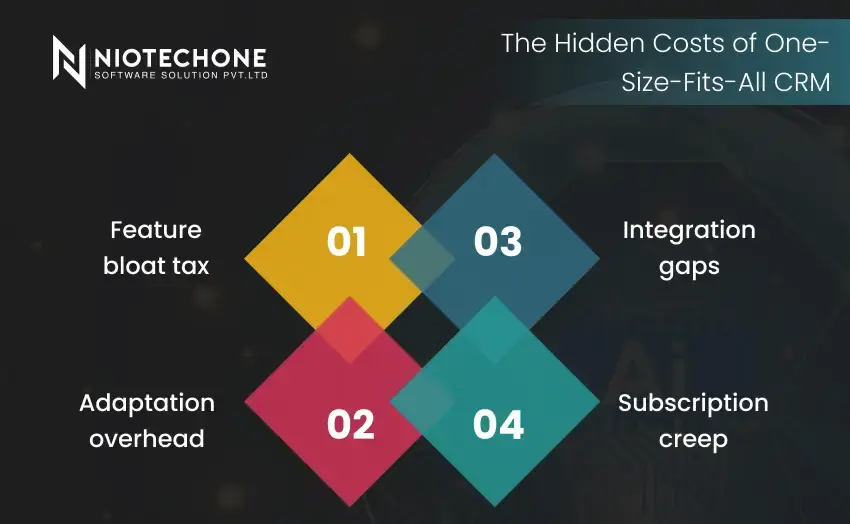
The Hidden Costs of One-Size-Fits-All CRM
Generic CRM systems are fast to implement, yet businesses make tradeoffs:
Feature bloat tax: Teams utilize 37% of the features in off-the-shelf CRMs (Nucleus Research, 2024).
Adaptation overhead: Sales reps waste 2.3 hours per week trying to bend workflows into inflexible systems.
Integration gaps: 68% of businesses operate 3 or more disconnected tools due to the inability of their CRM to integrate with existing systems.
Subscription creep: The price goes up 15-22 percent every year as you add users and modules that are necessary.
Real-life scenario: A medium-sized manufacturing company spent 47,000 a year on Salesforce but had to spend 14 hours of administrative time per week to produce usable reports. Their real CRM usage price? $82 per active user per month with concealed labor.
The Reason Global Businesses prefer Custom CRM Development Partners
International companies are increasingly engaging the services of established development teams to develop tailor-made CRM systems that are internationally compliant. A trusted development partner is one that has technical skills, domain knowledge, and cost effectiveness.
Indian software development companies are usually favored because of their experience in enterprise systems, good technical skills, and the capability to provide scalable solutions. Such alliances assist organizations in maximizing ROI without compromising quality and security.
Conclusion
The value of investing in tailor-made CRM software is much greater than a working customer database. It offers quantifiable benefits in terms of better sales performance, operational efficiency, scalability, and long-term cost control. Although the initial investment can be more expensive than off-the-shelf solutions, the ROI is always worth the choice in the long term.
Custom CRM software development is not a cost to businesses that want to build stronger customer relationships and achieve sustainable growth. By collaborating with a seasoned software development company, this investment will be able to provide long-term value.
Categories
Related Articles

Frequently Asked Questions FAQs
ROI encompasses higher revenue, lower operational expenses, improved customer retention, and scalability benefits in the long term.
Yes, custom CRM is very much aligned with business workflows, which results in increased efficiency and returns in the long run.
The majority of businesses start to realize the measurable ROI in 6-12 months of complete adoption.
Yes, properly designed, custom CRM can grow with the business and be cost-effective.
Indian development companies have good technical skills, economic experience, and experience in international CRM projects.


