Scaling software is one of the most fulfilling—and one of the hardest—stages in the technology journey of a company. When companies grow, their applications often accrue technical debt that can impede development, make costs disproportionate, and create long-term maintenance pain.
Technical debt can occur when a developer has to make a trade-off—with nearly everything from launching a new feature, to rushing to meet a deadline, to quickly prototyping a solution without discussing the principles of code quality or architecture. The compromises can sum up over time, and can eventually make custom software development, .NET Core application development, and ASP.NET Core development in Rajkot more painful, slower, and more costly.
For software development companies in Rajkot, and companies beyond, managing technical debt in a way that keeps scaling sustainable while still producing quality levels, maintaining security and rife with innovation, is consistently a challenge.
Technical debt is not always negative. Occasionally, short-cutting is important to fulfill an imminent business need. Yet, as with financial debt, it has an interest that builds. If left unattended, technical debt can:
Therefore, it is a goal to purposely manage tech debt, weighing speed versus quality in a way suited for sustainable longevity.
Scaling increases complexity. Each user, device, and/or integration that the software must account for turns early development shortcuts into substantial bottlenecks. Tech debt increases at scale for many reasons, including:
A Focus on Rapid Feature Development
Businesses will often take precedence on features over code quality. Short-term gain in deliverables means long-term pain in maintenance.Â
Old Legacy Code
Most early legacy code that was written did not account for scaling. This is common in .NET Core application development where the code slows down future work.Â
No Documentation
When there is no documentation, any new developer will be lost in the existing architecture. This means the likelihood of failing or creating errors exponentially increases.Â
Mixed Standards
If teams don’t hold to coding standards when developing with ASP.NET Core development in Rajkot, or their chosen framework, they will end up with entirely different code between dots of developers. Mixing code degrades maintainability.Â
Integration Complexity
The more the software scales, the more challenging it becomes to integrate, especially with multiple cloud services. Architecture and legacy systems will be exposed because of integration work, and it can put a strain on future integrations.
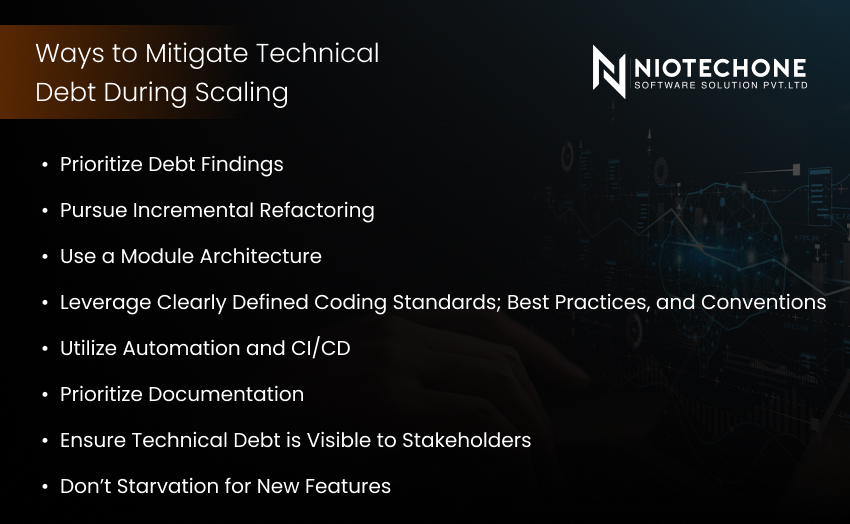
Technical debt has to be managed in a proactive, systematic manner. When it involves finding and managing debt, these different ways have been very effective for many organizations:
1. Prioritize Debt Findings
Whenever possible, take advantage of automated tools or regular code reviews to flag areas of high technical debt automatically. For example, .NET development teams that perform static code analyses may flag issues in legacy code, such as performance bottlenecks and security issues.
2. Pursue Incremental Refactoring
It is always easier to refactor small, incremental steps, than it is to just rewrite one whole system. This strategy is useful for custom software development efforts that need minimal downtime and/or have limited interruptions in service.
3. Use a Module Architecture
Using module or micro-service architecture is a great way to modularize an application making it more flexible to make one change without impacting the entire system. This is very useful for web developers and .NET Core development projects in Rajkot.
4. Leverage Clearly Defined Coding Standards; Best Practices, and Conventions
By adapting and creating and consistent coding standards and conventions this removes volatility and it becomes easier to maintain. Regularly auditing web development can promote a commitment to making high-quality and easily maintainable code by having developers check in with each other.
5. Utilize Automation and CI/CD
Automating running tests, deployments, and continuous integration will ensure that adding new code won’t lead to additional technical debt.Â
6. Prioritize Documentation
Make sure there is good documentation that is comprehensive and up-to-date for both legacy and new code. Â
7. Ensure Technical Debt is Visible to Stakeholders
Technical debt should be included in your project planning and road-mapping discussions.
8. Don’t Starvation for New Features
Try to find a balance of delivering new features and addressing the technical debt.
AI-based tools can provide valuable assistance in reducing tech debt when scaling:
Automated Code Review: AI identifies problematic patterns in .NET core software applications or custom enterprise mobility software solutions.
Predictive Maintenance: AI predicts where in the codebase code is likely to fail or cause bugs when scaling.
Refactoring: AI can suggest architectural patterns to use in place of ASP.NET Core development patterns in Rajkot to reduce subsequent debt.
Integrating AI into their software development practices will help companies to both scale quickly and manage high-quality code.
Conduct Regular Code Audits: Schedule periodic audit/review of code to limit the debt that may accumulate in the future.
Educate Staff: Invest in education for your developers surrounding best practices, especially in building .NET Core applications and cloud-based environments.
Implement Governance Policies: This is essentially a means to create policies around code reviews, documentation, and testing in order to enforce quality policy and expectations.
Measure Quality and Technical Debt: Use measures that assess and measure your technical debt or other areas related to quality improvement, and measure and track over time.
Scaling software without managing technical debt is likened to erecting a skyscraper on a shaky foundation. Eventually, all of the short-cut fixes accumulate and slow innovation, raise maintenance expenses, and create the potential for failure. Utilizing methods such as modular architecture, small refactors, AI-managed code, and documentation reduces technical debt while scaling.
Custom software development, ASP.NET Core development in Rajkot, Azure cloud application development, or .NET Core application development, managing technical debt allows the software to remain scalable, secure, and high-performing going forward: ensuring sustainable growth and user satisfaction.
Technical debt describes the shortcuts taken while coding or poor choices that you make while coding during development to get something to the end users faster.Â
Scaling introduces more levels of complexity. Rapid expansion of features, integrating with new services (like Azure cloud application development), inconsistent standards of code, and legacy code will all contribute to technical debt. If this is not managed, it will slow future ASP.NET Core development for Rajkot projects significantly.
Splitting applications into modules or microservices, allows teams to update or refactor modules independently of the system. It can be an effective way to build software, especially when we look at .NET Core application development, and custom enterprise mobility solutions.
In software development, AI can automate code reviews, predict code defects, and surface opportunities for refactoring. This allows software development businesses in Rajkot to manage their quality of .NET and ASP.NET Core development projects while at the same time scaling.
Incremental refactoring refers to improving on the code base through small manageable developments. It reduces risk and downtime systems and creates scalable Azure cloud application development projects for custom software development or other settings.
Copyright © 2026 Niotechone Software Solution Pvt. Ltd. All Rights Reserved.