
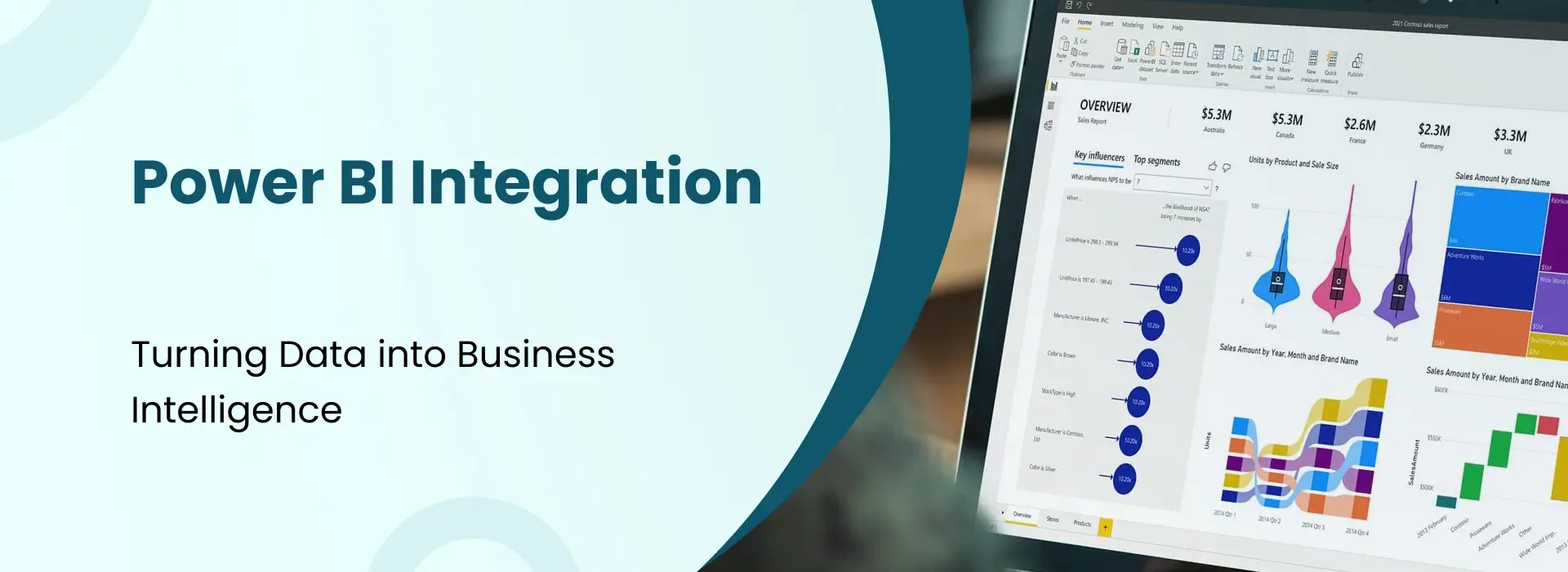
Power BI Integration: Turning Data into Business Intelligence
- Niotechone Marketing Team
Table of Contents
- Introduction
- What Is Power BI Integration?
- The Reason Why Businesses Require Business Intelligence
- The Advantages Of Power BI Integration
- Power BI Enterprise Application Integration
- Power BI and Data Visualization to Decision Makers
- Challenges in Power BI Integration
- Power BI Integration Security and Compliance
- The Future of Business Intelligence using Power BI
- Conclusion
Introduction
All businesses nowadays produce vast volumes of data. Daily sales, customer behavior, operational metrics, and performance reports are generated. Nevertheless, raw data do not contribute to the growth of businesses. The true worth is in knowing what that data is and how it can be used to make better decisions. This is where Power BI comes in.
Power BI is a Microsoft business intelligence tool that assists organizations in transforming complex data into understandable and actionable insights. When integrated with Power BI, businesses can visualize trends, track performance, and make data-driven decisions more quickly.
As companies become increasingly dependent on digital platforms, collaborating with a trusted software development company in India can help ensure that data systems are interconnected, secure, and geared for long-term success.

What Is Power BI Integration?
Power BI integration is the process of integrating Power BI with various data sources, including databases, cloud platforms, enterprise systems, and custom applications. Rather than manually gathering and processing data, Power BI automatically gathers data across various sources into a single dashboard.
This integration enables businesses to see real-time data, create interactive reports, and monitor key performance indicators at one location. Regardless of the source of data, be it an ERP system, CRM software, or a custom-built application, Power BI integration will provide consistency and accuracy. In the hands of skilled developers, it can be a potent base of business intelligence solutions at the enterprise level.
The Reason Why Businesses Require Business Intelligence
The modern business environment is very competitive and dynamic. Making decisions without data insights can result in inefficiencies, lost opportunities, and higher costs. Business intelligence assists organizations in knowing what is going on in different departments and why some results are being achieved.
Using business intelligence tools such as Power BI, organizations are able to examine trends, risks, and growth opportunities. Leaders can make decisions based on precise and timely data rather than assumptions. This trend of data-driven decision-making is the reason why most organizations are collaborating with a custom software development company in India to deploy scalable and dependable BI systems.
The Advantages Of Power BI Integration
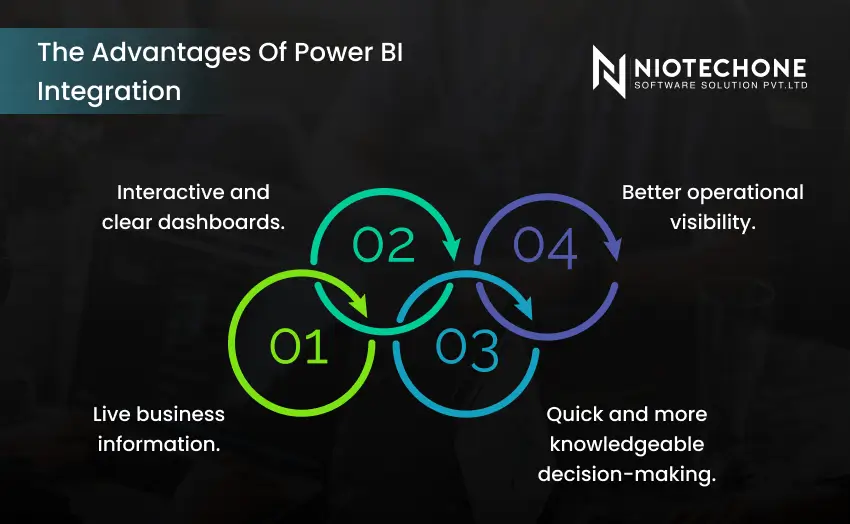
The integration of Power BI provides various advantages that have a direct effect on business performance. The most significant benefits are:
- Live business information.
- Interactive and clear dashboards.
- Quick and more knowledgeable decision-making.
- Better operational visibility.
These advantages enable teams to react fast to changes and align strategies with actual business results. Power BI also saves time and resources by eliminating reliance on manual reporting. It can be used together with custom software development to make sure that analytics solutions are tailored to the needs of a particular business rather than a one-size-fits-all solution.
Power BI Enterprise Application Integration
ERP, CRM, and supply chain systems are enterprise applications that produce huge volumes of structured data. The integration of Power BI allows these systems to interact with each other and display insights in a centralized dashboard. This simplifies the process of managers monitoring performance across departments without having to change platforms.
Power BI is crucial in enhancing transparency and accountability in the development of enterprise applications. Companies are able to track financial performance, customer interaction, and operational efficiency in real-time. Power BI can be a strategic layer that adds value to enterprise systems when properly integrated instead of substituting them.
Power BI and Data Visualization to Decision Makers
One of the strongest features of Power BI is data visualization. Decision-makers can navigate through interactive charts, graphs, and dashboards instead of looking at complex spreadsheets. Patterns, trends, and anomalies are easier to detect using visual representations.
Power BI dashboards can be tailored to various roles in an organization. Executives can concentrate on top-level KPIs, whereas operational teams can monitor specific performance indicators. This role-based model will make sure that all people can view the relevant data without any unnecessary complexity, which will enhance the overall efficiency of decision-making.
Challenges in Power BI Integration
Although the integration of Power BI has great advantages, there are some challenges that businesses might encounter in the process. Common issues include:
- Poor or inconsistent data.
- Security and access control issues.
- Complexity of integration between systems.
- Large-scale performance optimization.
These issues can be resolved through effective planning, data governance, and technical skills. Collaborating with a seasoned development team can assist businesses in avoiding the pitfalls and making the integration process a smooth one.
Power BI Integration Security and Compliance
Businesses that deal with sensitive information have data security as a priority. Power BI provides enterprise-level security, including role-based access control, data encryption, and industry standards. Nonetheless, the issue of security is very much dependent on the implementation of integration.
An effective Power BI integration will make sure that users can only access authorized data. It also complies with the compliance requirements, like data privacy regulations. Companies that engage a reputable software development company in India enjoy secure architectures that safeguard data without restricting its use.
The Future of Business Intelligence using Power BI
Business intelligence is shifting towards automation, artificial intelligence, and predictive analytics. Power BI is constantly being developed to accommodate AI-based insights, natural language queries, and sophisticated forecasting models.
With the capabilities being embraced by businesses, Power BI will be even more strategic in planning. The combination with the contemporary software systems will make the insights relevant and actionable. Companies that invest in Power BI now are more ready to face the data-driven future.
Conclusion
The integration of Power BI converts raw data into valuable business intelligence. It assists organizations to become clear and efficient and make decisions with confidence. Power BI adds value to data throughout the organization, whether it is enterprise applications or modern software systems.
The selection of the appropriate integration strategy and development partner is key to long-term success. Companies that collaborate with skilled specialists can unlock the potential of Power BI and establish a solid base of data-driven development.
Categories
Related Articles

Related Tags
Frequently Asked Questions FAQs
Power BI integration links Power BI to databases, applications, and systems to visualize and analyze business data in a single location.
It offers real-time insights, dashboards, and reports that facilitate data-driven decision-making.
Yes, Power BI is popular in the development of enterprise applications in terms of scalability and security.
Power BI can be easily integrated with custom software development projects via APIs and cloud services.
Indian companies provide experienced knowledge, economic skills and experience in enterprise BI solutions.


