Observability vs Monitoring: Building Resilient Enterprise Apps

Introduction:

The modern digital environment demands that company applications be always operational, capable, and intelligent. However, achieving the required level of reliability does not stop with just knowing if the servers are operational. Here is why the difference between observability and monitoring is important.

Observation tells you that something is wrong, while Observability tells you why it went wrong. As organizations adopt distributed systems, microservices, and AI-driven platforms, Observability will inevitably become the backbone of any truly robust and self-healing applications.

For companies working with a company that specializes in .NET development in Rajkot or a software development company in Rajkot, understanding observability will lead to better system health, faster debugging, and ongoing performance improvements.

Learning the Basic Difference: Monitoring and Observability

Monitoring is the act of aggregating normally monitored metrics – CPU usage, response time, memory usage, etc. It is reactive to the action (problems), meaning you react to alerts on your monitor/dashboard, detecting a problem.

On the other hand, observability is proactive; you have total insight into your entire system across logs, traces, and metrics, so that you can fix a problem you never knew existed.

To clarify what they mean:

  • Monitoring = known problems
  • Observability = unknown problems

This difference in terminology is significant for enterprise applications developed using .NET Core development tools, where distributed architecture creates complexity in identifying the root cause of issues.

Why Enterprises Need More Than Monitoring

Monitoring works well for monolithic applications, but modern environments are much more dynamic. Enterprise applications increasingly run on cloud-based, containerized, and microservice-based platforms. Monitoring a single server or endpoint is simply not sufficient.

Here’s why observability is so important:

  • It helps application developers understand not just what happened, but also “why”.
  • It helps to shorten Mean Time To Resolve (MTTR).
  • It provides context-based analytics for multi-dimensional decision making.
  • It helps to increase system resilience in the face of unpredictable failures.
  • It enables the integration of AI for Software Development in Rajkot and AI for Software Development in India predictive capabilities!


When companies see success with observability, it shifts their mindset from “responding to incidents” to “preventing incidents before they happen.”

Key Components of Observability

Observability is built on three key pillars — metrics, logs, and traces — which, together, create a view of the performance of the application from every angle.

Metrics:

Numerical data around the health of a system. This includes items like CPU, request latency, and memory consumption for a system.

Logs:

Detailed records of events indicating what happened within the system. It is valuable for debugging.

Traces:

Complete logs of user requests or processes as they traverse across multiple services or systems.

A competent ASP.NET Core Development in Rajkot or ASP.NET Core Development in India team will utilize modern frameworks and DevOps tools to enable end-to-end visibility across each of these three pillars.

How Observability Enhances corporate resilience

Corporate resilience is focused on creating systems that recover quickly and efficiently from a disruption. Observability can enhance corporate resilience in a number of ways:

  • To identify the early signs of system degradation before customers are impacted.
  • To support real-time load based auto-scaling.
  • To identify bottlenecks across microservices.
  • To support doing better incident post-mortems because of access to rich historical data.
  • To fuel AI based anomaly detection models using AI in Software Development in India or AI in Software Development in Rajkot skills.

By combining observability with automation and Azure cloud application development, organizations can start building self-healing enterprise ecosystems.

A layered architecture diagram showing logs, metrics, and traces feeding into a central observability dashboard for real-time insights.

The Technical Foundation of Observability

Understanding where to implement observability is critical for effective observability implementation and organizations will need to build their architecture around visibility into data.

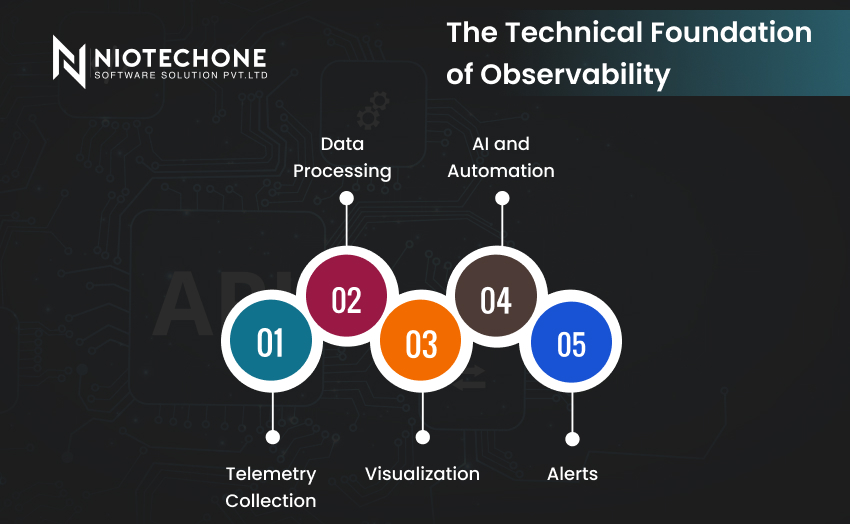
The following describes a general observability driven ecosystem:

  • Telemetry Collection: Collect logs, metrics, and traces across microservices.
  • Data Processing: Clean and normalize telemetry data and store it using tools like OpenTelemetry.
  • Visualization: Use dashboards to visualize analysis of trends in performance..
  • AI and Automation: Use machine learning models for predictive maintenance.
  • Alerts: Set up intelligent alerts based on thresholds or patterns.

A new .NET development company in India or Software development company in Rajkot can create these various layers for observability, designed to work easily with tools like Azure Monitor, Prometheus, Grafana, or Application Insights.

Azure's role in Observability

With Azure Monitor, Application Insights, and Log Analytics, users can get unified visibility across an organization’s applications, containers and infrastructure. With a couple of other custom software development services like ASP.NET Core development in India, you can inform your observability solution with Azure’s cloud-based capabilities, while taking advantage of automated diagnostics, and providing real-time insights into distributed environments.

Some Azure capabilities for observability include:

– Application performance management with Application Insights

– Visualization of dependencies involved with microservices

– Log analytics in real-time metrics using Kusto Query Language (KQL)

– Integration with Power BI for insight across the business

– AI-based alerts for anomalous behavior predictive of a failure

Adding Observability into Custom Enterprise Applications

As earlier mentioned, observability should be part of your development for enterprise-grade software. It’s built in, not in addition to.

For teams focused on custom software development and web development, integrating observability is easier than enabling it later in the life cycle. Custom application developers can incorporate observability during design when building applications based on OpenTelemetry or a distributed tracing framework.

Best practices:

  • Instrument the applications early in development with structured logging.
  • Utilize correlation IDs among services to follow user requests.
  • Facilitate fine-grained metrics collection on key performance indicators.
  • Deploy centralized dashboards to allow consolidated monitoring.
  • Automate alerting and escalation policies.

By adding observability to custom Enterprise mobility software solutions, developers help enable faster diagnosis, smarter decisions, and less downtime.

AI and Automation in Observability

AI observability will represent the next iteration of enterprise resilience.

Rather than manually combing through limitless logs and web-services, AI models will identify abnormal patterns, anticipate failure, and initiate the remediation process automatically.

This is where AI in Software Development in Rajkot and AI in Software Development in India offer the biggest value.

AI adds observability through:

  • Intelligent root cause investigations
  • System predictions for scaling
  • Incident correlation
  • Natural language summary of alerts
  • Continuous improvement suggestions

As enterprises evolve .NET Core application development by integrating AI, they gain smarter, faster, and more reliable systems.

A dashboard-style graphic showing system logs, traces, and real-time analytics, illustrating the benefits of observability for enterprise businesses.

Observability Benefits for Enterprise Businesses

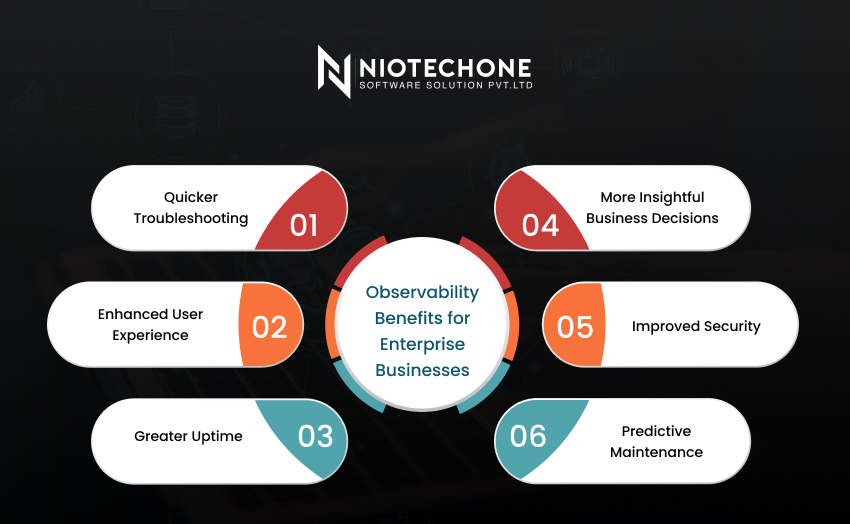
  • Quicker Troubleshooting: Teams determine root issues instantly.
  • Enhanced User Experience: Proactively resolving issues before users are impacted.
  • Greater Uptime: Resilient apps reduce service interruptions.
  • More Insightful Business Decisions: Operational data informs decisions on strategy.
  • Improved Security: Observability recognizes and identifies anomalies early.
  • Predictive Maintenance: AI alerts based upon predicted performance issues.

When seasoned .NET Core application developers integrate observability into their systems, it increases the likelihood they will possess these applications.

Conclusion

Monitoring tells you the symptoms. Observability tells you the diagnosis. In this era of complicated enterprise architectures, distributed microservices, and AI-driven systems: observability is no longer desirable; it’s essential. Organizations that embrace observability-first principles will be able to recover faster, gain richer insights, and continuously optimize their systems with evolutions at the forefront and never-ending.

Now, by engaging a quality .NET development company in rajkot or .NET development company in india educated in ASP.NET Core development in India, Azure cloud application development, and partly (AI in Software Development in India), enterprises can ensure when they build applications every layered segment, including the front end and the back end, they value keep level of visibility from their own facility, delivered and integrated securely, seamlessly, and reliably.

Frequently Asked Questions FAQs

Monitoring involves tracking established metrics and alert conditions while observability analyzes logs, metrics, and traces to gain insights into unknowns.

It allows teams to proactively identify and remediate problems before they impact end-users and support continuous availability and reliability - necessary for modern enterprises built on .NET Core application development and custom software development.

Some of the most popular tools are Azure Monitor, Application Insights, Prometheus, Grafana, and OpenTelemetry. A software development company in Rajkot can integrate observability well with Azure cloud application development.

AI-based models can detect anomalies, predict outages, and suggest remedial action. With AI in Software Development in Rajkot and AI in Software Development in India, enterprises can automate incident remediation and optimize reliability.

Begin to instrument your application with logs, metrics, and traces. Then you can use cloud-based analysis tools. Companies that partner with a .NET development company in Rajkot or .NET development company in India can get assistance with observability strategies and ongoing optimization.