Next-Gen Serverless 2.0

Introduction

The next significant development in cloud computing is Serverless 2.0. Although traditional serverless is about executing functions without server management, Serverless 2.0 extends this concept to include intelligent autoscaling, stateful execution, event-driven pipelines, distributed edge computing, and AI-assisted runtime optimization.

The new model enables businesses to create highly scalable applications that respond in real-time, operate at a global scale, and optimize themselves automatically.

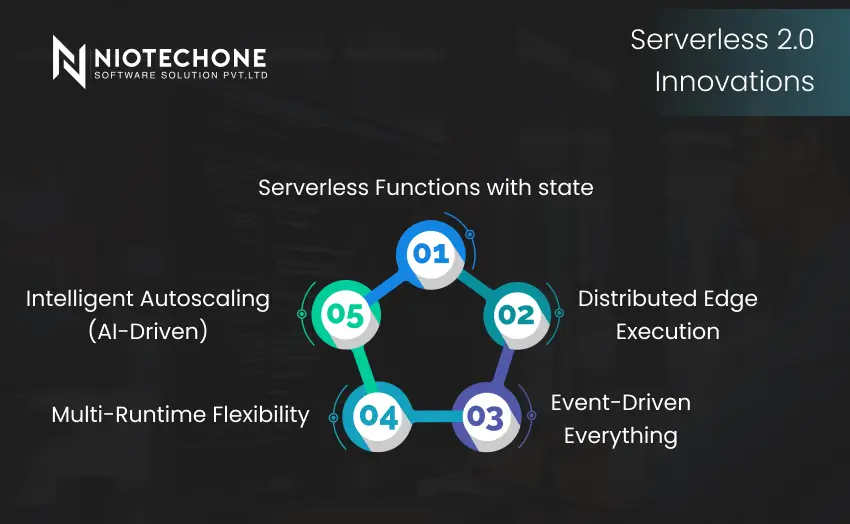
Serverless 2.0 innovations showing stateful functions, edge execution, AI autoscaling, and event-driven systems

Serverless 2.0 Innovations

1. Serverless Functions with state

  • Previous serverless systems were stateless, but Serverless 2.0 supports stateful micro-functions that keep workflows without external databases, allowing real-time pipelines and long-running processes.

2. Distributed Edge Execution

  • Functions run near the user at global edge positions, providing ultra-low latency applications to IoT, 5G, and immersive experiences.

3. Event-Driven Everything

  • Serverless functions can be activated by all actions, API calls, database updates, IoT signals, logs, and build entirely automated digital ecosystems.

4. Multi-Runtime Flexibility

  • Python, Go, Node.js, Java, and AI models can be executed in the same serverless workflow by developers, enhancing the speed and productivity of complex projects.

5. Intelligent Autoscaling (AI-Driven)

  • Serverless 2.0 uses ML to predict traffic patterns scalable before spikes and scalable after demand falls, minimizing latency and cloud cost.

The Reason Why Serverless 2.0 is relevant to the contemporary enterprise

Serverless 2.0 assists companies to create future-proofed applications that have the following benefits:

Lower Operational Overhead

  • No server administration, patching, or scaling, and teams are free to be innovative.

Faster Deployment Cycles

  • Infrastructure is not managed, and developers push code without much thought, reducing release time by a factor of orders of magnitude.

Billing Cost Effectiveness

  • Only pay when there is real execution time, not idle resources, best when there is irregular workload and startups.

Self-Healing and Resilient Systems

  • Functions are automatically restarted, failover immediately, and errors are handled by orchestrating themselves.

Smooth Interoperability with APIs and Microservices

  • Serverless 2.0 is the connector between cloud applications, databases, AI models, and third-party services.
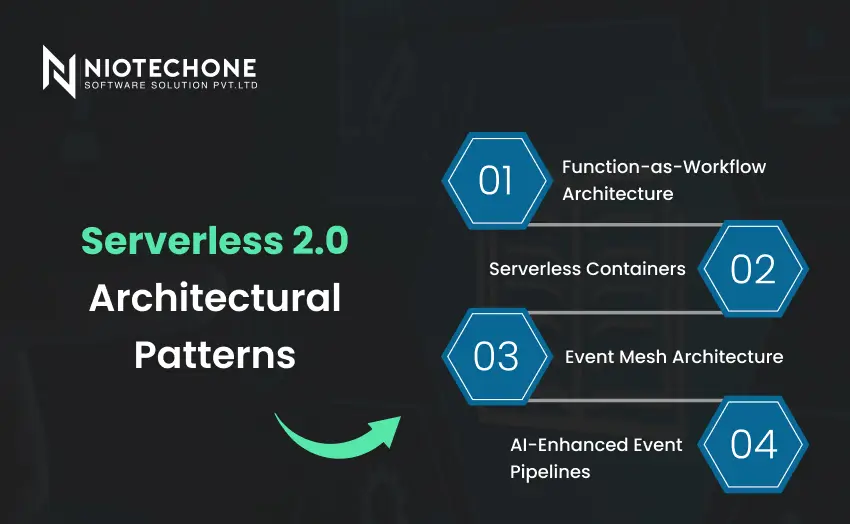
Diagram illustrating Serverless 2.0 architectural patterns with cloud functions and microservices

Serverless 2.0 Architectural Patterns

1. Function-as-Workflow Architecture

Business processes are stitched together by multiple functions that enable modular, easily updated logic across systems.

2. Serverless Containers

Auto-scaling and pay-per-use lightweight containers enhance consistency of complex workloads.

3. Event Mesh Architecture

An integrated messaging backbone that forwards events between apps, APIs, and edge nodes in real time.

4. AI-Enhanced Event Pipelines

AI identifies anomalies, anticipates user intent, and routes automatically in the pipeline.

Serverless 1.0 vs Serverless 2.0

Feature

Serverless 1.0

Serverless 2.0

State

Stateless

Stateful workflows

Scaling

Reactive

Predictive AI-based

Runtime

Limited

Multi-runtime & containers

Deployment

Functions only

Functions + edge + pipelines

Intelligence

Manual configs

Autonomous & learning

Use Cases

Simple tasks

Complex enterprise workloads

Difficulties with Serverless 2.0 Adoption

There are a number of advantages to using Serverless 2.0, but there are also risks that companies will need to understand. Serverless 2.0 is made up of distributed functions, event-based pipelines, execution at the edge, and automation with AI, which brings a level of complexity that is inherently different from traditional cloud environments.

Some of the key risks include the following: 

Complex Observability 

  • If you want to monitor and debug serverless functions developed in a distributed way, you will most likely need an advanced tracing system because traditional logging will not work here in the same way. 

Cold Start Risk

  • “Cold starts,” or functions that have not been executed before, potentially contain delays because the function takes longer to instantiate, which creates potential latency for the real-time experience. 

Vendor Lock-In 

  • The vendor lock-in is because serverless 2.0 features are cloud specific and this could be damaging on multiple fronts in a future transition.

Expanded Attack Surface 

  • If an organization develops many APIs, triggers, and event handlers will have an expanded attack vector surface (or threats) unless carefully shepherded. 

Event Management Challenges 

  • Event management is a key part of governance, including ensuring that the order in which they process is as expected, provide safeguards for duplication (idempotency), and ensure reliability.

Best Practices of building Serverless 2.0 Applications

1. Design with Event-Driven Thinking

Serverless 2.0 is driven by micro-events, streams, and automation triggers, so developers should design systems with events first, rather than functions. 

Explanation: Rather than creating large functions that manage multiple responsibilities, as best practice split your system into small steps that are triggered by events to allow for maximum scalability and resiliency. 

  • Decouple services with domain events
  • Design functions to be single-purpose and stateless
  • Use queues and streams to manage concurrency
  • Use either event choreography or orchestration patterns

2. Embed Strong Observability from Day One 

Serverless environments are short-lived, so visibility won’t happen organically. 

Explanation: Invest early in any sort of tracing, logging, or monitoring solutions to gain true end-to-end visibility across all of your micro-events, and through their lifecycle.

  • Use distributed tracing (AWS X-Ray, OpenTelemetry)
  • Use organized and centralized logs
  • Monitor event retries, dead letter queues and timeouts 
  • Log execution cost metrics throughout development

3. Focus on IAM, Permission Hygiene & Zero-Trust

In Serverless 2.0, security is driven by identity rather than by server. 

Explanation: Each function, event trigger, queue, and microservice need to have very strict permissions, you must minimize blast radius. 

  • Use least privileged access for each function. 
  • Use different roles for each event driven component (queue, event triggers, etc.)
  • Rotate keys and restrict environment vars
  • Review and audit IAM policies regularly.

4. Improve Cold Start Reduction

Cold starts are still a headache for mission-critical event pipelines.

Explanation: There are frameworks and other tools which reduce startup latency, and provide a better user experience and reliability to the system.

  • For your most mission-critical functions, consider using provisioned concurrency.
  • Use lightweight runtimes like Node.js or Go.
  • Minimize large libraries and the package size.
  • Pre-warm your functions by using scheduled triggers.

Conclusion

Serverless 2.0 is not a minor update, but a significant change in the design and implementation of digital systems. Intelligent scaling, stateful workflows, global edge deployment, and powerful event-driven automation enable organizations to finally create fast, resilient, cost-efficient, and future-ready applications.

Companies that embrace Serverless 2.0 today have a competitive edge, as they create applications that run with low friction and provide high-performance at scale. Serverless 2.0 will be the foundation of the next generation digital ecosystems as AI, IoT, and global systems continue to grow.

Frequently Asked Questions FAQs

Not completely- there are still servers, but users do not configure or manage them.

Yes, it is distributed and event-driven, which is perfect in large-scale digital ecosystems.

Yes, ML inference and lightweight models can execute both on the cloud and at the edge.

Cost is based on usage; typically, Serverless 2.0 means lower costs because you typically will pay solely for execution time and events.

Cost can decrease due to:

  • Less idle time for servers
  • Automatic Scaling
  • Minimal DevOps overhead
  • Faster development cycles

Although infrequent, poor architectural decisions (e.g., too many small functions) can increase costs.

Risks include:

  • Higher architecture complexity
  • Debugging distributed workflows
  • Cold start latency
  • Devastating over usage of minuscule functions
  • Misconfiguration of IAM permissions

Generally, leveraging best practices and good tooling in Serverless will help mitigate possible risk.