Monolith Architecture vs Microservices Architecture in 2026
- Niotechone Marketing Team
Table of Contents
- Introduction
- What Is a Monolithic Architecture?
- The Benefits of Monolithic Architecture in 2026
- Weaknesses of Monolithic Architecture at Scale
- What Is a Microservices Architecture?
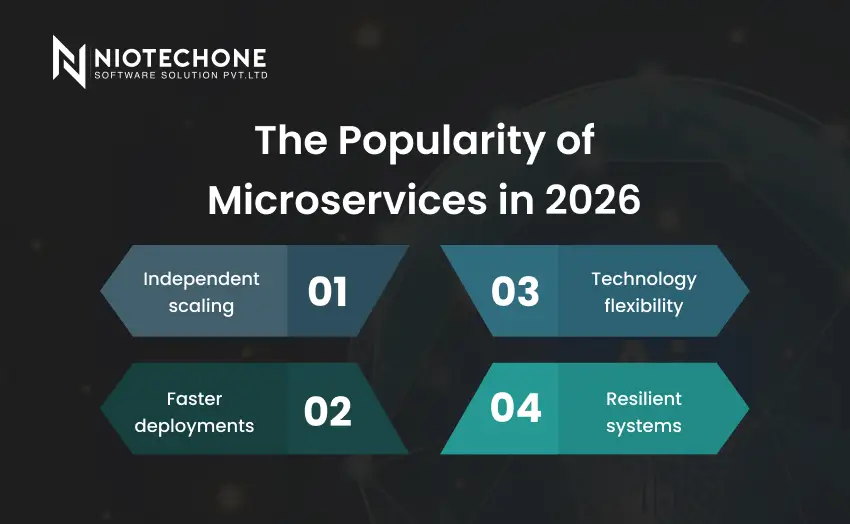
- The Popularity of Microservices in 2026
- The Benefits of Microservices Architecture in 2026
- Weaknesses of Microservices Architecture in Practice
- Monolith vs Microservices: Architectural Comparison
- Real-World Use Case: B2B Platform Scaling
- Selecting the Right Architecture: Practical Guidelines.
- Conclusion
Introduction
One of the most crucial decisions that businesses make today is selecting the appropriate software architecture. This decision has been further complicated in 2026, with companies weighing the trade-offs between speed, scalability, security, and cost efficiency.
The Monolithic architecture vs Microservices architecture debate is no longer a theoretical one to business owners, CTOs, startup founders, and enterprise leaders. It directly impacts:
- Time to market
- System scalability
- Cloud costs
- Productivity of development teams.
Being a custom software development company, we frequently encounter organizations that fail not due to their selection of the wrong technology, but due to their selection of the wrong architecture during their growth phase.
This article is a practical, decision-oriented comparison of Monolith vs Microservices in 2026, with particular insights into the development of .NET applications, ASP.NET Core application architecture, and modern enterprise systems.

What Is a Monolithic Architecture?
A monolithic architecture is one application that is deployed as a single unit.
The main features of a Monolith.
- Single codebase
- Single deployment unit
- Shared database
- Close interconnection of modules.
Monoliths are still in use in most projects of ASP.NET development companies, particularly in early-stage products.
The Benefits of Monolithic Architecture in 2026
Although the trends are changing, monolithic architecture is still applicable, especially when the products are at the initial stage of growth or when they are not very complex.
1. Easier Development and Deployment
A monolithic application is one with a single codebase and deployment unit. This makes it easy to develop, test, and deploy- it is best suited to MVPs and smaller teams.
2. Reduced Operational Complexity
Monoliths do not need sophisticated service orchestration, inter-service communication, or sophisticated monitoring systems. This minimizes overheads and infrastructure expenses.
3. Less Complex Debugging and Testing
Because everything is executed in one process, it is easier to trace bugs and test workflows than in distributed microservices systems.
Weaknesses of Monolithic Architecture at Scale
Monoliths tend to fail to satisfy the current scalability requirements as applications increase.
1. Poor Scalability and Flexibility
Monoliths scale as a whole. Although only a single module may need additional resources, the whole application will have to be scaled, which will result in the inefficient use of resources.
2. Slower Release Cycles
Any modification necessitates the re-deployment of the whole application. This raises deployment risk and slows down release cycles as the codebase expands.
3. Hard Team Cooperation at Scale
Merge conflicts, coordination issues, and reduced development velocity can be experienced in large teams that operate on a single codebase.
What Is a Microservices Architecture?
Microservices architecture divides an application into autonomous services, each of which performs a particular business task.
Each service:
- Runs independently
- Can be deployed separately
- Communicates via APIs
The current ASP.NET Core application architecture is highly compatible with microservices.
The Popularity of Microservices in 2026
Microservices are consistent with contemporary development.
These Enable:
- Independent scaling
- Faster deployments
- Technology flexibility
- Resilient systems
These are frequently the model of choice in the development of enterprise .NET applications, although not necessarily the correct starting point.
The Benefits of Microservices Architecture in 2026
Microservices architecture is created to suit systems that need to scale, evolve, and work independently. It is commonly used in 2026 by organizations developing complex, high-traffic, and cloud-native applications based on modern ASP.NET Core application architecture.
The following are the main benefits that make microservices appropriate for enterprise and growth-oriented platforms.
1. Scalability by Design
Microservices are deployed and scaled separately depending on demand. This enables businesses to scale only those parts that are under heavy load, and not the whole application.
2. Accelerated and Simultaneous Development
These allow various teams to work on various services at the same time. Shared deployments or tightly coupled codebases do not block teams, and this greatly enhances the speed of delivery, particularly in organizations that have distributed development teams.
3. Fault Isolation and System Resilience
Failures in a microservices-based system are isolated. Failure of one service does not cause the failure of the whole application. This enhances the reliability of the entire system and guarantees increased uptime of business-critical platforms.
4. Cloud-Native and DevOps Friendly
These are compatible with containerization, CI/CD pipelines, and cloud-native infrastructure. They are compatible with the latest cloud platforms and are therefore suitable for applications that are dependent on auto-scaling, high availability, and continuous delivery.
Weaknesses of Microservices Architecture in Practice
Although microservices have good scalability advantages, they also present operational and architectural complexity. These challenges may supersede the benefits without the appropriate knowledge and experience.
1. Greater Architectural Complexity
These must be planned with attention to service boundaries, communication protocols, and data ownership. Microservices can be defeated by poor design choices, which result in tightly coupled services that add to maintenance overhead.
2. Increased DevOps and Infrastructure Demands
Microservice operation requires advanced DevOps, such as service monitoring, logging, deployment automation, and failure management. Companies that lack effective DevOps might not be able to handle the load.
3. Service Communication Performance Overhead
These are based on network communication among services. This may add latency and affect performance, particularly in high-throughput systems, without appropriate optimization.
4. Increased Start-up and Education
Microservices demand greater initial investment in tooling, infrastructure, and talented developers than monolithic systems. This cost might not be warranted in small teams or in early-stage products.
Monolith vs Microservices: Architectural Comparison
Area | Monolithic Architecture | Microservices Architecture |
Deployment | Single unit | Independent services |
Scalability | Whole system | Service-level |
Development speed | Fast initially | Faster long-term |
Complexity | Low early | High upfront |
Cloud readiness | Limited | High |
Maintenance | Harder at scale | Easier with discipline |
Real-World Use Case: B2B Platform Scaling
A mid-sized B2B business was started using a monolithic ASP.NET Core application.
Initial Phase:
- Fast development
- Simple deployment
- Small team
Growth Phase:
- Increased traffic
- Feature expansion
- Multiple development teams
Transition:
- The company progressively divided key modules into microservices without abandoning the core monolith.
Result:
- Predictable complexity, consistent performance, and growth.
Selecting the Right Architecture: Practical Guidelines
Choose Monolith If:
- You are building an MVP
- The team is small
- Needs are specific and restricted.
Choose Microservices If:
- You expect rapid growth
- Several teams operate simultaneously.
- It needs independent scaling.
A modular monolith that becomes microservices is the most feasible in most instances.
Conclusion
By 2026, the monolith vs. microservices debate will no longer be about which one is better. It is about what is right in your business today- and tomorrow.
- Monoliths are fast and easy.
- Microservices are scalable and resilient.
The most appropriate architecture is the one that is in line with your business objectives, team maturity, and expansion strategies. By engaging a seasoned .NET development company, this decision will be strategic, rather than reactive.
Software is an engine of growth rather than a constraint when architecture is selected carefully.
Categories
Related Articles

Frequently Asked Questions FAQs
No. Monoliths can still be used with MVPs and smaller systems when properly designed.
Microservices are more scalable, but only when done right. Ineffective implementation adds complexity.
Yes, ASP.NET Core is popular in the development of high-performance microservices.
Usually no. A monolith that is modular is more feasible in the initial stages.
Ineffective architecture raises the cost of the cloud due to inefficient scaling and resource utilization.