

Mobile App Security for React Native & .NET MAUI
- Niotechone Marketing Team
Table of Contents
- Introduction
- The Importance of Mobile App Security
- Learning about Security Issues in Cross-Platform Development
- React Native vs .NET MAUI
- Best Practices to Secure React Native and .NET MAUI Apps
- How Secure Architecture Reduces Risk in Cross-Platform Mobile Apps
- Common Mobile Security Mistakes Developers Should Avoid
- Conclusion
Introduction
Modern businesses have been supported by mobile applications. Mobile apps are now used to store, process, and transmit sensitive user and business data in banking, healthcare, e-Commerce, and enterprise workflows. Security threats are on the rise as more people use their mobiles. Cyberattacks, data leaks, and unauthorized access are no longer isolated cases, but they are everyday risks.
Mobile app security is no longer a choice for businesses that deal with a software development company in India or a .NET development company in Rajkot. It is a fundamental need to safeguard users, preserve trust, and comply with standards.
The Importance of Mobile App Security
Mobile applications deal with personal information, payment information, business intelligence, and enterprise credentials. One vulnerability can reveal thousands of users and ruin the reputation of a company forever.
The current users are more conscious of privacy and data protection. When an application does not secure its data, they delete it instantly. To businesses, it translates to loss of revenue, negative reviews, and legal implications.
Regulatory compliance also depends on security. Healthcare, finance, and logistics are some of the industries that are required to adhere to stringent data protection regulations. Mobile application development is secure, which guarantees business stability and customer trust in the long term.
Learning about Security Issues in Cross-Platform Development
Cross-platform frameworks share a common codebase to save on development time. Although this strategy enhances efficiency, it also poses common security threats across platforms.
In contrast to native development, cross-platform applications are dependent on third-party libraries and platform bridges. Unless these components are secured, attackers may take advantage of them.
Web security is also different from mobile security. Mobile applications communicate with the storage, sensors, and operating systems of the device, and this necessitates an extra layer of protection that most businesses fail to consider.

React Native vs .NET MAUI
Security Aspect | React Native | .NET MAUI |
Framework Security Model | Relies heavily on JavaScript runtime and native bridges, which can increase the attack surface if not handled carefully | Uses .NET runtime with a more controlled and strongly typed environment, reducing certain security risks |
Data Storage Security | Requires third-party libraries for secure storage, which must be chosen and configured correctly | Provides built-in secure storage options through .NET and platform APIs |
Code Exposure Risk | JavaScript code can be easier to reverse engineer if not properly obfuscated | Compiled .NET code is harder to reverse engineer compared to JavaScript |
Authentication Handling | Often implemented using external libraries and custom logic | Integrates smoothly with ASP.NET Core authentication and identity services |
Platform-Specific Security Controls | Requires manual handling of platform-specific permissions and security rules | Better native integration with Android, iOS, and Windows security features |
Dependency & Package Risks | Depends on a large open-source ecosystem, increasing the need for dependency audits | NuGet ecosystem is more structured, with strong version and compatibility control |
Enterprise Security Readiness | Suitable for enterprise use, but requires strict security practices | Well-suited for enterprise application development with built-in security patterns |
Compliance & Standards Support | Compliance depends on how libraries and APIs are implemented | Easier to align with enterprise compliance and security standards |
Long-Term Security Maintenance | Requires continuous monitoring of third-party packages | Centralized updates through the Microsoft .NET ecosystem improve maintainability |
Best Practices to Secure React Native and .NET MAUI Apps
The security-first mentality must be used during the development lifecycle. Security is not a single activity but a continuous process.
Key best practices include:
- The use of robust authentication and authorization.
- Sensitive data encryption at rest and in transit.
- Ensuring API communication through appropriate validation.
- Regular security testing and code reviews.
Misconfigurations are the cause of most security problems and not limitations of the framework.
How Secure Architecture Reduces Risk in Cross-Platform Mobile Apps
Mobile app security issues usually begin at the architecture level, rather than the code itself. In React Native or .NET MAUI, developers share much of the logic between platforms. This further complicates architectural decisions since one fault can affect several operating systems simultaneously.
A secure architecture is concerned with the separation of concerns, controlled data flow, and distinct boundaries between the UI, business logic, and backend services. This architecture enhances security as well as simplifies the testing and maintenance of apps in the long run.
Significant architectural security factors are:
- Storing authentication and authorization logic on the server side.
- Not using hard-coded secrets in common code.
- Storing data in secure storage systems offered by both platforms.
- Restricting access to device capabilities according to actual user requirements.
An architecture that is well planned assists teams in avoiding security gaps before they occur, particularly when they are backed by cross-platform development teams that are experienced.
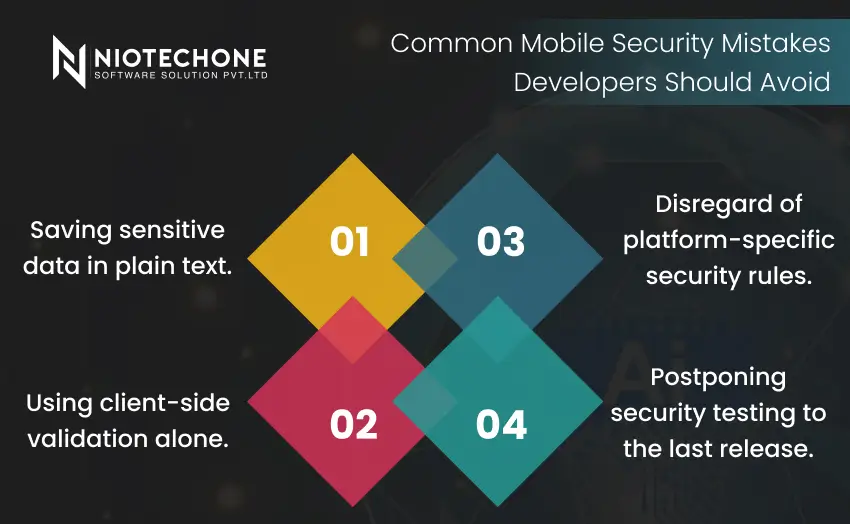
Common Mobile Security Mistakes Developers Should Avoid
Even the latest systems, such as React Native and .NET MAUI, are not able to guard against bad implementation decisions. Most security problems occur due to the neglect of basic best practices in the rush of development cycles.
Developers tend to concentrate on functionality and performance without realizing that they have left security holes. In the long run, such gaps may put user data, APIs, or even backend systems at risk.
The following are some of the common errors that must be avoided:
- Saving sensitive data in plain text.
- Using client-side validation alone.
- Disregard of platform-specific security rules.
- Postponing security testing to the last release.
By solving these problems at the outset, development teams can mitigate risk in the long term and create mobile applications that users can rely on.
Conclusion
Mobile app security is not a luxury anymore; it is a business requirement. Both React Native and .NET MAUI are powerful platforms to develop modern mobile applications, and their security is dependent on their implementation.
Through best practices and collaboration with an established software development company in India, companies can develop secure, scalable, and future-proof mobile applications.
Categories
Related Articles

Frequently Asked Questions FAQs
Yes, React Native can be safe when secure APIs, encryption, and appropriate authentication are observed.
When built with Microsoft-approved security standards, NET MAUI provides enterprise-level security.
The most prevalent risks are insecure data storage, weak authentication, and unprotected APIs.
Indian development companies provide skilled resources, cost effectiveness and experience in secure application development.
Yes, custom mobile applications enable custom security controls and enhanced protection of sensitive data.


