In the modern digital age, businesses are abandoning legacy, standalone hoteling or loosely coupled applications, and moving to be hyper-connected smart ecosystems, in which digital products, AI-enabled services, APIs, and devices integrate to provide a seamless experience. Hyper-connected systems enable communication in real-time, help to automate decisions, and can begin to coherently orchestrate processes across the business landscape.
Modern, foundational technologies such as AI-Powered API Ecosystems, Neuro-Symbolic AI-based Systems, Composable Commerce, Cloud-Edge Fusion, and Autonomous Business Systems, serve as the forefront and, or, back-bone of the hyper-connected smart ecosystem. Together, they will allow businesses to operate faster, smarter, and with greater flexibility than ever before.
Hyper- Connected Smart Ecosystems is an environment of digital integration, in which applications, IOT devices, APIs, data systems, and AI layers interconnect (continually) instead of working in isolation / in silos and become singular digital networks.
Hyper- Connected Smart Ecosystems will convert workflows that are static to dynamic and self-optimizing networks of connected services. For example, data will move from the cloud and to the edge autonomously; AI engine(s) can instantly ascertain patterns to analyze and enact conditions; systems will change and modernize to user behavior in real time with Adaptive UX layers moving forward; and changes will be dictated by an invisible but orchestrated algorithm.
As businesses grow, the complexity of managing systems and connecting jobs increases (which means more fragmented). Hyper-connectivity diminishes fragmentation and creates a unified experience.
Key Benefits:
APIs are a foundational component to any interconnected system—they depend on AI-powered technology to supersize their function.
AI-Powered API Ecosystems analyze traffic patterns, comprehend data structures, automatically create mappings and even identify security threats. Instead of engineering dozens of these integrations, AI-powered APIs are self-learning and completely automate connectivity between apps.
What AI-powered APIs offer:
Encapsulating digital ecosystems to be more dependable and extensible.
A smart ecosystem is not only backend intelligence—the front-end needs to also adapt. Adaptive UX that utilizes AI, behavioral analytics, and contextual signals to automatically change interfaces, flows, and content.
How Adaptive UX improves hyper-connected systems:
The entire customer journey can feel seamless, intelligent, and effortless when combined with AI-enabled APIs and autonomous systems.
Hyper-connected digital ecosystems produce large amounts of data—much in an unstructured or semi-structured manner. Neuro-Symbolic AI Systems help businesses to navigate this complexity by integrating:
This combination allows organizations to produce more accurate and transparent outcomes from AI. In a connected ecosystem, these systems can provide:
Neuro-symbolic AI essentially becomes the “brain” that helps the whole ecosystem logically think and intelligently act.
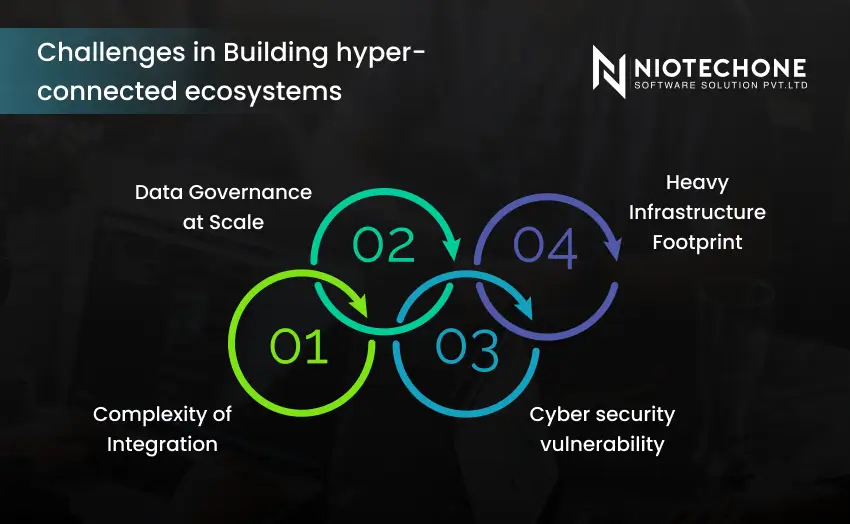
Delivering a hyper-connected smart ecosystem is a powerful proposition, yet it presents many practical challenges. Integrating cloud services, IoT devices, APIs, AI-driven engines, and Enterprise Systems into an architecture creates complexity. Below is an overview of the critical challenges organizations are facing today.
1. Complexity of Integration
Integrating diverse systems, spanning from legacy ERP platforms to the most modern mobile applications, introduces architectural complexity, as each system leverages different workflows, formats, and communication protocols.
2. Data Governance at Scale
In a hyper-connected ecosystem, data is shared across multiple environments, such as a cloud, edge, or on-premise system.
3. Cyber security vulnerability
Every new connection is an entry point to compromise; without strong encapsulation, increase risk to cybersecurity.
4. Heavy Infrastructure Footprint
Hyper-connected systems require the fastest, most scalable, and dependable infrastructure available.
The second wave of hyper-connectivity will be concerned with:
Those businesses that adopt these innovations early will have enormous competitive advantages in terms of speed, scalability, and customer satisfaction.
Smart ecosystems are hyper-connected and rapidly becoming the basis of modern digital business. Enterprises can achieve new automation, intelligence and scale by integrating applications, APIs, devices, cloud platforms, and AI engines into a single network. These ecosystems make it possible to make decisions in real-time, flow data seamlessly, and innovate more quickly, to help businesses create more responsive, personalized, and future-ready experiences.
Although issues such as complexity of integration, data governance, and security risks still persist, the current developments in AI-driven APIs, cloud-edge fusion, modular architectures, and autonomous orchestration tools are making the process easier than ever. The early adoption of these technologies provides companies with a high competitive edge particularly in industries where speed and connectivity are the most important factors.
A hyper-connected smart ecosystem is a system in which devices, applications, cloud services, APIs, and AI systems interact in real time. It enables companies to automate operations, enhance teamwork, and provide smooth digital experiences on all platforms.
They assist organizations to respond more quickly, process data in real-time, and automate complicated processes. This results in improved customer experiences, increased productivity and improved operations within departments and systems.
AI-based APIs are used to automate integrations, streamline data flow, and make systems smarter. They are able to automatically identify patterns, correct data inconsistencies, improve security, and facilitate seamless interaction between cloud, mobile, IoT, and enterprise environments.
They are safe when constructed using the current security measures like API gateways, encrypted data transmission, zero-trust architecture, and AI-based threat detection. Because each connection is a source of risk, it is necessary to monitor it constantly.
Edge computing processes data nearer to the source, such as sensors or devices, and reduces latency and enhances performance. This facilitates real-time decision-making in logistics, manufacturing, smart cities and travel-tech platforms.
3rd Floor, Aval Complex, University Road, above Balaji Super Market, Panchayat Nagar Chowk, Indira Circle, Rajkot, Gujarat 360005.
Abbotsford, BC
15th B Street 103, al Otaiba Dubai DU 00000, United Arab Emirates
3rd Floor, Aval Complex, University Road, above Balaji Super Market, Panchayat Nagar Chowk, Indira Circle, Rajkot, Gujarat 360005.
Abbotsford, BC.
15th B Street 103, al Otaiba Dubai DU 00000, United Arab Emirates.
Copyright © 2026 Niotechone Software Solution Pvt. Ltd. All Rights Reserved.