How to Stop Scope Creep in Software Project Management

Introduction

Software projects rarely fail because of poor coding. More often, they fail due to unclear requirements, uncontrolled changes, and poor planning. One of the most common reasons behind these failures is scope creep.

Scope creep occurs when new features, requirements, or changes are added to a project without adjusting the timeline, budget, or resources. What begins as a small modification can quickly grow into a major disruption.

For companies undertaking custom software development, knowing how to prevent scope creep is essential to ensuring successful software project delivery on time, on budget, and on target.

Scope creep in software project management showing expanding requirements and project complexity

What Is Scope Creep in Software Project Management?

Which occurs when a project’s scope keeps changing without adjusting its allocated time and budget, AI can detect scope creep.

This implies that the project begins as one thing but ends up being something much bigger than what was originally intended.

Example of the Scope Creep

For example, a company contracts a development team for the following:

  • Customer portal development
  • Login authentication system
  • Dashboard analytics

However, halfway through the development process, the company requests the following:

  • Mobile app integration
  • Advanced reporting system
  • Multi-language support
  • Third-party API integration

Without any changes to the budget and timeline, the project becomes unstable. This is scope creep.

In formal software project management, change is expected, but uncontrolled change is dangerous.

Why Scope Creep Occurs

Scope creep is not something that happens in one day. It tends to happen because of flaws in project planning and communication.

1. Inadequate Requirement Gathering

When the discovery phase is done in a hurry, the requirements can be fuzzy or not fully defined. When this is realized later, new requirements are added.

2. Inadequate Documentation of Scope

When there is inadequate documentation of the scope on the following:

  • Features
  • Deliverables
  • Milestones
  • Exclusions
  • It becomes hard to manage changes.

3. Inadequate Change Management Process

When there is no structured change management process in place, small changes are casually approved without analysis.

4. Misalignment of Stakeholders

Stakeholders have different expectations. When there is no early alignment of stakeholders, new requirements emerge later.

5. Misinterpretation of Agile

Agile is flexible, but some teams misinterpret it as “unlimited changes are allowed.” Agile needs discipline, sprint planning, and prioritization of the product backlog, not chaos.

The Real Impact of Scope Creep

Let’s take a closer look at the real effects. Organizations often underestimate the effects of scope creep.

1. Budget Overruns

Each new feature means development time, testing, and deployment. Without budget changes, profit margins decrease.

2. Missed Deadlines

New features mean longer project timelines. Missed deadlines can lead to:

  • Lost market share
  • Decreased competitive edge
  • Angry investors

3. Developer Burnout

It leads to decreased productivity and morale when developers are asked to accomplish more without adequate planning.

4. Increased Technical Debt

Features added in a hurry often affect code quality. These leads are unstable systems that are costly to maintain.

5. Client Dissatisfaction

The best way to “please” clients is often the worst strategy.

Effective software project management helps maintain a balance between flexibility and control.

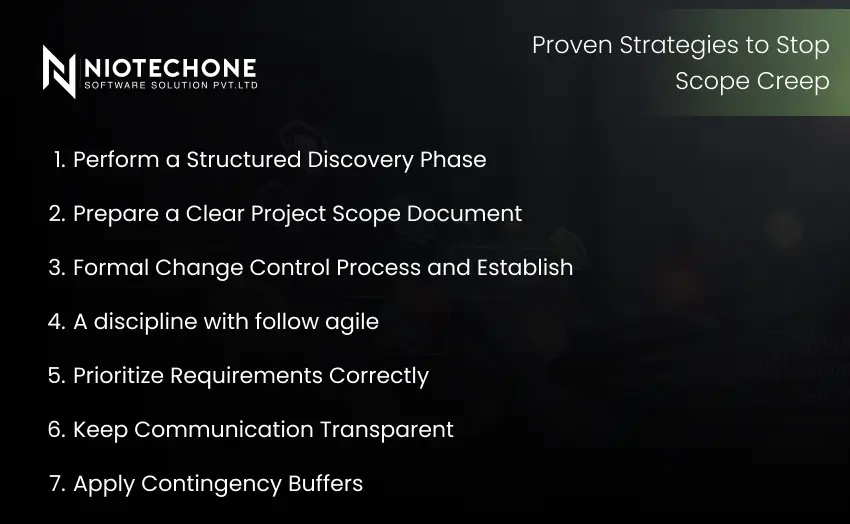
Strategies to prevent scope creep including clear documentation, change control, and agile discipline

Proven Strategies to Stop Scope Creep

Here are the proven strategies that are used in professional project environments.

1. Perform a Structured Discovery Phase

The discovery phase is the backbone of every successful software development project.

This involves:

  • Business requirement analysis
  • Technical feasibility analysis
  • User journey analysis
  • Risk analysis
  • Cost analysis

Spending time up front avoids confusion down the line.

At Niotechone Software Solution Pvt. Ltd., the structured discovery process avoids confusion during development.

2. Prepare a Clear Project Scope Document

A clear scope document should contain:

  • Project goals
  • Feature list
  • Functional requirements
  • Non-functional requirements
  • Timeline
  • Budget
  • What is NOT included

A clear scope document avoids confusion.

3. Formal Change Control Process and Establish

Changes are unavoidable. However, they should follow a formal process.

A formal change control process involves:

  • Submission of written change requests
  • (Risk, time, cost) analysis impact
  • Client approval
  • Timeline & budget adjustments
  • Documentation updates

This makes the process transparent and accountable.

4. A discipline with follow agile

Agile development methodology is an effective way to handle changing requirements. However, it should be followed with discipline.

Best practices for agile development include:

  • Sprint cycles
  • Prioritized product backlog
  • Sprint planning meetings
  • Sprint reviews
  • Retrospectives

Agile development does not mean flexibility. It means controlled flexibility.

5. Prioritize Requirements Correctly

Not all requirements have the same priority.

Applying prioritization techniques such as:

  • Business value scoring
  • ROI-based prioritization

Can help avoid unnecessary additions.

6. Keep Communication Transparent

Open communication with clients avoids surprise requests.

Best practices include:

  • Weekly status updates
  • Milestone reviews
  • Transparent documentation sharing
  • Visual progress tracking


7. Apply Contingency Buffers

Contingency planning is part of professional software project management.

Add:

  • (10-20%) buffer time
  • A contingency budget 
  • Risk mitigation planning

This helps avoid project instability while allowing flexibility.

The Role of Software Project Management in Preventing Scope Creep

Good project management in software development is a control process.

It provides:

  • Alignment of business with technology
  • Risk management
  • Cost management
  • Time management
  • Quality management

Without proper management, even the best programmers cannot produce reliable outcomes.

How Niotechone Software Solution Pvt. Ltd. Manages Scope in Software Development Projects

For organizations that invest in custom software development, selecting the right software development partner is essential.

At Niotechone Software Solution Pvt. Ltd., managing scope is a part of the software development process.

1. Requirement Engineering Process

Each project involves thorough requirement analysis to avoid confusion.

2. Detailed Documentation Standards

There is no scope for confusion in documentation, and thus, assumption-based development is avoided.

3. Delivery-based milestone

The project is broken down into smaller chunks with approval milestones.

4. Agile Sprint Governance

Each sprint involves:

  • Scope definition
  • Deliverables with fixed timelines
  • Backlog management


5. Risk Monitoring Framework

Ongoing risk monitoring prevents uncontrolled scope growth.

6. Client Collaboration

Clients are provided with proper updates and impact analysis for every change request.

This helps in:

  • On-time delivery
  • Budget control
  • Scalable design
  • Maintainability

Best Tools for Effective Scope Management

Modern software project management employs tools to improve visibility and control.

Some popular tools are:

  • Jira (Agile management)
  • Trello (Task management)
  • Asana (Workflow management)
  • Microsoft Project (Timeline management)

Warning Signs Your Project Is Suffering from Scope Creep

Beware of the following warning signs:

  • Ongoing addition of new features
  • Extended deadlines
  • Unplanned rising costs
  • Developer frustration
  • Failure to update documentation

What is the Difference? between Scope Creep vs Scope Change

Feature

Scope Creep 

Scope Change

Definition

Unofficial, incremental, and unapproved growth of project requirements.

Formal, approved modification to the project scope, budget, or timeline.

Control Process

None. Occurs without proper authorization.

Strict. Follows a change control procedure.

Approval

Informal or verbal requests

Formal sign-off by project owner.

Documentation

Rarely documented.

Fully documented.

Budget/Timeline

Impacts the budget and schedule negatively without adding funding.

Adjustments to the budget and schedule are agreed upon.

Impact

Almost always negative 

Can be positive, allowing adaptation to new needs.

Example

Adding a small extra feature to a website.

A client requests to add a login page, resulting in a signed change order for extra budget.

Conclusion

Scope creep increases the cost and duration of the project. With effective software, it is possible to manage project management scope creep.

When you partner with a software development company and a .NET development company, your project will be completed as anticipated in terms of scheduling, budgeting, and meeting your development goals. You need to take charge of your software development projects, so there are no surprises.

Frequently Asked Questions FAQs

Scope creep refers to the uncontrolled expansion of a project's outputs, e.g., the inclusion of additional features, beyond what was initially agreed upon or expected, without updating the time/budget/resources.

Scope creep occurs for many reasons; for example, unclear requirements (what exactly has to be accomplished), poor change control, misaligned stakeholders, or misuse of Agile methodologies.

By having clear documentation as to what will be included in the scope of a project, a formal change control process, following Agile methodologies, and communicating openly with everyone involved in the project.

You can use Agile to help control changes as they occur during the life of a project; however, there needs to be discipline in how you control those changes. If they are uncontrolled at all, then you can still create scope creep.

The main purpose of project management is to ensure all projects deliver the final product on schedule, within the agreed budget, and align with an organization's related business objectives.