How to Reduce Cloud Waste Without Impacting Performance

Introduction

Cloud computing has revolutionized the contemporary business. It allows scalability, integration of AI, global access, and quicker product launches. However, in 2026, there is one problem that will silently consume enterprise budgets: cloud waste.

Most organizations that have moved to cloud application development projects find that their monthly Azure bills continue to increase even when performance is not enhanced. The issue is not often the cloud itself. The actual problem is ineffective architecture, ineffective monitoring, and uncontrolled scaling.

In the case of businesses that engage a .NET development company or a strategic custom software development company, a mix of architecture discipline, DevOps automation, and financial governance is necessary to reduce cloud waste without affecting performance.

Why Cloud Waste is an emerging business issue in 2026

Based on industry trends, enterprises squander 20-35 percent of their cloud budgets because of:

  • Oversized virtual machines
  • Idle resources
  • Unoptimized databases
  • Poor API efficiency
  • Lack of cost monitoring
  • Inefficient scaling rules

Unmanaged cloud infrastructure is a financial risk as AI in software development consumes more compute, and multi-tenant SaaS platforms expand.

Waste reduction does not imply performance reduction. It is an intelligent optimization of architecture.

Cloud waste in modern applications with unused cloud servers and resources.

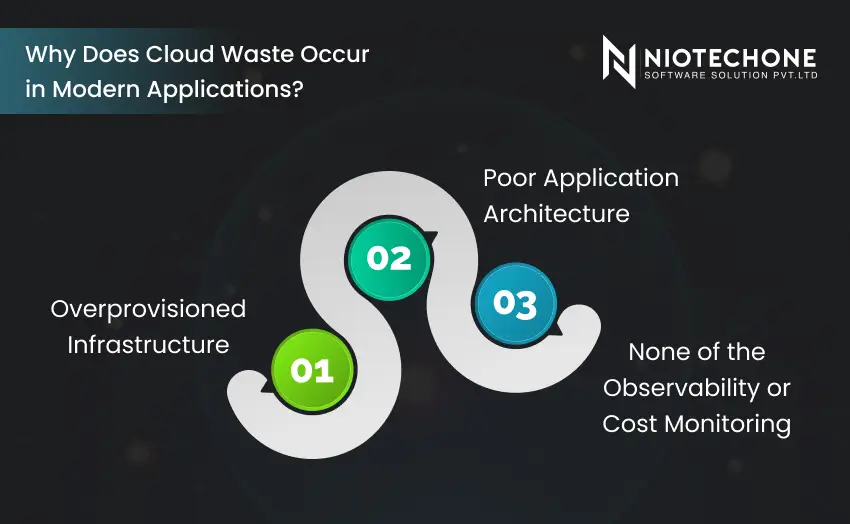
Why Does Cloud Waste Occur in Modern Applications?

Decision-makers need to know the underlying causes of the problem before resolving it.

1. Overprovisioned Infrastructure

Most teams spin up big VM instances on demand. This leads to:

  • Low CPU utilization
  • Underused memory
  • Unutilized capacity

An ASP.NET Core development company is a professional company that develops systems according to actual usage patterns and not assumptions.

2. Poor Application Architecture

The poorly optimized ASP.NET Core application architecture may contain:

  • Heavy database queries
  • Large API payloads
  • Blocking operations that are synchronized.
  • Lack of caching

In case of inefficient applications, the cloud resources make up raising cost.

3. None of the Observability or Cost Monitoring

In the absence of systematic surveillance:

  • Idle environments run 24/7
  • Test cases are still alive
  • Scaling policies misfire
  • Storage grows unchecked


An established software development company incorporates monitoring at the outset.

Strategies to minimize cloud waste while maintaining system performance

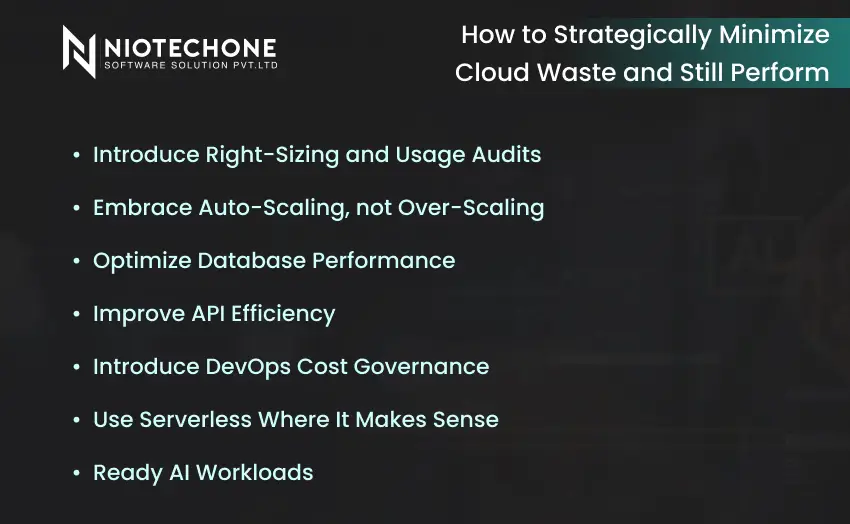
How to Strategically Minimize Cloud Waste and Still Perform

1. Introduce Right-Sizing and Usage Audits

Analyze:

  • CPU utilization
  • Memory usage
  • Storage growth
  • Traffic patterns
  • Peak usage times

Right-sizing makes sure that you pay only what you consume.

In the case of enterprise SaaS applications developed on .NET application development, overhead is greatly minimized by usage-based scaling.

2. Embrace Auto-Scaling, not Over-Scaling

Rather than provisioning large instances permanently:

  • Use horizontal scaling
  • Define traffic-based rules
  • Allow scale-in when not in use.
  • Individual production and staging areas.

A correct Azure cloud architecture will enable automated scaling and uptime.

3. Optimize Database Performance

One of the largest hidden cost drivers is database inefficiencies.

Common Issues:

  • Missing indexes
  • Unoptimized queries
  • Big raw data responses
  • No query caching

Database optimization methods are:

  • Index tuning
  • Partitioning
  • Read replicas
  • Connection pooling
  • Caching layers

When properly managed by a professional custom .NET development services provider, performance is enhanced, and resource consumption is reduced.

4. Improve API Efficiency

Cloud consumption is driven by APIs.

Poor API design leads to:

  • Excessive data transfer
  • Duplicate calls
  • Inefficient endpoints

Optimized APIs must contain:

  • Pagination
  • Compression
  • Response filtering
  • Version control
  • Caching mechanisms

A well-organized ASP.NET Core development company is concerned with reducing the amount of compute and bandwidth without compromising responsiveness.

5. Introduce DevOps Cost Governance

The DevOps strategy should include cloud cost management.

Key practices include:

  • Budget alerts
  • Automated shutdowns of the environment
  • Infrastructure as Code
  • Reserved instance planning
  • Cost anomaly detection

6. Use Serverless Where It Makes Sense

Serverless computing will assist in minimizing idle infrastructure in 2026.

Serverless advantages:

  • Pay-per-execution model
  • No idle resource billing
  • Automatic scaling
  • Reduced maintenance

Serverless minimizes operational waste in event-driven workloads or background jobs.

7. Ready AI Workloads

AI in software development raises compute demand.

To prevent runaway costs:

  • Isolate AI workloads
  • Use scalable container services
  • Schedule batch processing
  • Optimize data pipelines

Cloud Waste vs. Cloud Optimization: A Comparison

Wasteful Practice

Optimized Approach

Always-on large VMs

Auto-scaled instances

Manual deployments

CI/CD pipelines

Heavy API responses

Filtered & paginated responses

No cost monitoring

Real-time cost dashboards

Monolithic architecture

Modular microservices

Database full-table scans

Indexed and optimized queries

No caching

Distributed caching strategy

The difference lies in architectural maturity.

Real-World Case Study: 32% Azure Costs Reduction

Situation

An expanding SaaS company saw a 60 percent growth in Azure billing in 8 months. There was no change in performance.

Root Causes

  • Oversized VMs
  • Inefficient APIs
  • No auto-scaling
  • Poor database indexing
  • Idle test environments

Solution

The organization collaborates with a strategic .NET development company:

  • Reorganized ASP.NET Core application structure.
  • Auto-scaling rules in place.
  • Optimized API responses.
  • Added Redis caching.
  • Establish automatic shutdown times.
  • Implemented cost monitoring dashboards.

Results

  • Monthly cloud spend decreased by 32%.
  • Improved API response time.
  • 99.9% uptime maintained.
  • Improved performance under traffic peaks.

This proves that cost optimization and performance improvement can co-exist.

Enterprise leaders must be ready to:

  • Cloud cost analytics powered by AI.
  • SaaS billing models based on usage.
  • Resource distribution of edge computing.
  • Multi-cloud strategies
  • Automated FinOps tools
  • Planning of carbon-efficient infrastructure.

An innovative custom software development company integrates technical architecture and financial governance.

Conclusion: Intelligent Architecture, Reduced Cloud Costs

Cloud waste is not a cloud issue. It is a governance and architecture issue. By 2026, businesses will need to integrate performance engineering, DevOps automation, AI-ready infrastructure, and cost monitoring to realize sustainable cloud growth.

Through investment in optimized ASP.NET Core application architecture, disciplined application development in .NET, and structured Azure cloud architecture, businesses can save unnecessary expenditure without compromising performance.

Collaborating with an established .NET development company or an enterprise-oriented ASP.NET Core development company will make sure that your cloud environment is efficient, scalable, and future-proof.

Frequently Asked Questions FAQs

Cloud waste is the cost of unused or underutilized cloud resources, including idle servers or oversized instances.

Not if done correctly. Optimization enhances performance and minimizes redundant infrastructure.

ASP.NET Core supports high-performance APIs, efficient middleware, and modular architecture, which minimizes compute consumption.

Azure offers auto-scaling, monitoring, cost alerts, and serverless services to manage expenditure.

AI may raise expenses when mismanaged. Formal architecture and workload separation avoid unnecessary compute expenditure.