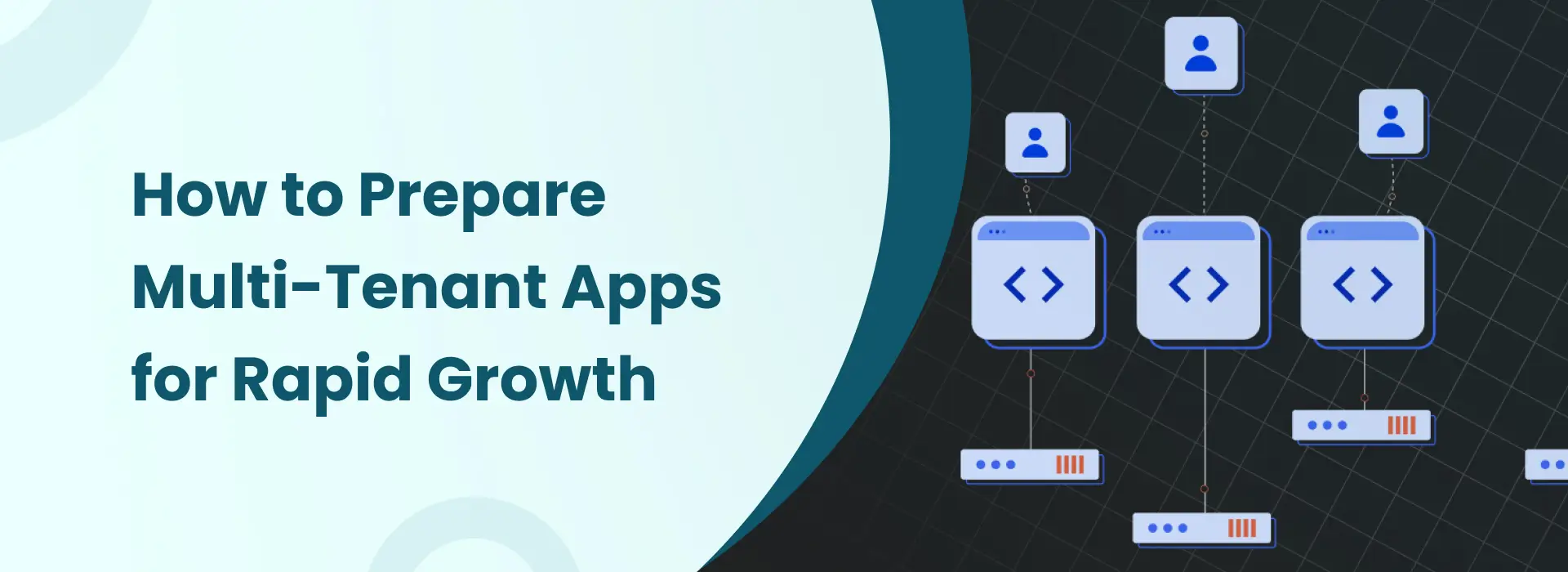
How to Prepare Multi-Tenant Apps for Rapid Growth
- Niotechone Marketing Team
Table of Contents
- Introduction
- What Is a Multi-Tenant Application?
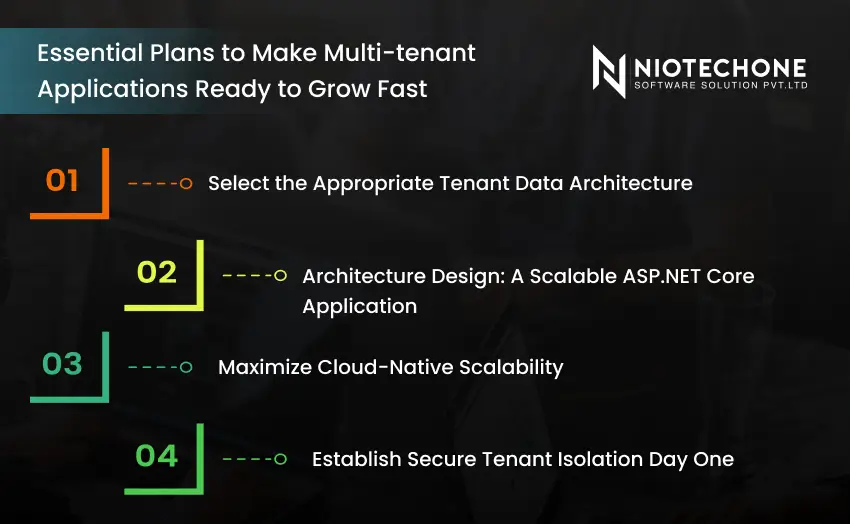
- 1. Select the Appropriate Tenant Data Architecture
- 2. Architecture Design: A Scalable ASP.NET Core Application
- 3. Maximize Cloud-Native Scalability
- 4. Establish Secure Tenant Isolation Day One
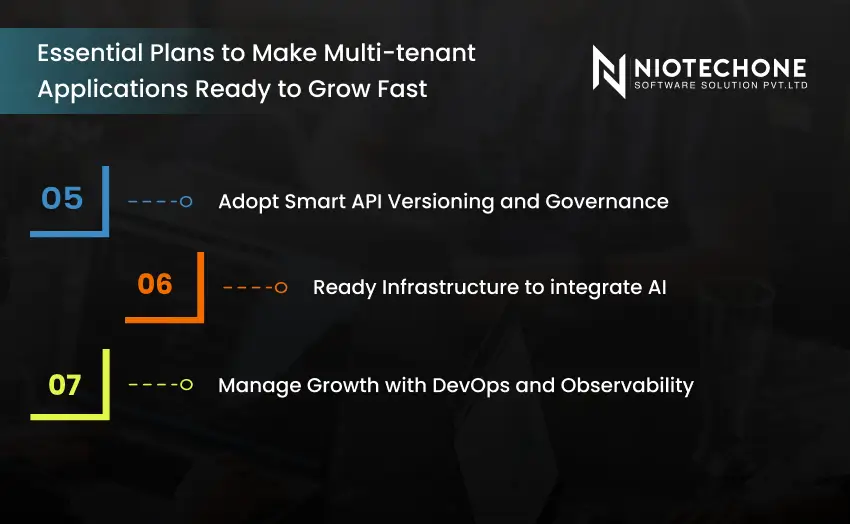
- 5. Adopt Smart API Versioning and Governance
- 6. Ready Infrastructure to integrate AI
- 7. Manage Growth with DevOps and Observability
- Multi-Tenant Growth Readiness Checklist
- Real-World Use Case: Scaling a Multi-Tenant HR Platform
- Trends in 2026 that will affect Multi-Tenant Architecture
- Conclusion
Introduction
Multi-tenant applications are driving the modern SaaS economy. In 2026, businesses are creating shared infrastructure to serve many customers from a single application environment, whether it is FinTech dashboards and healthcare platforms or enterprise ERP systems.
Most startups and businesses roll out multi-tenant systems without scaling. As customer growth accelerates, performance declines, security threats escalate, and infrastructure costs spiral out of control.
When you are dealing with a .NET development company, you need to make sure that you are ready to scale your multi-tenant platform to a high level at the very beginning of your architecture.
What Is a Multi-Tenant Application?
A multi-tenant application is a software architecture design in which one instance of an application is shared among many customers, with their data being isolated. Businesses share infrastructure with logical separation instead of installing individual software on each client. This will lower the cost of operation, ease the maintenance process, and enhance scalability, which will be the backbone of the modern SaaS platforms in 2026.
The main features of a multi-tenant application:
- A single application example with multiple customers.
- Isolation of logical data between tenants.
- Maintenance and updates are centralized.
- Elastic cloud-based infrastructure.
- Economical use of resources.
- Tenant-specific settings and personalization.
Multi-tenant systems are highly scalable, secure, and growth-ready when properly designed with a structured architecture, such as ASP.NET Core and cloud-first deployment strategies.
Essential Plans to Make Multi-tenant Applications Ready to Grow Fast
1. Select the Appropriate Tenant Data Architecture
Your data isolation model determines scalability and security.
Common Multi-Tenant Data Models
Model | Description | Pros | Cons |
Shared Database, Shared Schema | All tenants share the same tables | Cost-efficient | Limited isolation |
Shared Database, Separate Schema | Schema per tenant | Better isolation | Higher complexity |
Separate Database per Tenant | Independent DB for each tenant | Maximum isolation | Higher infrastructure cost |
For enterprise SaaS platforms, many modern .NET development services providers prefer hybrid models for flexibility.
A skilled ASP.NET Core API development company will assist you in choosing the appropriate architecture depending on the anticipated growth.
2. Architecture Design: A Scalable ASP.NET Core Application
A clean architecture is the beginning of multi-tenant scalability.
The ASP.NET Core application architecture in the modern world must consist of:
- Service-layer separation
- Tenant-aware middleware
- Centralized authentication
- Modular API endpoints
- Dependency injection
Do not use hardcoded tenant logic. Rather, apply dynamic tenant resolution with middleware pipelines.
This will make your Scalable software application maintainable as tenants increase to 10,000.
3. Maximize Cloud-Native Scalability
The fast development requires a flexible infrastructure.
Formalized cloud application development guarantees:
- Auto-scaling computer resources.
- Load balancing
- Fault tolerance
- Distributed caching
- Disaster recovery planning
When implemented on Azure cloud architecture, you will have:
- Azure App Services scaling
- Azure SQL performance tiers
- Azure Kubernetes Service (AKS)
- Managed identity security
Nevertheless, unoptimized cloud scalability is more expensive. It is essential to monitor and use analytics.
4. Establish Secure Tenant Isolation Day One
Trust is ruined immediately when security failures in multi-tenant apps occur.
The major security practices are:
- Role-based access control
- Tenant-based data filtering
- OAuth/JWT authentication (API)
- Row-level database security
- Data encryption
A skilled ASP.NET developer in Rajkot or an enterprise team will make sure that both application and database levels of data isolation are implemented.
Security should be proportional to the number of users.
5. Adopt Smart API Versioning and Governance
The number of feature requests increases with the size of tenants. In the absence of API versioning, new integrations are broken by updates.
An ASP.NET Core API development company ought to apply:
- Version-controlled endpoints
- Backward compatibility
- API gateway management
- Request throttling
This avoids instability in product evolution.
6. Ready Infrastructure to integrate AI
AI in software development is not an option in 2026.
Multi-tenant platforms are becoming more and more integrated:
- Predictive analytics
- Intelligent dashboards
- Automated reporting
- Personalized recommendations
To support AI modules:
- Always structure APIs
- Maintain clean data models
- Assure high-performance queries
- Do not have tightly coupled services
AI-ready architecture adds value to the platform without affecting stability.
7. Manage Growth with DevOps and Observability
The quick growth requires discipline.
An established software development company will adopt:
- CI/CD pipelines
- Automated testing
- Blue-green deployments
- Real-time monitoring
- Log aggregation
Observability tools enable you to identify:
- Issues related to the performance of tenants.
- Query inefficiencies
- Resource overuse
- API latency
Monitoring-less scaling is gambling.
Multi-Tenant Growth Readiness Checklist
Here is a quick executive summary:
Area | Growth Risk | Prepared Solution |
Database | Bottlenecks | Schema optimization & scaling |
APIs | Breaking changes | Version-controlled endpoints |
Infrastructure | Downtime | Auto-scaling Azure setup |
Security | Data leaks | Tenant-based isolation |
Deployment | Manual errors | CI/CD pipelines |
AI Readiness | Integration failure | Clean modular architecture |
If multiple risks apply to your system, architectural modernization should be a priority.
Real-World Use Case: Scaling a Multi-Tenant HR Platform
Business Scenario
One of the fastest-growing HR SaaS companies has 200 enterprise clients in a year.
Their primitive architecture employed:
- Shared database schema
- Minimal API optimization
- Manual scaling
Growth Challenges
- Database locking issues
- Reduced reporting performance.
- Rising Azure costs
- Integration failures
Structured Solution
The system was redesigned in collaboration with a specialized .NET development company in Rajkot.
- Separate schema per tenant
- Optimized indexing strategy.
- Design of APIs using microservices.
- Azure auto-scaling rules
- CI/CD automation
Results
- 3x performance improvement
- 35% cloud cost optimization
- Improved uptime
- Easy integration of new enterprise customers.
This change shows that the decisions made in architecture are more important than the size of the infrastructure.
Trends in 2026 that will affect Multi-Tenant Architecture
Enterprise leaders need to adjust to:
- Composable SaaS platforms
- AI-driven personalization
- Zero-trust security models
- Adoption of serverless architecture.
- Edge computing integration
- Usage-based pricing models
An innovative custom software development company will match the trends in architecture and ensure the reliability of the system.
Conclusion
The introduction of a multi-tenant application is not the end. To maintain a high growth rate, strategic architecture, secure data isolation, optimized APIs, and structured cloud deployment are needed.
Having the appropriate ASP.NET Core development company, organized custom .NET development services, and a safe Azure cloud architecture, your multi-tenant platform can expand without any doubt of stability.
When your organization is about to grow fast, you can be sure that your system is not only ready to meet the current demand, but also the future growth by collaborating with a seasoned custom software developer in Rajkot.
Categories
Related Articles

Frequently Asked Questions FAQs
The most common growth blockers are database performance bottlenecks and inappropriate tenant isolation.
Azure offers elastic scaling, managed databases, identity services, and DevOps tools that can accommodate quick tenant expansion.
AI adds to data and processing requirements. Performance problems may occur without optimized APIs and architecture.
It is based on your business model. Separate databases are usually beneficial to enterprises that need high data isolation.
Yes, Unproductive queries, high API calls, and inefficient scaling policies are major contributors to the high costs of Azure hosting.