

How to Plan a Successful Software Development Roadmap
- Niotechone Marketing Team
Table of Contents
- Introduction
- What Is a Software Development Roadmap?
- The importance of a Software Development Roadmap
- Step 1: Establish Clear Business Objectives
- Step 2: Requirement Gathering and Requirement Validation
- Step 3: Choose the appropriate technology stack
- Step 4: Organize the Roadmap into Phases
- Step 5: What is the most important thing?
- Step 6: Develop a Realistic Timeline
- Step 7: Resource and Responsibility Planning
- Step 8: Add Cloud and Scalability Strategy
- Step 9: Track Progress and Adapt
- Conclusion
Introduction
To create scalable and high-quality digital products, it is necessary to plan a successful software development roadmap. A roadmap is a strategic map that links business goals to technical implementation, so that all development activities are geared towards long-term growth.
Companies that invest in the development of custom software usually collaborate with a software development company in Rajkot or a .NET development company in Rajkot to develop structured and future-oriented solutions. Regardless of whether the project is ASP.NET Core development in Rajkot, cloud platforms, or enterprise systems, a clear roadmap can assist teams to prevent delays, budget overruns, and misaligned priorities.
What Is a Software Development Roadmap?
A software development roadmap is a high-level planning document that describes the way a product will develop. It does not enumerate all the tasks but concentrates on goals, milestones, priorities, and timelines.
A roadmap is flexible, unlike a rigid project plan. It changes with the changing business requirements, technology, and user expectations. This strategy is particularly useful with bespoke enterprise mobility software and cloud-based systems.
A clear roadmap keeps teams on track and provides stakeholders with an overview of progress and direction.

The importance of a Software Development Roadmap
Teams tend to be reactive without a roadmap. This results in wastage of effort, duplication of work, and missed deadlines. A roadmap provides order and clarity to complicated development initiatives.
It helps organizations:
- Align business strategy with software goals.
- Budget and plan resources.
- Reduce development risks
- Enhance cross-team cooperation.
In the case of companies that embrace the use of Azure cloud application development, roadmap planning will make sure that scalability and performance are factored in the initial stages.
Step 1: Establish Clear Business Objectives
Any winning roadmap begins with business goal clarity. Software cannot exist in a vacuum; it must be able to support quantifiable results.
Start by identifying:
- The business issue that the software addresses.
- The target audience and their requirements.
- Efficiency, revenue, or customer satisfaction are key success metrics.
In the case of businesses collaborating with a software development company in Rajkot, this measure will make sure that technical decisions are made in line with commercial interests.
Step 2: Requirement Gathering and Requirement Validation
After having goals, the next thing is to know what the software should do. This stage entails the cooperation of business stakeholders and technical teams.
Rather than listing all the features in detail, concentrate on:
- Core functionality
- Security expectations and performance.
- Integration requirements with existing systems.
This method makes the roadmap realistic and flexible in the development process, which is critical in custom software development projects.
Step 3: Choose the appropriate technology stack
The choice of technology plays a major role in the success of the roadmap. The stack selected must be scalable, secure, and upgradeable.
ASP.NET Core development is favored by many enterprises in Rajkot because of its performance, security, and enterprise readiness. It can be used together with Azure cloud application development to provide highly scalable and reliable solutions.
The most important considerations when selecting technology
Factor | Why It Matters |
Scalability | Supports future growth |
Security | Protects sensitive business data |
Performance | Ensures fast user experience |
Cloud readiness | Enables flexible deployments |
Maintainability | Reduces long-term costs |
Step 4: Organize the Roadmap into Phases
A roadmap must be divided into rational stages, and implementation becomes easy and clear.
The majority of effective roadmaps contain:
- Planning and discovery
- MVP or initial release
- Core feature development
- Testing and optimization
- Deployment and scaling
This incremental method is effective in the case of tailor-made enterprise mobility software solutions, where constant enhancement is central.
Step 5: What is the most important thing?
All features do not provide the same value. Good roadmaps rank features by business impact and feasibility.
Instead of enumerating dozens of features, concentrate on:
- Critical user problem-solving features.
- Product differentiating capabilities.
- Scalability-supporting improvements.
This approach guarantees quicker payback and avoids scope creep, particularly in long-term custom software development projects.
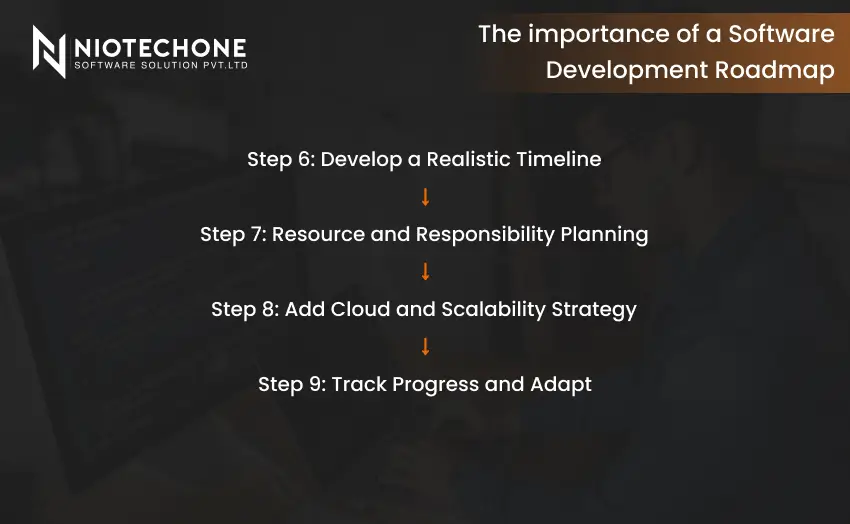
Step 6: Develop a Realistic Timeline
Execution should be guided by timelines, not coerce teams to unrealistic delivery.
A good roadmap is ambitious and realistic, taking into consideration development, testing, feedback, and revisions.
Example High-Level Timeline
Phase | Estimated Duration |
Discovery & Planning | 2–3 weeks |
MVP Development | 6–8 weeks |
Core Features | 8–12 weeks |
Testing & QA | 3–4 weeks |
Deployment | 1–2 weeks |
Skilled teams of a .NET development company in Rajkot usually have buffer time to deal with unforeseen difficulties.
Step 7: Resource and Responsibility Planning
Accountability and speed of delivery are enhanced by clear ownership. The roadmap must specify the roles of the person in charge of implementation, review, and decision-making.
This includes:
- Development teams
- QA and testing resources
- Infrastructure and cloud expenses.
- External vendors or tools
The development of ASP.NET Core in Rajkot projects is smoother when properly planned.
Step 8: Add Cloud and Scalability Strategy
The current software should be scalable at the beginning. Cloud planning is no longer a choice.
With the inclusion of the Azure cloud application development in the roadmap, businesses will benefit:
- On-demand scalability
- Better system reliability.
- Quick deployments and updates.
Cloud-ready roadmaps enable businesses to expand without significant re-architecture.
Step 9: Track Progress and Adapt
A roadmap is not a fixed document. Periodic reviews assist teams in adjusting to business priorities, technology, or user feedback.
Monitoring the progress with the help of sprint reviews, stakeholder meetings, and performance metrics will make the roadmap relevant and actionable.
Conclusion
An effective software development roadmap is a strategic resource that aligns vision, technology, and implementation. It assists companies to produce superior products, minimize risks, and grow with certainty.
A software development company in Rajkot or a .NET development company in Rajkot provides an organization with a competitive edge by investing in structured planning. Be it the development of custom software, ASP.NET Core development in Rajkot, or scalable development of Azure cloud applications, a well-thought-out roadmap is the key to success in the long term.
A roadmap, when properly implemented, can turn software development into a predictable, growth-oriented strategy rather than a reactive process.
Categories
Related Articles

Frequently Asked Questions FAQs
The majority of roadmaps span 6-12 months with quarterly reviews.
Yes, agile roadmaps are prioritized and result-oriented as opposed to predetermined deliverables.
Absolutely, Roadmaps enable startups to grow effectively and prevent expensive rework.
Every quarter or when significant business changes take place.
No. In fact, accelerates the execution by minimizing confusion and rework.


