The quality of software is no longer a technical checklist. It is a direct business differentiator in 2026.
Regardless of whether you are dealing with a .NET development company, an ASP.NET development company, or a custom software development company, the quality of your software has a direct impact on revenue, scalability, customer trust, and long-term growth.
Startup founders, CTOs, and enterprise decision-makers need to consider more than feature testing to assess the quality of software. It involves the assessment of architecture, performance, security, scalability, and long-term maintainability.
Software Quality is the degree to which a software product can satisfy the requirements and meet the expectations of the users. It makes the application reliable, efficient, secure, and easy to use.
Good software is one that does what it is supposed to do, is fast, and is stable in various circumstances. It must also be scalable, maintainable, and compatible with different devices or platforms.
Software quality can be achieved through best development practices, extensive testing, bug fixing, and constant improvement of the product through user feedback.
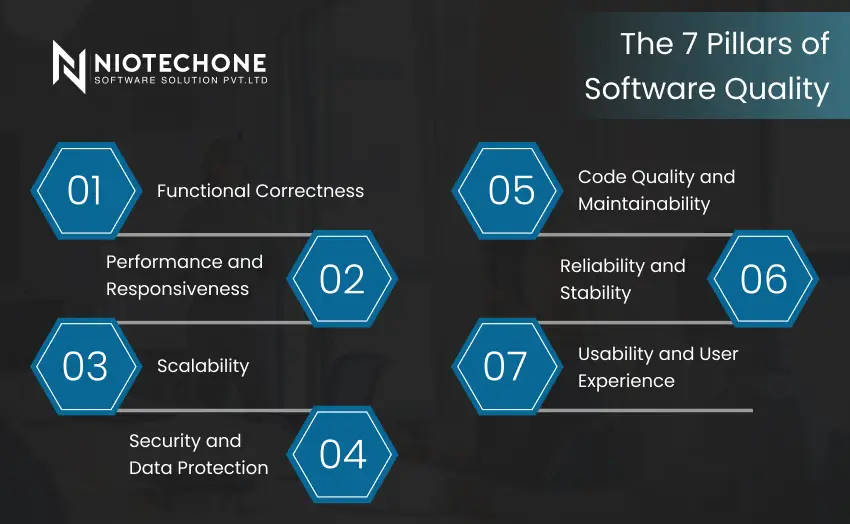
There is no single measure of high-quality software. It is the outcome of robust foundations in architecture, performance, security, and long-term maintainability. The seven pillars that business leaders and CTOs must consider when evaluating any software product are listed below.
Software should simply do what it was created to do. All workflows, calculations, integrations, and outputs must be business-oriented.
Functional quality refers to the system acting predictably when operating in normal and edge-case conditions. It must be able to handle invalid inputs and ensure data integrity is maintained.
Key evaluation points:
Other quality improvements are meaningless without functional correctness.
User experience and customer retention are directly influenced by performance. Any delay in API response time can decrease engagement and conversion rates.
High-performance systems are optimized at various levels, such as database queries, backend processing, and front-end rendering.
What to examine:
Measurement of performance should not be done just before launch.
Scalability defines the ability of software to expand with your business. A system that performs well with 500 users might not perform with 50,000 users unless scalability is designed into it.
Scalable software applications are built with distributed systems, stateless APIs, and cloud infrastructure.
Look for:
Scalability is not an upgrade; it is an architectural choice.
Security is no longer a choice. Data breaches in 2026 will ruin trust and lead to regulatory fines.
Quality software does not consider security as an afterthought but as part of its architecture.
Notable security indicators:
Security maturity is a measure of a general engineering discipline.
Software must evolve. Flexibility is required by new features, regulatory changes, and integration needs.
Maintainable systems are designed, documented, and simple to extend without compromising on the current functionality.
Evaluation areas:
Separation of concerns and clean architecture.
Low maintainability raises the cost of development in the long term and reduces innovation.
Reliability guarantees that the system is reliable in the long run without any sudden crashes or downtime.
Stable systems have adequate monitoring, logging, and recovery to deal with failures gracefully.
Key aspects:
Reliability creates customer trust and continuity.
Even technically powerful software may fail when users cannot navigate it.
Usability is concerned with intuitive workflows, clean design, and low friction in user interactions.
Quality indicators include:
Technical excellence is linked to business success through user experience.
Aspect | Low-Quality Software | High-Quality Software |
Architecture | Monolithic, rigid | Modular, scalable |
Performance | Slows under load | Handles growth smoothly |
Security | Basic validation | Multi-layer protection |
Cloud Strategy | Afterthought | Cloud-native design |
Code Structure | Spaghetti code | Clean architecture |
Maintenance | Expensive & slow | Predictable & manageable |
This difference directly affects business ROI.
A mid-size company had approached a software development company following performance problems.
Problems discovered:
Following re-architecture with ASP.NET Core application architecture and appropriate Azure cloud architecture, the findings were:
Quality testing showed underlying flaws- not superficial bugs.
1. AI-Driven Code Reviews
Vulnerabilities and performance problems are now automatically identified by AI tools.
2. Shift-Left Testing
Testing is not done after deployment, but during development.
3. Cloud Cost Optimization as a Quality Metric
Bad architecture raises cloud expenses.
4. API-First Architecture
Modern systems focus on API structure at the outset.
5. Observability Over Monitoring
Standard is real-time telemetry, distributed tracing, and proactive alerts.
Any custom software developer or any vendor worldwide is required to meet these standards by forward-thinking companies.
The quality of software is not a technical luxury. It is a business necessity. By 2026, businesses that consider architecture, scalability, security, cloud readiness, and AI integration will have a competitive edge. The ones that concentrate on delivering features only end up paying the price in performance problems and technical debt.
It is important to partner with the right software development company, whether you are developing a SaaS platform, enterprise solution, or scalable startup product. When you are looking to find a reliable custom software developer, then quality evaluation should be your first step, not your last.
Key indicators are scalability, performance stability, clean architecture, security compliance, automated testing coverage, and maintainability.
Misconfiguration of clouds causes downtime, low performance, and high costs. A correct Azure cloud architecture is resilient and scalable.
In 2026, AI-based capabilities will enhance automation, analytics, personalization, and operational efficiency. Although not a requirement for all apps, AI preparedness is strategic.
ASP.NET Core offers high performance, cross-platform compatibility, robust security frameworks and scalability of enterprise applications.
Growing businesses should have quarterly technical audits and continuous monitoring.
3rd Floor, Aval Complex, University Road, above Balaji Super Market, Panchayat Nagar Chowk, Indira Circle, Rajkot, Gujarat 360005.
Abbotsford, BC
15th B Street 103, al Otaiba Dubai DU 00000, United Arab Emirates
3rd Floor, Aval Complex, University Road, above Balaji Super Market, Panchayat Nagar Chowk, Indira Circle, Rajkot, Gujarat 360005.
Abbotsford, BC.
15th B Street 103, al Otaiba Dubai DU 00000, United Arab Emirates.
Copyright © 2026 Niotechone Software Solution Pvt. Ltd. All Rights Reserved.