How to Build High‑Performance Web Applications in 2026
- Niotechone Marketing Team
Table of Contents
- Introduction: The importance of High-Performance Web Apps in 2026
- Select the Appropriate Frameworks and Tech Stack
- Front-End Optimization Techniques
- Back-End and Database Optimization
- Monitoring, Testing and Continuous Improvement
- High-Performance Apps Security
- Case Studies: High-Performance Web Applications
- The Future of Optimization in 2026
- Conclusion
Introduction: The importance of High-Performance Web Apps in 2026
The web in 2026 is more demanding, smarter, and faster than ever. Users demand blistering load times, smooth interactions, and no downtime. Studies indicate that a 1-second delay in loading a page can decrease conversions by 7 percent, and 40 percent of users will leave a site that takes more than 3 seconds to load.
Speed is not the only aspect of high-performance web applications, as it affects user interaction, search engine ranking, and business expansion. As a web developer, UI/UX designer, or CTO, you no longer have the option to build high-performance web apps, but it is a mission-critical requirement.
This guide will discuss the most appropriate frameworks, optimization methods, and approaches to assist you in providing fast, scalable, and efficient web applications in 2026.
Select the Appropriate Frameworks and Tech Stack
A high-performance web application begins with the technology you select. The right stack has the potential to enhance speed significantly, decrease load times, and guarantee scalability.
Suggested Front-End Frameworks:
- React 18 + Next.js 14 – Server-side rendering (SSR), hydration is faster, and web pages are SEO-friendly.
- SvelteKit – Minimal runtime, lightweight, and blazing fast.
- Vue 3 + Nuxt.js – Effective reactivity system and automatic code-splitting.
Suggested Back-End Technologies:
- Node.js 20 – It is efficient in handling asynchronous operations, which is why it is ideal for high-concurrency applications.
- Go or Rust – Excellent high-performance low-latency APIs.
- Serverless Architecture, AWS Lambda, or Azure Functions to automatically scale with demand.
Pro Tip: Check whether your framework has lazy loading, SSR, and minimal JavaScript bundles, which are important features that can greatly decrease load times.
Front-End Optimization Techniques
The first impression that users have is the front-end. Even a fast backend can be killed by a slow front-end. Here are key strategies:
a) Code Splitting and Lazy Loading
Splitting your JavaScript bundle into smaller parts enables browsers to load only the parts that are required at the beginning. This is easy with tools such as Webpack, Vite, or Rollup.
Example: Load the homepage elements initially and delay the blog content until the user scrolls.
b) Image & Media Optimization
- Modern image formats such as WebP or AVIF should be used.
- Use srcset to serve responsive images.
- Video compression and CDN delivery.
c) Reduce Render-Blocking Resources.
- Critical CSS to minimize render delays.
- Async or defer non-critical JavaScript.
- Determine bottlenecks with Lighthouse or PageSpeed Insights.
d) Browser Caching & CDN
- Store static resources (images, CSS, JS) in a CDN to be available worldwide.
- Reduce repeated downloads using cache-control headers.
e) Progressive Web App (PWA) Enhancements
- PWAs store resources to be used offline.
They enhance speed through lessening server requests and developing app-like experiences.
Back-End and Database Optimization
A quick back-end will provide a smooth delivery of data and a stable performance.
a) Effective Server Architecture
- Scale with serverless functions.
- Run on high-performance cloud providers such as AWS, Azure, or GCP.
- Think about edge computing to minimize latency to global users.
b) Database Performance
- Proper indexing of SQL queries.
- Read-intensive operations should be done using NoSQL databases.
- Use caching layers using Redis or Memcached to minimize load times.
c) API Optimization
- Keep payloads minimal. Only send the necessary data.
- Get only what is required with GraphQL.
- Introduce rate limiting to avoid overloading the server.
Pro Tip: Database optimization, caching, and effective API design can reduce server response time by up to 80%.
Monitoring, Testing and Continuous Improvement
High-performance applications need to be monitored and iterated:
- Performance Monitoring Tools: New Relic, Datadog, or Lighthouse CI.
- Load Testing: Test high traffic with JMeter or k6.
- A/B Testing: Determine what optimizations improve UX and conversions.
- Real User Monitoring (RUM): Monitor performance in real-time on devices and networks.
Pro Tip: Performance is never complete. Scalability, Continuous improvement means that your app can grow with traffic and complexity.
High-Performance Apps Security
Performance is not only speed, but also safe, reliable, and resilient:
- Use HTTPS and secure headers.
- Rate limiting and throttling to avoid overload.
- Streamline authentication to minimize unwarranted server calls.
Example: OAuth 2.0 and JWT tokens minimize the number of database queries and maintain secure sessions.
Case Studies: High-Performance Web Applications
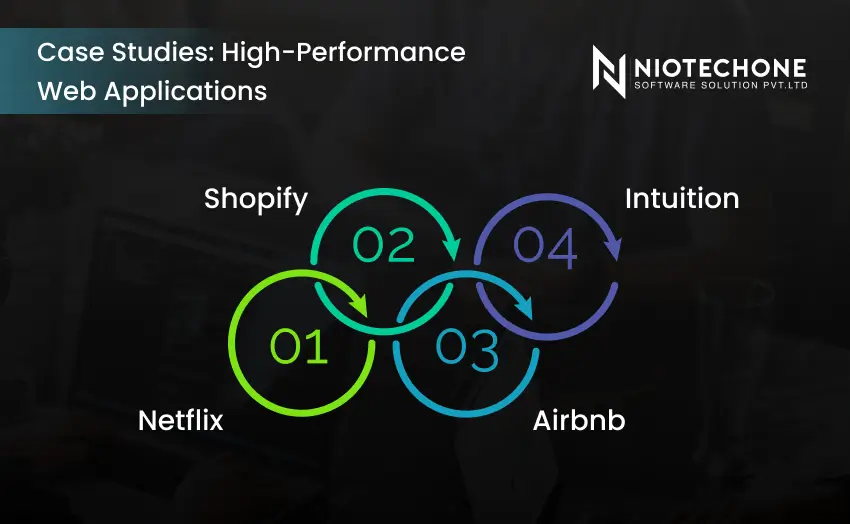
Netflix – Adaptive streaming, advanced caching, and microservices are used to serve millions of people effectively.
Shopify – React front-end with CDN caching to provide a seamless global e-commerce experience.
Airbnb – Uses SSR, lazy-loaded images, and optimized APIs to ensure low page load times across the globe.
Intuition – Minor optimizations, when multiplied by front-end, back-end, and infrastructure, result in large performance improvements.
The Future of Optimization in 2026
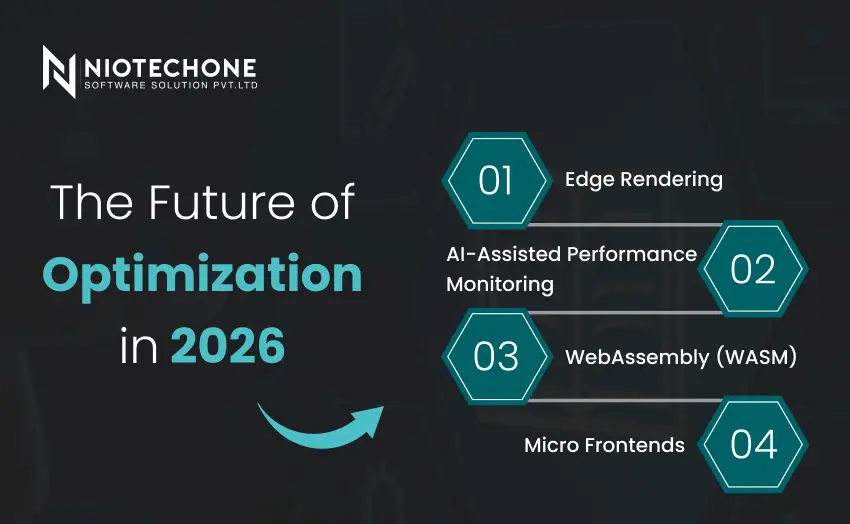
- Edge Rendering: Minimise latency by processing requests nearer to users.
- AI-Assisted Performance Monitoring: Anticipate bottlenecks in advance.
- WebAssembly (WASM): Execute performance-sensitive code in the browser at near-native speed.
- Micro Frontends: Render individual components of the application independently to render faster.
Conclusion
The development of high-performance web applications in 2026 will require the selection of strategic frameworks, optimizing the front-end and back-end, and constant monitoring. With these strategies, your web apps will not just meet users’ expectations but surpass them, leading to engagement, conversions, and long-term growth.
Begin using these professional methods now to develop rapid, scalable, and future-proof web applications.
Categories
Related Articles

Frequently Asked Questions FAQs
It is a web application that loads quickly, can handle high traffic, and provides a smooth UX without delays.
Monitor load times, responsiveness, and runtime performance with Lighthouse, WebPageTest, or New Relic.
React 18 + Next.js 14, SvelteKit, and Vue 3 + Nuxt.js are optimized to SSR, lazy loading, and fast rendering.
Absolutely. Quick websites are ranked higher in search engines and they attract more users.
Continuously. Monitoring of performance should be done as your app grows and traffic patterns vary.