How Modern Software Teams Balance Speed and Stability
- Niotechone Marketing Team
Table of Contents
- Introduction: Why Speed and Stability Matter More Than Ever in 2026
- Why Speed vs Stability Is the Wrong Question
- Architecture as the Foundation for Sustainable Delivery
- Modular Design Enables Faster, Safer Development
- Automation Is the Backbone of Speed Without Risk
- CI/CD Pipelines That Guard Quality
- Feature Flags Separate Speed and Risk
- Observability: Moving Fast Without Flying Blind
- AI in Software Development: Acceleration With Supervision
- Managing Technical Debt Without Slowing Down
- Software Project Management Unites Business and Engineering
- The Balance of Speed and Stability in Mobile App Teams
- Poorly Balanced Teams vs Modern Software Teams
- Real-World Scenario: Scaling Without Breaking
- Conclusion: Sustainable Speed Is a Competitive Advantage
Introduction: Why Speed and Stability Matter More Than Ever in 2026
Software is not a support feature anymore in 2026; it is the foundation of competitive advantage. Business owners, CTOs, and enterprise leaders want to see features delivered faster without compromising reliability. However, most organizations continue to think that speed and stability are at the two ends of the spectrum.
The current, high-performing teams, which are often led by an established custom software development company, have learned to strike a balance between quick innovation and long-term system stability. This article dissects the way that modern software teams strike that balance, what distinguishes them and failing teams, and what business leaders ought to seek when engaging a software development company in 2026.
Why Speed vs Stability Is the Wrong Question
It is not a matter of deciding between speed and stability, but rather creating systems and teams that enable both.
Organizations that pursue speed only tend to encounter:
- Frequent production issues
- Rising technical debt
- Slower delivery over time
Conversely, over-optimizing teams tend to:
- Miss market opportunities
- Deliver features too slowly
- Lose competitive relevance
Architecture as the Foundation for Sustainable Delivery
Speed and stability are either facilitated or killed silently in architecture.
Modern software teams invest early in:
- Distinct separation of concerns.
- Modular system design.
- Clear data boundaries.
This translates to the adoption of clean ASP.NET Core-based architectures in .NET ecosystems that can be developed and tested independently. Good architecture makes sure that modifications in one section of the system do not propagate in an unpredictable manner throughout the application. A scalable software application is not patched into existence later.
Modular Design Enables Faster, Safer Development
Tightly coupled monolithic systems slow down teams in the long run. This is not the case in modern teams, where systems are designed based on modular components or services.
Benefits include:
- Faster feature releases
- Reduced regression risk
- Easier maintenance
Modular design enables teams to enhance speed without adding instability, whether they are creating enterprise platforms or consumer-facing products.
This is one of the fundamental principles of mature custom software development companies that serve enterprise and mid-sized customers.

Automation Is the Backbone of Speed Without Risk
Speed cannot be maintained manually.
Modern teams automate:
- Unit and integration testing.
- Construct and release pipelines.
- Infrastructure provisioning.
Automation will make sure that the rapid changes are checked every time and minimize human error. This enables teams to roll out regularly without worrying about the stability of the system.
Automation is not a luxury in 2026; it is a necessity.
CI/CD Pipelines That Guard Quality
Continuous Integration and Continuous Delivery (CI/CD) pipelines assist teams in releasing faster and impose quality requirements.
Good pipelines consist of:
- Automated test execution
- Code quality checks
- Managed deployment plans
CI/CD pipelines eliminate friction instead of slowing down teams by identifying issues early, when they are cheaper and safer to resolve.
Feature Flags Separate Speed and Risk
Feature flags enable teams to release code without necessarily turning it on to users.
This enables:
- Gradual rollouts.
- Rollback without redeployment.
- Limited exposure production testing.
Feature flags enable teams to be more confident in deploying faster because they can manage exposure and impact.
Observability: Moving Fast Without Flying Blind
Modern systems should be visible to be stable at speed.
Successful teams invest in:
- Structured logging
- Performance metrics
- Distributed tracing
This enables teams to identify problems at an early stage, learn how the system works, and fix problems before they turn into outages.
AI in Software Development: Acceleration With Supervision
AI is no longer a substitute but a useful tool for developers.
In modern teams, AI is used to:
- Suggest code improvements.
- Generate test cases.
- Determine performance bottlenecks.
Responsibly used AI in software development enhances the productivity of developers and aids in maintaining stability. Blindly relying on teams that do not practice architectural discipline, however, tends to bring about hidden risks.
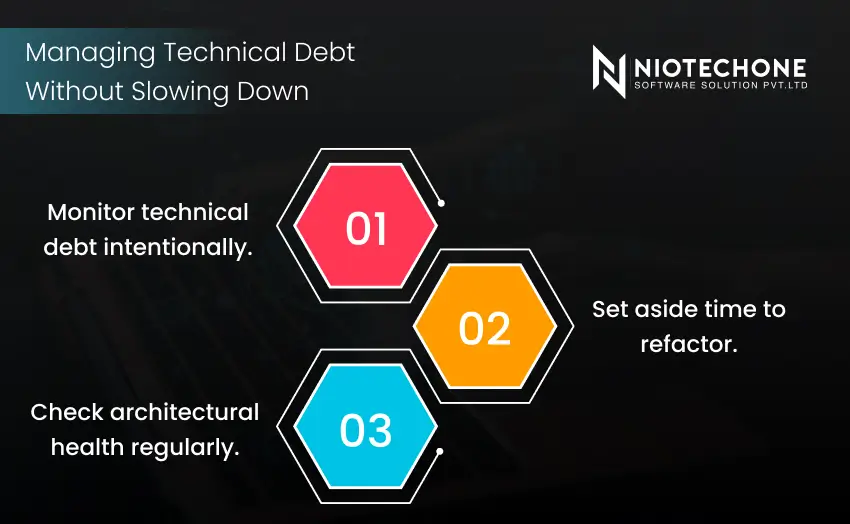
Managing Technical Debt Without Slowing Down
Technical debt is unavoidable. Ignoring it is optional.
Modern teams:
- Monitor technical debt intentionally.
- Set aside time to refactor.
- Check architectural health regularly.
This will avoid short-term speed benefits becoming long-term delivery delays. Debt is not to be avoided, but to be managed to enhance stability.
Software Project Management Unites Business and Engineering
Organizational challenges are not only technical but also speed and stability.
Good software project management guarantees:
- Realistic timelines
- Clear prioritization
- Business alignment and system capacity
When leadership recognizes the cost of shortcuts, teams can construct sustainably.
The Balance of Speed and Stability in Mobile App Teams
The development of mobile apps adds another layer of complexity:
- Platform fragmentation.
- App store approval delays.
- Performance constraints.
This is solved by modern mobile app development companies by:
- Cross-platform business logic.
- Automation of testing pipelines.
- Independent evolution of APIs.
The outcome is quicker iteration without affecting user experience or reliability of the app.
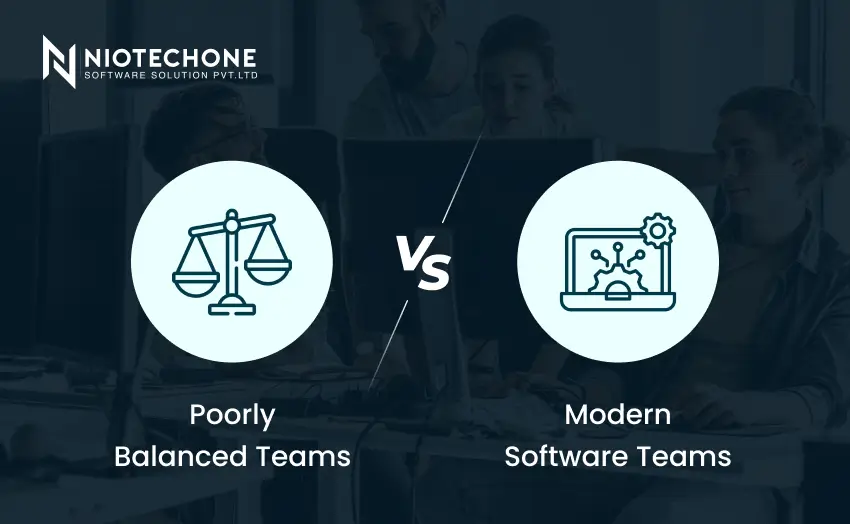
Poorly Balanced Teams vs Modern Software Teams
Aspect | Poorly Balanced Teams | Modern Balanced Teams |
Architecture | Tightly coupled | Modular and scalable |
Deployment | Large, risky releases | Small, frequent releases |
Testing | Mostly manual | Largely automated |
Incident Handling | Reactive | Proactive |
Long-Term Velocity | Declines | Improves over time |
Real-World Scenario: Scaling Without Breaking
One of the mid-sized businesses collaborated with Niotechone Software Solution Pvt. Ltd. to upgrade its platform. The aim was to deliver features faster without downtime.
The team was able to accomplish:
- 40% faster release cycles.
- Major decrease in production accidents.
- Better scalability of the system.
This shows how speed and stability can support one another when designed properly.
Conclusion: Sustainable Speed Is a Competitive Advantage
The most successful software teams in 2026 will not be the fastest, but the most sustainably fast.
They strike a balance between speed and stability by:
- Thoughtful architecture.
- Observability and automation.
- Responsible use of AI.
- Good software project management.
For businesses investing in digital development, it is essential to select the right software development company. The right partner does not simply provide features but creates systems that develop safely, scale with confidence, and safeguard long-term ROI.
Categories
Related Articles


Frequently Asked Questions FAQs
Yes, Speed and stability are mutually reinforcing, not competing, with proper architecture, automation, and disciplined project management.
Not with automated testing, CI/CD pipelines, and observability. Speed is only dangerous when it is based on shortcuts.
AI speeds up development and testing, yet stability is reliant on human supervision and good architectural choices.
Bad architecture increases the effect of change. Good architecture separates changes, allowing quicker and safer updates.
No. Mid-sized companies benefit the most because early discipline prevents costly rewrites later.