How Agile Fails Without the Right Engineering Culture
- Niotechone Marketing Team
Table of Contents
- Introduction
- What Agile Was Designed to Achieve
- The Core Problem: Process Without Engineering Discipline
- What an Engineering Culture Really Looks Like
- Agile vs Engineering-Driven Agile
- Engineering Culture: The Lost Foundation
- Real-World Case: When Agile Went Wrong
- The Role of Leadership in Engineering Culture
- How to Fix Agile Failure in Your Organization
- Conclusion
Introduction
Agile was a promise of quicker releases, enhanced cooperation, and constant enhancement. However, in 2026, delayed sprints, unstable releases, and frustrated teams remain a challenge to many businesses. Agile is not often the problem. The problem is that there is no powerful engineering culture behind it.
To any .NET development company, Agile would not be able to survive without disciplined engineering practices. Sprint boards and daily standups are meaningless when code quality, architecture, and ownership are overlooked. The distinction between Agile success and failure is not in ceremonies, but in culture, whether you are running a startup or an enterprise-level software development company in Rajkot.
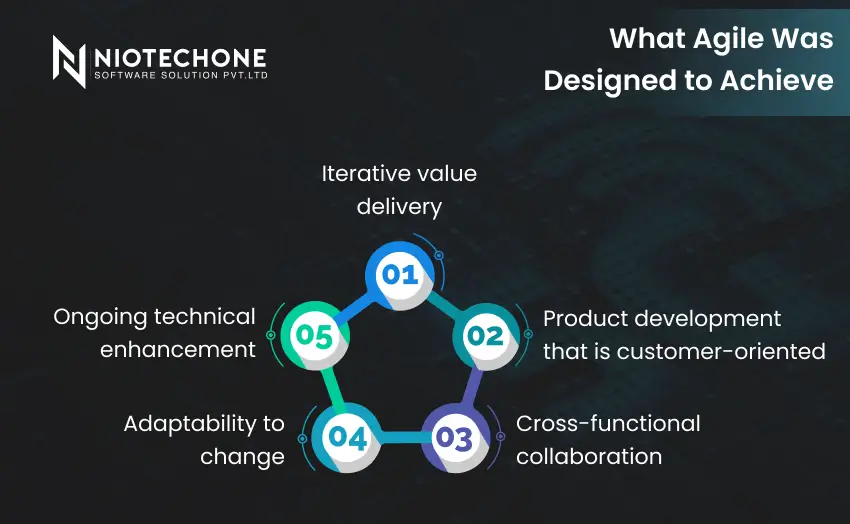
What Agile Was Designed to Achieve
Agile was not just about speed. It was designed to create:
- Iterative value delivery
- Product development that is customer-oriented
- Cross-functional collaboration
- Ongoing technical enhancement
- Adaptability to change
However, when organizations adopt Agile rituals without engineering excellence, the result is chaos disguised as progress.
Rapid code, poor architecture, and reactive fixes cannot be used to create a scalable software application. Agile speeds up all things, even bad practices.
The Core Problem: Process Without Engineering Discipline
Many organizations jump into the Agile methodology with the greatest of excitement. They put a lot of effort into creating sprint planning tools, hiring Scrum Masters, and creating velocity charts. When a software development company focuses only on ceremonies and does not pay attention to engineering discipline, Agile becomes a mechanical routine instead of a performance system.
What Happens When Process Replaces Discipline?
- Code is delivered, yet the number of bugs increases
- Software is delivered consistently, yet the amount of stability diminishes
- Velocity may appear to be high in the beginning, but it will sharply decrease
- Developers feel more pressure than they do empowerment
- Maintenance costs quietly rise
This is an extremely dangerous trend for a custom software development company. Clients expect long-term use out of their scalable software applications, not sporadic delivery spikes followed by instability.

What an Engineering Culture Really Looks Like
A good culture makes Agile do what it was meant to do. It secures product velocity, enables scalable software application development, and minimizes long-term risk. Engineering culture has a direct influence on the quality of delivery and business results of any serious software development company.
1. Architecture Is Planned, Not Accidental
Successful teams do not figure it out later. They establish a clear ASP.NET Core application architecture and then scale features.
This includes:
- Distinct separation of concerns.
- API-first design approach.
- Modular service boundaries.
- Security and performance planning.
In mature environments, architecture is developed along with the product, yet it is never neglected. Whether it is the development of cloud applications, an architectural field of study that avoids chaos in the future.
2. There Is No Compromise on Code Quality
Culture engineering implies no shortcuts in code.
Professional teams practice:
- Mandatory peer code reviews.
- Static code analysis tools.
- Uniform coding guidelines.
- Clean naming conventions.
- Continuous refactoring.
A skilled ASP.NET Core development company knows that poor code slows down development in the future. Temporary speed is never as good as sustainable velocity.
3. Testing is Intrinsic to the Process
Testing is not a final step. It belongs to development since the beginning.
Strong teams practice:
- Business logic unit testing.
- APIs integration testing.
- Automated regression testing.
ASP.NET Core API validation in the workflow of API development companies.
Intelligent test case generation and predictive bug detection are also supported by AI in software development in 2026. Nevertheless, tools do not substitute culture; they just facilitate it.
4. DevOps and Automation Are Standard
Organizations that are engineering-oriented invest in automation.
This includes:
- CI/CD pipelines
- Infrastructure as Code
- Automated deployments
- Real-time monitoring
- Rollback strategies
Automation is a guarantee of stability to businesses that develop scalable software applications.
Agile vs Engineering-Driven Agile
Agile Without Culture | Engineering-Driven Agile |
Focus on sprint velocity | Focus on sustainable velocity |
Feature-first mindset | Architecture-first mindset |
Manual deployments | Automated CI/CD pipelines |
Reactive bug fixing | Preventive testing strategy |
No documentation | Living technical documentation |
In 2026, high-performing teams combine Agile flexibility with strong engineering governance.
Engineering Culture: The Lost Foundation
The culture of engineering is the shared attitude that values:
- Code quality over shortcuts.
- Planning the architecture of the feature rush.
- Automated testing.
- Constant integration and delivery.
- Knowledge sharing and documentation.
In the absence of this, even the finest ASP.NET Core development company will not be able to provide uniform results.
Agile accelerates output. The culture of engineering makes output sustainable.
Real-World Case: When Agile Went Wrong
A medium-sized company collaborated with a software development company in Rajkot to upgrade an old system with ASP.NET Core.
They adopted Agile sprints at once. But within six months:
- Technical debt increased.
- APIs were poorly documented.
- Failure to integrate became common.
- Emergency patches were necessary to release.
The root cause was not Agile. It was a lack of code review standards, test automation, and architectural governance.
Following the reorganization of engineering processes, the implementation of CI/CD pipelines, and the implementation of clean architecture principles, the sprint velocity became stable, and the quality of products increased significantly.
The Role of Leadership in Engineering Culture
Developers do not create an engineering culture. It is influenced by leadership choices.
CTOs and founders must:
- Do not make unrealistic sprint commitments
- Set aside time to refactor
- Invest in cloud infrastructure
- Promote architectural discourse
Agile is not about rushing. It must imply being smart.
How to Fix Agile Failure in Your Organization
In case your Agile implementation seems to be broken, you can take into account the following corrective measures:
- Audit your engineering practices
- Enhance architectural control
- Introduce CI/CD automation
- Measure quality indicators
- Promote ongoing records
Above all, engage a competent ASP.NET Core development company with process and engineering depth.
Conclusion
Agile fails not due to its imperfection. It does not work because organizations confuse speed with maturity.
Agile is anarchic and unsustainable without a disciplined engineering culture. However, with the help of robust architecture, DevOps automation, and accountability, it can be a potent driver of innovation.
Businesses cannot afford weak systems in 2026. They require robust, scalable, and future-proof solutions. The collaboration with a well-established .NET development company such as Niotechone Software Solution Pvt. Ltd. will make sure that Agile is not merely a process, but a sustainable competitive advantage.
Agile is a tool. The basis is engineering culture. The structure will never stand without a foundation.
Categories
Related Articles

Frequently Asked Questions FAQs
Agile does not work when teams concentrate on process rituals without upholding engineering practices such as testing, architecture planning, and code reviews.
Yes, but structured architecture and DevOps maturity, in addition to Agile, are needed in enterprise .NET application development.
Good engineering guarantees modular design, clean APIs, and cloud-native readiness, which are critical to a scalable software application.
AI aids in testing, monitoring, and productivity. Nevertheless, it is not able to substitute disciplined engineering practices.
Yes, even startups that are collaborating with a software development company in Rajkot have to focus on architecture to prevent rework in the future.