Headless Mobile Architecture

Introduction

The mobile development environment is evolving rapidly. The single backend + single frontend model is no longer sufficient as businesses develop to support multiple screens, devices, and platforms. The current users demand smooth experiences, be it on mobile, transitioning to a tablet, or communicating with a wearable device. Enterprises are shifting to Headless Mobile Architecture to accommodate this new era of flexibility.

Headless Mobile Architecture decouples the backend and the frontend. Rather than linking the interface of an app to the server logic, developers create separate layers that are linked by APIs. In the case of organizations that engage a .NET development company in Rajkot, a web development company in Rajkot, or teams that deal with custom software development, the headless approach is more efficient, faster, and agile in the long run.

Dark-themed graphic with digital cube structures and the text 'What Is Headless Mobile Architecture?

What Is Headless Mobile Architecture?

Headless Mobile Architecture implies that the frontend (UI) and the backend (business logic and data) of an application are developed as two autonomous systems. They are all-API-based, which means that each layer can develop without impacting the other.

In conventional applications, the frontend is highly reliant on the output of the backend. This restricts freedom and raises development time. Conversely, a headless model provides organizations with the ability to refresh interfaces, introduce new experiences, and innovate on many channels without affecting the business engine.

This is particularly useful in businesses that have custom enterprise mobility software solutions, .NET core application development, or Azure cloud application development, where scalability and performance are essential.

The functionality of Headless Mobile Architecture

An API-first architecture is at the core of headless systems. This implies that every business logic, data model, workflow, and operation is made available via REST or GraphQL APIs. These APIs supply various UI layers, including mobile apps, wearable apps, PWAs, dashboards, kiosks, or even IoT displays.

Core Workflow Explained

  • Backend is developed independently in .NET, Node.js, Java, Python, or cloud-native.
  • APIs open up the backend to any frontend.
  • Frontend teams develop experiences with React Native, Flutter, Swift, Kotlin, or others.
  • Cloud platforms (such as Azure) are scalable and secure.
  • Orchestration layers deal with performance, caching and routing.


This architecture introduces uniformity to multi-device experiences and provides developers with increased freedom and speed.

The Reason why Enterprises are moving to Headless Mobile Architecture

Modern businesses require flexibility. They need to create applications more quickly, refresh them more frequently, and provide smooth omnichannel experiences. All these objectives are supported by the headless approach.

Indian businesses, particularly those collaborating with a software development company in Rajkot, are finding headless systems to be the best since they make the systems less complex, faster to release, and more maintainable in the long-term.

Key enterprise motivations

  • Quickly updated without changing the backend.
  • Multi-channel and multi-device support.
  • Improved performance with dedicated frontends.
  • Emerging technology architecture.
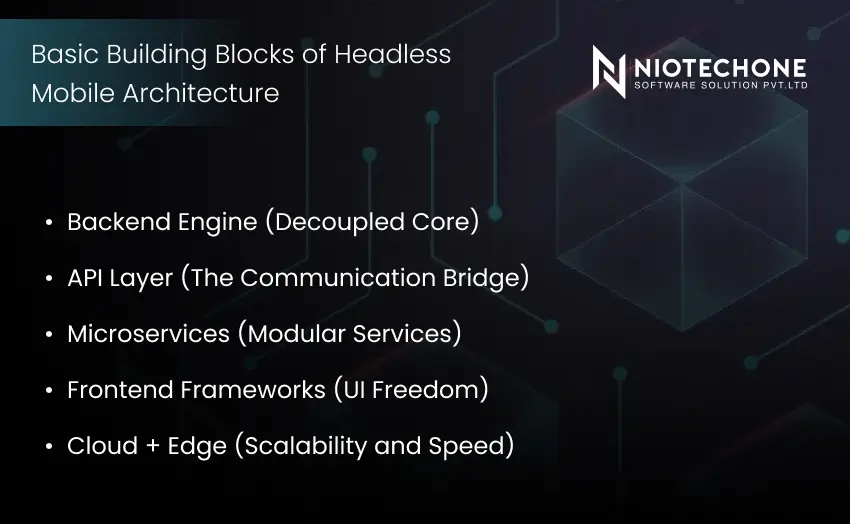
Infographic listing the basic building blocks of headless mobile architecture, including backend engine, API layer, microservices, frontend frameworks, and cloud-edge scalability.

Basic Building Blocks of Headless Mobile Architecture

There are a number of building blocks in a complete headless system. All the parts are independent of each other but interact via APIs to provide a coherent experience.

Backend Engine (Decoupled Core)

  • The backend deals with business logic, workflows and data storage. It is not affected by the changes in frontends.
  • This enables the developers to update UI layers without compromising the stability of the back end.

API Layer (The Communication Bridge)

  • APIs make data and actions available to every frontend.
  • They are consistent and can be used by several channels to use the same backend services.

Microservices (Modular Services)

  • Businesses do not have a single large backend, but rather independent microservices.
  • This enhances scalability and minimizes risks of failure.

Frontend Frameworks (UI Freedom)

  • Modern Android, iOS, hybrid apps and PWAs frameworks are used by teams.
  • Any UI can be customized without restrictions at the backend.

Cloud + Edge (Scalability and Speed)

  • Cloud computing such as Azure provides scalability whereas edge computing provides quicker response time.
  • This combination drives real-time experiences, particularly in enterprise mobility.

Headless Mobile Architecture Business Advantages

Headless architecture is not merely a technical enhancement- it is a business value generator. Businesses that seek to expand digital services, update applications, or develop sustainable platforms gain a lot.

Faster Time-to-Market

Frontend and backend teams are independent of each other, which saves time in development.

Omnichannel Flexibility

Mobile apps, wearables, kiosks, PWAs, and others can be powered by the same backend.

Reduced Development Costs

Shared backend logic and reusable APIs reduce the cost of long-term maintenance.

Higher Performance

Each platform has a frontend that is optimized to enhance speed.

Easier Modernization

UI updates do not need any changes in the backend, which makes redesigns simpler.

Scalable Architecture

Cloud-native systems and microservices deal with increasing workloads.

Better Security Control

The API gateways secure the flow of data, enhancing security among devices.

The API-First Development in Headless Mobile Systems

Headless mobile architecture is based on API-first design. Rather than developing APIs as an add-on, the system is developed with APIs at the center, with clean, modular connectivity between services and mobile frontends. This will enhance consistency and make sure that all interfaces, such as app, dashboard, chatbot, or partner system, are fed the same data and logic.

Automation and generative AI are also more easily adopted with API-first development. The AI-based APIs have the ability to personalize, automate workflows, analyze behavior, and assist predictive features in all mobile applications.

The main benefits of API-first architecture:

  • Regular data delivery: All mobile customers receive coherent responses.
  • Reusable services: A single API may serve dozens of app experiences.
  • Increased security: API gateways are standardized and thus easier to control and monitor.

Conclusion

Headless Mobile Architecture is changing the way businesses create digital experiences. It introduces agility, speed, and flexibility to mobile development by decoupling the frontend and the backend and enabling an API-first model. Headless systems provide the scalability and performance that modern businesses require, whether you are creating enterprise applications, travel portals, SaaS solutions, or customer-facing mobile solutions.

Enterprises in Rajkot and the rest of India are adopting headless architecture with the help of strong technologies such as Azure cloud, .NET Core, microservices, and AI to remain competitive and future-ready.

Frequently Asked Questions FAQs

It is a method in which the frontend and the backend are distinct systems that are linked by APIs. This provides greater freedom and flexibility to developers.

Conventional apps are closely integrated, thus slow to update. Headless applications enable independent updates, quicker releases, and multi-device.

Yes, Android apps, iOS apps, web apps, wearables, and kiosks can all be powered by a single backend.

Yes, Headless systems are very secure when API gateways, identity layers, and cloud security tools are put into practice.

Initial configuration can be more expensive, but long-term maintenance and scaling is much less expensive.