Enterprise Software Maintenance: Cost-Cutting Trends 2026
- Niotechone Marketing Team
Table of Contents
Introduction
To most organizations, the cost of maintaining enterprise software development takes up to 70 per cent of the IT budget. Business leaders, CTOs, and enterprise decision-makers are increasingly pressured to lower maintenance expenses and guarantee reliability, security, and scalability in 2026.
Software maintenance is no longer a matter of patching bugs, but it also involves updates, infrastructure, compliance, and AI-driven optimization. The selection of the appropriate custom software development company can have a great influence on the cost and efficiency.
This article discusses the recent developments in affordable enterprise software maintenance and how businesses are using innovation to achieve maximum ROI and maintain high-quality software operations.
The Future of Enterprise Software Maintenance in 2026
Enterprise software maintenance is the process of maintaining software systems to ensure that they are operational, secure, and scalable. Conventionally, maintenance involves:
- Patch management and bug fixes.
- Monitoring and optimization of performance.
- Security updates
- Interconnection with new systems.
But in 2026, maintenance transcends technical maintenance. To minimize long-term expenses, organizations need to take into account cloud optimization, AI-based monitoring, and proactive architecture refactoring.
Enterprise Software Maintenance Cost Drivers
Knowledge of what contributes to maintenance costs assists companies in planning better. The key cost drivers are:
- Difficult to update legacy architecture.
- Low-quality code or inconsistent development standards.
- Absence of automated testing and CI/CD pipelines.
- Manual error correction and monitoring.
- Multifaceted integrations between various platforms.
The hidden costs of poorly designed enterprise systems are often underestimated by organizations, and may result in more downtime, slower feature delivery, and higher technical debt.
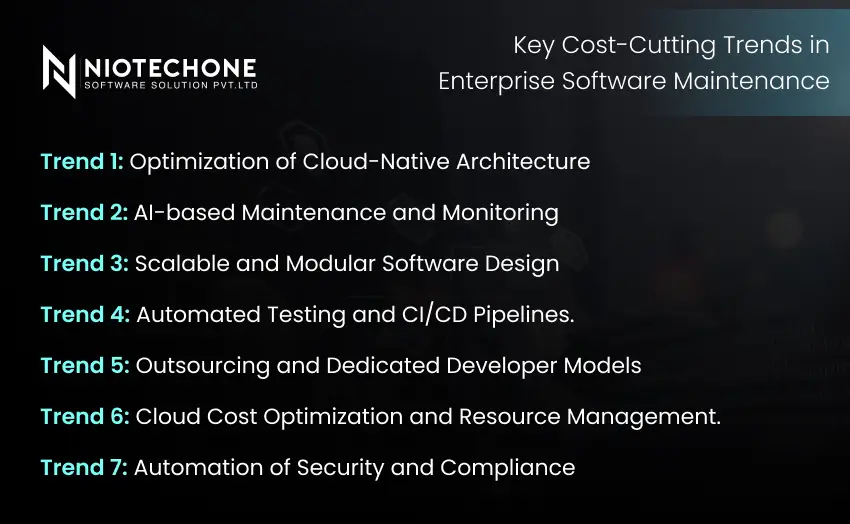
Key Cost-Cutting Trends in Enterprise Software Maintenance
Trend 1: Optimization of Cloud-Native Architecture
The transition to cloud-native infrastructure is no longer a choice, but one of the major cost-saving measures.
Modern trends include:
- Paying as you use with auto-scaling cloud resources.
- Moving old workloads to the Azure or AWS cloud services.
- Moving to serverless or containerized to minimize operational overhead.
Re-architecting software to the cloud helps organizations save on infrastructure expenses and enhance reliability and performance.
Example:
A medium-sized company has migrated its ERP system to Azure cloud architecture, which has saved it 35 percent of the costs of servers and enhanced the uptime of the system.
Trend 2: AI-based Maintenance and Monitoring
AI is changing the maintenance of enterprise software by anticipating failures, automating routine processes, and finding optimization opportunities.
Benefits include:
- Anticipatory warnings of system breakdowns.
- Bug detection and regression analysis are automated.
- Code refactoring recommendations with AI.
- Intelligent cloud infrastructure allocation.
This enables organizations to minimize manual intervention, minimize downtime, and focus on high-impact maintenance activities.
Trend 3: Scalable and Modular Software Design
A scalable software application is also easier to maintain since updates and improvements can be implemented separately.
Modular software design offers:
- Isolation of component functionality.
- Simpler implementation of new features.
- Scaling of critical modules independently.
- Less risk of downtime during updates.
Companies that engage a custom software development company can adopt modular designs in the development of .NET applications and ASP.NET Core architecture to maximize performance and minimize maintenance expenses.
Trend 4: Automated Testing and CI/CD Pipelines.
In 2026, automated testing and continuous integration/continuous deployment pipelines will be necessary to minimize maintenance overhead.
Advantages include:
- Pre-production bug detection.
- Reducing manual QA hours
- Enabling regular updates without interfering with users.
- Assurance of compliance and security standards.
Example:
Niotechone Software Solution Pvt. Ltd. applied CI/CD pipelines to an enterprise application of a client, halving the number of deployment failures and shortening manual maintenance time by 40 per cent.
Trend 5: Outsourcing and Dedicated Developer Models
By employing specific developers or outsourcing maintenance to a software development company, it is possible to save money and still have expertise.
Benefits include:
- Availability of specialized skills (e.g., Azure .NET development services).
- Scaling of teams according to demand.
- Less overhead on recruiting and training internal teams.
Businesses are able to sustain performance and reliability without straining internal resources.
Trend 6: Cloud Cost Optimization and Resource Management.
Cloud services are scalable but may be expensive when not handled appropriately. Businesses are implementing measures to minimize cloud-based maintenance costs:
- Periodic resource utilization audits.
- Auto-scaling and spot instances of non-critical workloads.
- Microservices that are containerized to reduce idle resources.
- AI-based predictive cost management.
This proactive strategy will make sure that the adoption of the cloud will not add to the maintenance expenses.
Trend 7: Automation of Security and Compliance
Security maintenance is a cost that is not always visible. By 2026, businesses will be using automation and AI to deal with security threats.
Automation trends include:
- Automated vulnerability testing and remediation.
- Threat detection and incident prediction based on AI.
- Ongoing adherence to standards such as GDPR, HIPAA, or SOC2.
Integrating security in routine maintenance minimizes the expensive manual audits and emergency patching.
Traditional vs Modern Maintenance Approaches
Aspect | Traditional Maintenance | Modern Maintenance (2026) |
Infrastructure | Fixed servers, manual scaling | Cloud-native, auto-scaling |
Testing | Manual QA | Automated CI/CD pipelines |
Monitoring | Reactive | AI-driven predictive |
Cost Control | Difficult to forecast | Optimized via automation & cloud |
Team Model | Fully internal | Hybrid or outsourced with experts |
Security | Manual patching | AI-driven, continuous compliance |
Real-World Case: How to save on maintenance without affecting quality
One of the world’s logistics companies was grappling with high maintenance expenses on old enterprise software. They collaborated with Niotechone Software Solution Pvt. Ltd. and introduced:
- Modular architecture of .NET Core.
- Cloud migration to Azure
- Automated CI/CD pipelines
- AI-driven system monitoring
Outcome: The maintenance expenses were reduced by 30 per cent, uptime was raised by 25 per cent, and the efficiency of the team was enhanced significantly
Conclusion
Enterprise software maintenance is moving beyond bug fixing in 2026. Companies can save money, enhance reliability, and scale without fear by using cloud-native architecture, AI-driven monitoring, automated pipelines, and modular design.
By collaborating with an established custom software development company such as Niotechone Software Solution Pvt. Ltd., maintenance will be strategic, cost-effective, and in line with business expansion.
Categories
Related Articles

Frequently Asked Questions FAQs
Using cloud-native architecture, modular design, AI monitoring, automated testing, and dedicated developer models.
AI forecasts failures, optimizes resource utilization, automates bug detection, and aids in proactive code refactoring.
A scalable, modular refactoring approach lowers the maintenance costs in the long run and enhances performance.
Yes. Specialized teams offer expertise, flexibility and reduce overheads as compared to full-time internal teams.
Auto-scaling, server less architecture, and pay-as-you-go models save on infrastructure costs and enhance uptime.