
Enterprise Database Design Best Practices
- Niotechone Marketing Team
Introduction
Modern business operations rely on enterprise databases, which are the basis of critical applications and the storage of valuable information. A properly designed database guarantees effective data management, security, and quick access to decision-making.
Nevertheless, most companies are only interested in features or cloud migration and do not pay much attention to designing databases based on best practices. Failure to consider these basics may result in performance bottlenecks, maintenance issues, and increased costs in the long run.
Collaborating with a Software Development Company in Rajkot or India enables organisations to deploy optimised database architectures that facilitate the development of enterprise, web, and mobile applications, providing long-term scalability and reliability.
Know Your Business Needs
The first step to successful database design is to have a clear picture of what your business needs. Organizations need to determine the nature of data they process, the expected volume of transactions, reporting requirements, and regulatory requirements like GDPR or HIPAA.
Early definition of these factors will assist in ensuring that the database structure is in line with the current operations and future expansion. A Rajkot-based .NET development company can help in converting these requirements into a powerful database structure that facilitates the smooth enterprise processes, effective reporting, and access by all stakeholders, which will simplify future system upgrades.
Select the Appropriate Database Model
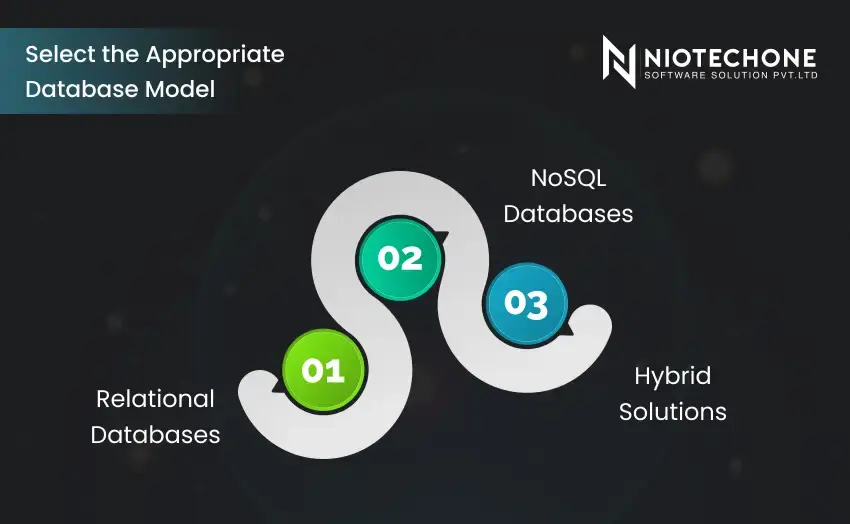
The choice of the database model is important. Options include:
- Relational Databases: Suited to structured data with complex relationships.
- NoSQL Databases: Ideal when the data is unstructured or semi-structured, and the schema is flexible.
- Hybrid Solutions: Use relational and NoSQL advantages in large-scale applications.
The selection of the appropriate model will be based on your business, type of app, and projected growth. In the case of enterprise and web applications, relational models remain the norm, while NoSQL solutions are particularly useful in mobile application development.
Normalize, Do Not Over-Normalize
Normalization minimizes redundancy and enhances data integrity, whereas over-normalization may slow down queries and make reporting difficult. Best practices include:
- Use the third normal form (3NF) on most tables.
- Consider denormalization of high-read or analytics-intensive tables.
- Trade-off between data integrity and application performance.
Normalization is done properly to facilitate easy cooperation among developers, QA teams, and database administrators.
Performance Indexing Strategies
To enhance the speed of queries and the overall database performance, indexing is necessary. With large datasets, searches, joins, and aggregations can be performed fast with proper indexing. Strategies that can be used effectively include indexing primary and foreign keys and using composite indexes for complex queries.
Unnecessary indexes should be avoided, as they can slow down data insertion and update operations. An intelligently indexed database allows applications to scale effectively and facilitates smooth operations in the development of web and mobile applications, improving user experience and operational stability.
Ensure Data Integrity and Consistency
The integrity of data is essential to sound business insights. Techniques include:
- Impose primary and foreign key constraints.
- Unique constraints are used to avoid duplication.
- Use triggers or stored procedures to authenticate data.
An Indian based company that develops in .NET can incorporate strong integrity rules in the database to minimize errors and ensure confidence in vital information.

Scalability and Growth Planning
Enterprise databases should be built to support the increase in users and data without affecting performance. Scalable design guarantees that as the organization grows, applications remain efficient to support smooth operations on web, mobile, and cloud platforms. This can be achieved through several strategies:
- Horizontal scaling of distributed systems: It involves the addition of more servers or nodes to distribute the workload so that high-traffic applications do not slow down.
- Vertical scaling to larger instances: Adding more CPU, memory, or storage to existing servers can support larger workloads without redesigning the system.
- Splitting huge tables: Splitting huge tables into smaller, manageable parts enhances query performance and minimizes bottlenecks.
- Elastic scaling on the cloud: With the help of cloud databases, it is possible to scale automatically according to demand, which means that the resources will be available when the traffic peaks.
Scalable database design is essential to support the development of modern enterprise applications and mobile application development, particularly in businesses with seasonal peaks, high growth, or international expansion.
A well-planned design phase minimizes downtime, prevents expensive migrations in the future, and makes both custom software development and .NET Core applications responsive and reliable as business needs change.
Secure at the beginning
Sensitive and valuable information is stored in enterprise databases, and therefore, security is a priority. Role-based access controls, data encryption at rest and in transit, and regular audits are necessary measures to avoid unauthorized access.
The current cloud-based systems also offer better monitoring and threat detection to maintain the regulatory standards. Security investment at the design stage safeguards business information, customer confidence, and risks that would otherwise interfere with business operations.
Backup and Disaster Recovery
To mitigate against unforeseen failures or loss of data, a sound backup and disaster recovery plan is necessary. Organizations are advised to have automated daily backups, duplicate data in different geographical locations, and periodically test the restoration processes.
These will reduce downtime, protect vital business processes, and make sure that operations can be maintained even in the event of hardware failures or cyber attacks. Collaboration with seasoned development teams will help to make sure that these recovery mechanisms are incorporated into enterprise software solutions.
Conclusion
The design of an enterprise database influences all the operations of an organization, including the performance of the application, security, and scalability. Adherence to best practices, such as knowing the business needs, choosing the appropriate model, ensuring data integrity, and future planning, makes systems robust, reliable, and future-proof.
Collaboration with a Custom Software Development Company in Rajkot will ensure that enterprise, web, and mobile applications are high-performing and secure, and operational risks are minimized and long-term business objectives are supported.
Categories
Related Articles

Frequently Asked Questions FAQs
Knowing the business requirements and developing a scalable and secure framework is essential to success in the long term.
Take into account the nature of data, expected growth, the nature of the application, and integration needs.
Normalization guarantees consistency of data and minimizes redundancy, enhancing data accuracy.
No, encryption is necessary to secure sensitive data and comply with the requirements.
Multi-location replication and regular restore testing should be done daily.


