
DevOps Mistakes That Increase Cloud Costs
- Niotechone Marketing Team
Table of Contents
- Introduction
- Why Cloud Costs Get Out of Control
- Mistake 1: Overprovisioning Infrastructure
- Mistake 2: Absence of Auto-Scaling Strategy
- Mistake 3: Ineffective CI/CD Pipelines
- Mistake 4: Overlooking Resource Cleanup
- Mistake 5: Low Monitoring and Observability
- Mistake 6: Poor Architecture Design
- Mistake 7: Lack of Cost Governance Policies
- Real-World Case: When DevOps Made Things More Expensive
- Best Practices of DevOps to optimize costs in 2026
- Fast DevOps vs Cost-Optimized DevOps
- Conclusion
Introduction
Cloud computing has revolutionized modern software delivery. As startups build SaaS platforms and enterprises modernize legacy systems, cloud application development has become the new standard. Nevertheless, the cloud may be scalable and flexible, but it can silently increase operational costs if DevOps practices are not well applied.
A significant number of CTOs engage a .NET development company with the anticipation of effective deployments on Azure or other cloud solutions. However, without disciplined DevOps governance, even well-constructed systems are costly to maintain. Regardless of whether you are operating a startup that is growing or you are employed in a software development company in Rajkot, it is important to know the DevOps errors that will make cloud costs more expensive in 2026.
Why Cloud Costs Get Out of Control
Cloud pricing models are usage-based. That means:
- Oversized servers raise computing expenses.
- Storage that is not used builds up quietly.
- Unproductive CI/CD pipelines waste resources.
- Poor monitoring hides waste
The problem is not the cloud. The issue is uncontrolled DevOps practices.
Resource consumption should be optimized by a scalable software application built on a robust ASP.NET Core architecture. In the absence of governance, however, costs increase month after month.
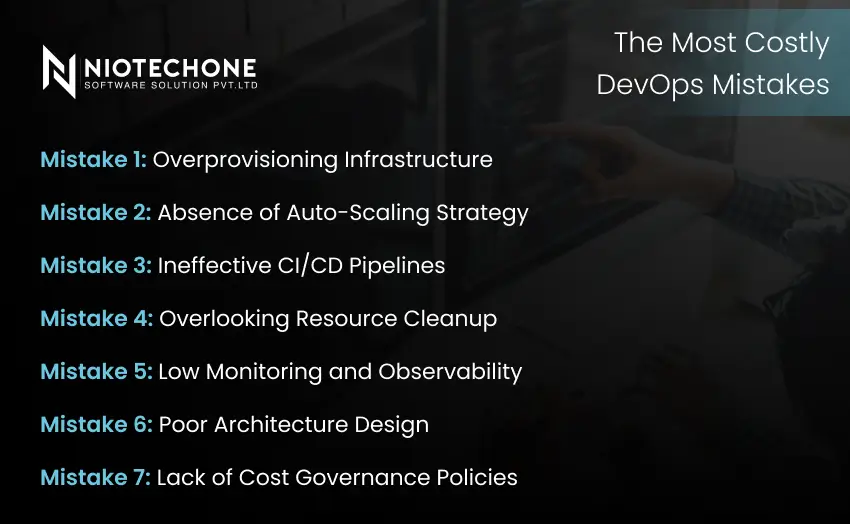
The Most Costly DevOps Mistakes
Mistake 1: Overprovisioning Infrastructure
Provisioning of resources that are not necessary is one of the most frequent DevOps mistakes.
Teams often allocate:
- Unnecessarily large virtual machines.
- Moderate workload, high-performance databases.
- Continuous development and testing environments.
This normally occurs when there is a rush in deployment or weak monitoring.
Right-sizing instances is essential in Azure cloud architecture. An established ASP.NET Core development company constantly checks the performance indicators and reallocates resources according to the real usage.
Business Impact
- Higher monthly cloud payments.
- Underutilized infrastructure
- Less ROI on cloud migration.
Mistake 2: Absence of Auto-Scaling Strategy
Dynamic scaling is supported by modern cloud environments. However, it is not properly configured in many organizations.
In the absence of appropriate scaling rules:
- Systems run at peak capacity 24/7
- Performance problems are brought about by traffic spikes
- Scaling results in slow responses
A professional .NET development company in Rajkot will make sure that the development of cloud applications has auto-scaling logic that is in line with actual usage patterns.
Sustainable DevOps in 2026 implies scaling up on demand- and scaling down automatically.
Mistake 3: Ineffective CI/CD Pipelines
Modern software delivery requires CI/CD pipelines. Nonetheless, inefficiently optimized pipelines are more expensive.
The typical inefficiencies in pipelines are:
- Unnecessary full builds.
- Deploying minor documentation changes.
- Replicated testing environments.
- Unutilized containers waste resources.
A skilled ASP.NET Core API development company develops lean and efficient pipelines that minimize unnecessary compute utilization.
Automation must not cost money, but save it.
Mistake 4: Overlooking Resource Cleanup
Unutilized assets are built up in cloud environments.
Examples include:
- Unattached storage volumes
- Old test environments
- Orphaned containers
- Obsolete backup snapshots
These resources are active and billable without automated cleanup scripts.
Proper DevOps governance in enterprise .NET application development involves automated lifecycle management and scheduled audits.
Mistake 5: Low Monitoring and Observability
You cannot maximize what you do not see.
Most organizations implement applications without effective monitoring tools. This leads to:
- Unnoticed performance inefficiencies.
- Redundant database scaling.
- Excess logging storage
- Overactive services
The development of modern cloud applications should involve:
- Live performance monitoring
- Cost dashboards
- Usage analytics
- Alert systems
AI in software development is currently an important part of predictive monitoring- detecting cost spikes that are abnormal before they turn into financial liabilities.
Mistake 6: Poor Architecture Design
Architectural flaws are the root cause of DevOps errors.
In case the ASP.NET Core application architecture is not modular and optimized:
- Services can overlap workloads.
- APIs can handle redundant information.
- Database queries can be inefficient.
- Background jobs can use up unnecessary memory.
The first step towards sustainable cloud optimization is the right architecture design.
An in-house software development company that emphasizes structured architecture minimizes waste in the long-term operations.
Mistake 7: Lack of Cost Governance Policies
There must be discipline in cloud cost management.
Lack of governance in organizations may result in:
- Budget alerts
- Resource tagging strategies.
- Environment segmentation
- Role-based access controls
When several teams utilize resources separately, expenses become out of control.
A responsible software development company in Rajkot ensures that governance policies are put in place from the start.
Real-World Case: When DevOps Made Things More Expensive
A medium-sized SaaS company contracted a custom software developer in Rajkot to move its system to Azure.
At first, deployments were successful. But within six months:
- Cloud costs increased by 40%
- Test environments ran 24/7
- Data logging was too bulky.
- CI/CD pipelines caused unnecessary builds.
Having performed a DevOps audit, the team:
- Implemented auto-scaling
- Optimized build triggers
- Scheduling of the introduced environment.
- Cleaned unused storage
Outcome: 28 percent decrease in monthly cloud expenses without performance loss.
This underscores the direct relationship between DevOps maturity and financial efficiency.
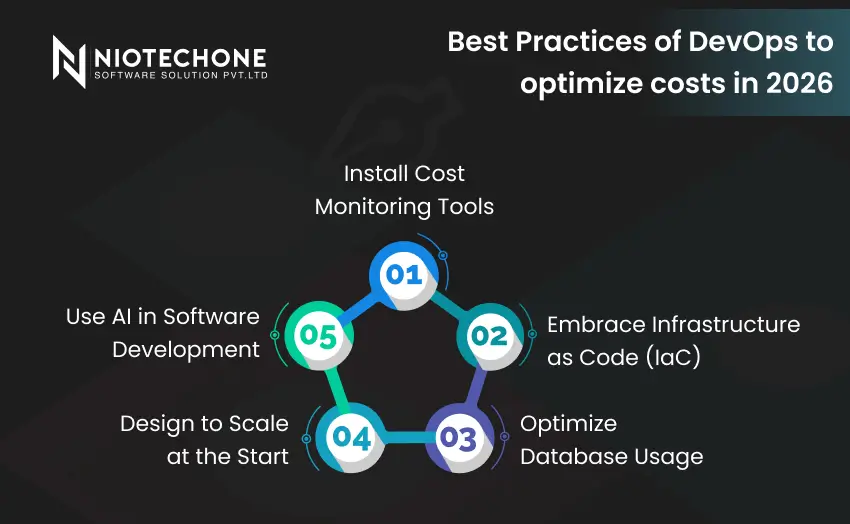
Best Practices of DevOps to optimize costs in 2026
Organizations must use the following strategies to avoid incurring unnecessary cloud costs:
1. Install Cost Monitoring Tools
Use cloud-native dashboards to:
- Track real-time usage
- Identify idle resources
- Forecast monthly expenses
Optimization opportunities can now be proposed automatically by AI-driven analytics.
2. Embrace Infrastructure as Code (IaC)
Infrastructure as Code guarantees:
- Stable environment configuration.
- Easy scaling adjustments
- Fewer configuration errors.
This method enhances predictability in the development of cloud applications.
3. Optimize Database Usage
The biggest cost contributors are usually databases.
Best practices include:
- Index optimization
- Query performance tuning
- Archiving historical data
- Appropriate use of serverless database options.
A skilled ASP.NET developer in Rajkot pays much attention to the efficiency of the database in development.
4. Design to Scale at the Start
A scalable software application must:
- Logically separate services.
- Do not have monolithic bottlenecks.
- Facilitate effective API interactions.
- Reduce unnecessary processing.
Clean architecture minimizes unwarranted cloud usage.
5. Use AI in Software Development
In 2026, AI tools assist DevOps by:
- Anticipating traffic trends.
- Identifying idle infrastructure.
- Recommending scaled-down instances.
- Automating cost anomaly alerts.
AI assists in the engineering field- but strategy is human-centred.
Fast DevOps vs Cost-Optimized DevOps
Approach | Fast DevOps | Cost-Optimized DevOps |
Deployment Speed | High | Balanced |
Monitoring | Basic | Advanced |
Auto-Scaling | Limited | Intelligent |
Resource Cleanup | Manual | Automated |
Cost Visibility | Low | High |
Long-Term ROI | Uncertain | Predictable |
Conclusion
Cloud platforms offer flexibility and scalability—but without disciplined DevOps practices, they become expensive quickly.
The most common DevOps mistakes—overprovisioning, weak monitoring, inefficient pipelines, and poor architecture—directly increase operational costs. In 2026, businesses must prioritize cost-aware engineering alongside rapid deployment.
Partnering with an experienced ASP.NET development company or a trusted .NET development company in Rajkot ensures that cloud application development is not only scalable but financially sustainable.
Categories
Related Articles


Frequently Asked Questions FAQs
The expenses are inflated by overprovisioned infrastructure, ineffective monitoring, idle resources, and inefficient DevOps pipelines.
Optimising the architecture, employing auto-scaling mechanisms, automating the cleanup process, and tracking real-time usage.
Not necessarily. Poorly optimized pipelines increase costs. Efficient DevOps practices can maintain speed while controlling expenses.
AI detects abnormal expenditures, forecasts traffic, and suggests infrastructure changes.
Clean ASP.NET Core application architecture minimizes redundant processing and duplication of resources.