Custom Software vs Off‑the‑Shelf: What’s Right for Your Business?
- Niotechone Marketing Team
Introduction
The selection of the appropriate software is a very important choice that any business makes, be it a startup, a developing company or an established business. In India, particularly for businesses in Rajkot, the choice between off-the-shelf software and custom software development can have a major effect on efficiency, scalability, and long-term costs. Custom solutions are flexible and offer custom workflows, whereas off-the-shelf software is fast and less expensive to start with.
What Is Off-the-Shelf Software?
Off-the-shelf software is ready-made software that is meant to be used by a large number of people. These are generic tools that are designed to address generic business issues without customization. They can be CRM systems, accounting software, HR platforms, and project management tools.
Key Features
- Ready-made workflows that fit most businesses.
- Updates and features that are controlled by the vendor.
- Basic user interface with minimal customization.
Advantages
- Quick implementation: Software can be implemented in days.
- Reduced initial expense: Small business and start-up friendly.
- Low technical configuration: No development team required.
- Vendor support: The provider does updates and bug fixes.
Limitations
- Minimal customization: You cannot modify fundamental features of your workflow.
- Integration issues: Hard to integrate with other business systems.
- Vendor dependency: The provider controls your software roadmap.
- Unseen expenses: Extra modules, user licenses, and add-ons may add to costs.
When Off-the-Shelf Software Works Best
- Your business processes are standardized.
- You require a fast solution for day-to-day operations.
- The budget is limited
- Software is not a fundamental differentiator of your business.
In the case of start-up companies, off-the-shelf software offers a fast, low-risk entry.
What Is Custom Software?
Tailor-made software suits your company’s specific needs. Unlike off-the-shelf solutions, it supports your unique workflows and operational requirements. To build these solutions, companies in India usually hire a software development company in Rajkot.
The custom applications that are developed today are usually built based on .NET Core application development, Custom software development, and Azure cloud application development, which enables them to be scaled, secure, and flexible in terms of integration.
Key Features
- Completely integrated with your business processes.
- Planned to expand your business.
- Is compatible with existing systems.
- Secure and scalable, and optional AI-enabled.
Advantages
- Precise business fit: No trade-off on the way your business works.
- Scalability: Can expand with more users, modules, and integrations.
- Ownership of features and data: Complete ownership of the software.
- Long-term ROI: Saves on repeated licensing fees.
Limitations
- Increased initial expense: It involves development investment.
- Slower implementation: Development and testing require weeks or months.
- Needs planning: Maintenance and updates should be handled either in-house or through a partner.
When Custom Software Works Best
- Your business processes are either unique or complex.
- You intend to expand operations in the long run.
- Software has a direct effect on revenue or efficiency.
- You require enterprise mobility solutions or AI integration.
Custom Software vs Off-the-Shelf
Factor | Custom Software | Off-the-Shelf Software |
Fit for business processes | Exact match | Generic, one-size-fits-all |
Customization | Unlimited | Minimal |
Deployment time | Weeks to months | Immediate |
Scalability | High | Often limited |
Integration | Seamless | Challenging |
Ownership | Full | Vendor-controlled |
Long-term cost | Predictable | Can increase over time |
This table shows the trade-offs between speed, cost, control, and long-term scalability. The selection of the appropriate solution will be based on what factors are most important to your business.
Cost Comparison: Short-Term vs Long-Term Impact
Off-the-Shelf Software Costs:
- First license or subscription charges.
- Extra staff per-user fees.
- Premium add-ons or upgrades.
- Switching costs in case of migration.
Custom Software Costs:
- One-time development fee
- Optional maintenance is continuing.
- No recurring license fees
- Customized to eliminate redundant features.
Takeaway: Off-the-shelf software may appear cheaper in the short term, but custom software can be more cost-effective in the long term (3-5 years) as your business expands.
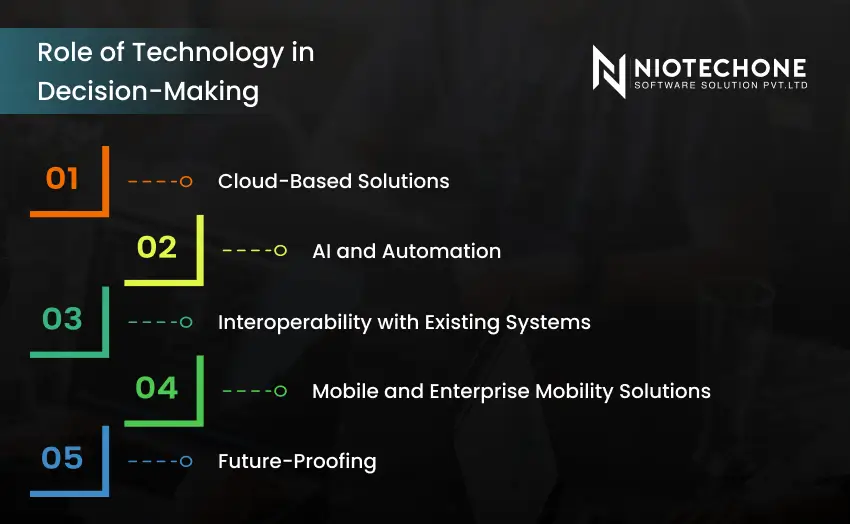
Role of Technology in Decision-Making
Technology is a key factor in deciding between custom software and off-the-shelf software to use in your business. The modern business requires solutions that are not only able to address the existing issues but also be able to adjust to the future requirements.
Important Technological Factors
1. Cloud-Based Solutions
Scalable, secure, and accessible software is made possible by cloud platforms such as Azure cloud application development.
Off-the-shelf tools might not be as integrated with the cloud as custom software can be.
2. AI and Automation
AI has the potential to automate repetitive processes, process large volumes of data, and enhance decision-making.
Custom solutions that incorporate AI are more advantageous to businesses in Rajkot that are looking into AI in software development.
3. Interoperability with Existing Systems
Enterprise systems may need to be integrated with ERPs, CRMs, or mobile applications.
Custom solutions may be created to work together without disrupting the workflow.
4. Mobile and Enterprise Mobility Solutions
Field staff and remote teams require cross-device apps.
Tailor-made Enterprise mobility software solutions offer secure and scalable mobile access.
5. Future-Proofing
Companies ought to look at software that can be upgraded and expanded in the future.
Custom software enables you to adopt new technologies without significant upheavals, unlike off-the-shelf solutions that can compel workarounds.
Lesson: Technology is not a tool; it is one of the determinants of the appropriate software. Planned businesses tend to have higher ROI, easier operations, and quicker scalability.
Real-Life Case Studies / Examples
The analysis of real-life situations assists companies in knowing how software decisions work in reality.
Case Study 1: Mid-Sized Enterprise
Problem: A manufacturing company used off-the-shelf ERP software.
Issue: It was not integrated with mobile sales teams and AI-based analytics.
Solution: Created a bespoke enterprise mobility software solution that has AI-driven analytics.
Result: Live data access, predictive analytics, and remote reporting simplified operations and shortened decision-making by half.
Case Study 2: AI-Based Customer Support System
Problem: A service company desired quicker customer service and individualized attention.
Issue: Ready-made solutions were not able to offer AI-based automation or CRM integration.
Solution: Built a bespoke AI-based platform on .NET Core and cloud.
Result: Automated routine queries, 30 percent decrease in response time, and customer satisfaction scores.
Insight: These examples demonstrate that unique workflows or growth ambitions of businesses are better served by custom software development, whereas off-the-shelf tools are a short-term or interim solution.
Conclusion
The custom software or off-the-shelf software is a business strategy.
- Ready-made software is best suited to rapidity, low initial investment, and standard processes.
- Custom software development offers flexibility, scalability, and cost-effectiveness in the long term.
Companies in Rajkot and other parts of India that require control, integration, and growth opportunities often find that custom solutions developed by a .NET development company in Rajkot or a software development company in India offer the best benefit.
Finally, the correct software is the one that fits your business processes today and helps you grow tomorrow.
Categories
Related Articles

Frequently Asked Questions FAQs
Software is more suitable for companies with distinct processes, long-term expansion strategies, or operations that are revenue-dependent. Off-the-shelf is used in standard, short-term requirements.
Custom software is more expensive initially, but can be more cost-effective in the long-term because of the avoided recurring subscription fees and increased efficiency.
Businesses tend to move to custom platforms when off-the-shelf solutions restrict scalability, integrations, or operational efficiency.
Yes, Automation, predictive analytics, and personalization are AI features that are simpler to apply in custom solutions.
Seek experience in .NET Core application development, ASP.NET Core, cloud solutions, industry experience, and long-term support.