Digital commerce is evolving faster than ever before. Traditional monolithic e-commerce platforms – once the stronghold of online retail – are struggling to keep pace with our expectations around agility, scalability, and personalization. Monolithic systems arose with everything tightly coupled as one unit where checkout, inventory management, and many other features all ran on the same massive codebase.
While it worked fine back in the day when online shopping was still new, monolithic e-commerce platforms became less optimal for businesses that need to keep evolving. When one feature needed updating it usually meant reconstructing and redeploying the overall architecture. Thus, we were introduced to Composable Commerce. This new framework is changing how businesses think about building and delivering digital shopping experiences.
Composable Commerce is more than a technology; it is a philosophy. It’s about putting power and flexibility into the business’s hands for innovative change.Â
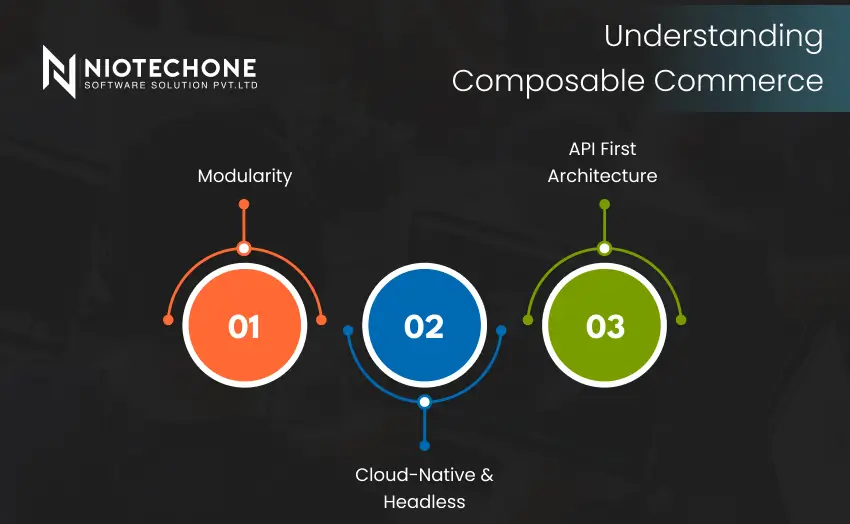
At its essence, composable commerce is the combination of three principles:Â
Your e-commerce store is like a LEGO set; each piece (product catalog, recommendation engine, payment gateway) can be disassembled, removed, or upgraded. Businesses can opt for “best-in-class” solutions that meet their own needs and seamlessly interface with one another.
This architecture allows custom enterprise application delivery companies to build stronger and more efficient e-commerce platforms that are more agile, adaptive, and customer centric.
Monolithic e-commerce systems were and are so prevalent because they provide everything that is needed to run an e-commerce store within a single ecosystem– catalog management, checkout, analytics, and customer data. However, as business needs change these systems have started to show their age.
Here’s why businesses are moving away from monolithic systems:Â
Reduced flexibility: Change in one area can often break another area, because of the tightly coupled codebase.Â
Vendor lock-in: Organizations are reliant on a single provider for updates, customization, and integration.
Scalability issue: Scaling is expensive because you have to duplicate the entire application, not just the components that grow in demand.
High maintenance cost: As food and beverage systems grow older, it becomes increasingly cumbersome to fix bugs and make upgrades.
In contrast, composable commerce provides developers and business departments the flexibility to continuously evolve—quickly react to changes in market need, technology, and consumer expectations.
Composable commerce is built on a modern technology stack designed for flexibility, speed, and cloud scalability. This architecture can be built using .net core, Azure cloud applications, and API driven microservice architecture, all of which deliver performance and maintainability at enterprise scale.
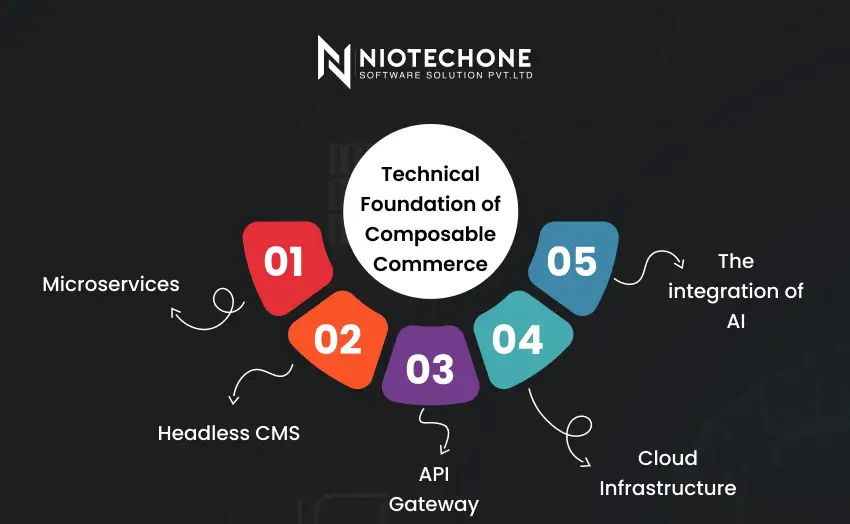
Key Components of a Composable Architecture
Microservices: Every e-commerce function (search, inventory, checkout, promotions) is built and deployed as a standalone microservice.
Headless CMS: The content layer is decoupled from the presentation layer to provide consistent user experiences across web, mobile and IoT devices.
API Gateway: The API gateway is the central access point that facilitates routing requests between modules securely and efficiently.
Cloud Infrastructure: Using Azure cloud application development, organizations can host and scale every microservice independently.
The integration of AI: Machine learning models are enhancing product recommendations, automatically conducting customer interactions, and dynamically adjusting pricing.
Composable commerce represents more than a technological shift — it’s a business shift. For modern organizations, especially those investing in custom enterprise application development in India, this model creates the opportunity for new innovation, agility, and competitive differentiation.
Traditional e-commerce systems were developed for a slower world. They provided stability but did not offer the ability to be nimble in the marketplace. Today’s customers expect personalized experiences, multi-device capabilities, and faster response times; elements that only a modular system can deliver on fully.
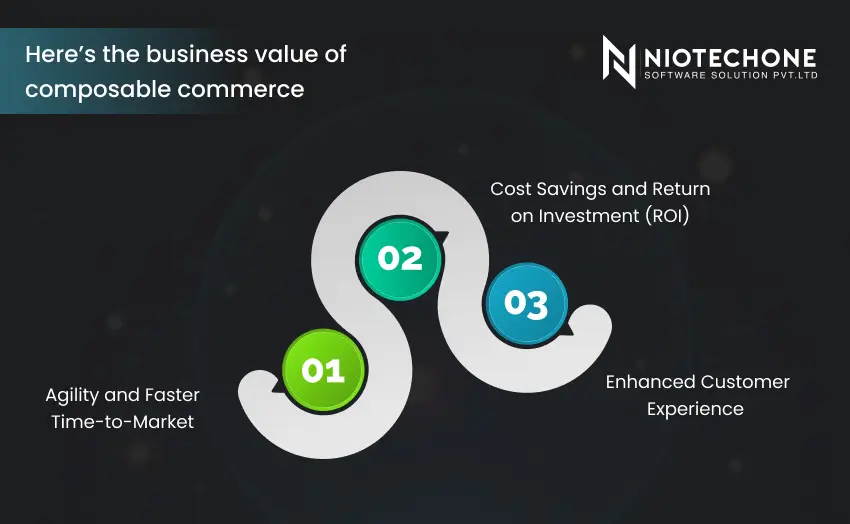
Here’s the business value of composable commerce:
1. Agility and Faster Time-to-Market
Composable architectures enable development teams to add new features or channels in isolation. Instead of needing to redeploy the entire platform, you can update an individual service — for example, upgrading a payment gateway or applying a new AI recommendation engine — without having downtime.
This agility lends itself to drastically reduced time-to-market which in turn allows companies to adapt instantly to consumer behavior, emerging trends, or seasonal demand. A .NET Core application development framework also accelerates updating time-to-market due to more modular APIs and reusable code components.
2. Cost Savings and Return on Investment (ROI)
Monolithic architecture leads to high upgrade costs and long development cycles, and composable commerce changes this equation by letting businesses pay only for what they need.
Instead of needing to rebuild an entire system, you can choose to enhance or complement a single service — like Azure Cognitive Search for product discovery — while retaining the same stack for the rest of your solution.
The ROI of composable commerce is based on lower maintenance costs, shorter development lifecycles, and scalability that allows for more sustainable growth.
3. Enhanced Customer Experience
Composable commerce allows the ability to create hyper-personalized shopping experiences. In any cloud application development, utilizing AI and analytics allows you to provide content, offers, and recommendations that change in real-time based on user preferences.
Some examples include:
These examples culminate in a seamless customer-first experience that converts and rewards loyalty.
The transition to composable commerce is a watershed moment in digital transformation that enables enterprises to transcend monolithic platforms to a modular, intelligent, and cloud-native future. For companies in India especially those working with a .NET Development Company in Rajkot, or a web development company in Rajkot composable commerce is not a trend but a critical strategy for innovation without disruption, scalability without waste, and personalization without complication.
Monolithic systems build everything into a single unit, whereas composable commerce aims to deconstruct the functionality into modular microservices that may be swapped. This will foster innovation and growth for businesses.
The Azure Cloud gives organizations the infrastructure for hosting, scaling, and securing microservices via Azure Kubernetes Service, Logic Apps, and API Management tools. It ultimately provides reliability and compliance for global upkeep.
It is primarily positioned towards enterprise businesses, however, the modular nature of composable commerce also supports high scalability and cost-effective implementations great for SMBs wanting to grow. They can implement it small and expand as needed.
ASP.NET Core provides the flexibility, speed, and API-first design that is necessary when developing modular microservices. It is also easy to work with in a cloud-native deployment tightly coupled with Azure.
Most enterprises will see ROI somewhere between 6–12 months by cutting maintenance costs, providing resources to roll out new features faster, and consumers converting better due to user experience improvements.
3rd Floor, Aval Complex, University Road, above Balaji Super Market, Panchayat Nagar Chowk, Indira Circle, Rajkot, Gujarat 360005.
Abbotsford, BC
15th B Street 103, al Otaiba Dubai DU 00000, United Arab Emirates
3rd Floor, Aval Complex, University Road, above Balaji Super Market, Panchayat Nagar Chowk, Indira Circle, Rajkot, Gujarat 360005.
Abbotsford, BC
15th B Street 103, al Otaiba Dubai DU 00000, United Arab Emirates
Copyright © 2026 Niotechone Software Solution Pvt. Ltd. All Rights Reserved.