
Code Meets Cognition: How AI Is Redefining Software in 2026
- Niotechone Marketing Team
Table of Contents
- Introduction
- The Change of the Traditional Software to Intelligent Systems
- The way AI is transforming software development processes
- What Will Be Different in AI-Powered Software Applications in 2026?
- Enterprise-level Intelligent Software Systems
- The Advantages of AI-Powered Software to Businesses
- Difficulties in AI-Based Application Development
- The Changing Interaction Between Humans and Intelligent Software
- The Future Prospect: Self-Learning, Adaptive, and Evolutionary Software
- Conclusion
Introduction
In 2026, software development has come to a defining point. Over decades, applications were based on fixed rules, fixed logic and fixed workflows. That model is quickly disappearing today. The software of the modern world does not simply follow the instructions, it watches, learns, adapts, and makes decisions. This is the point of code and cognition.
AI has ceased to be an experiment and has become an expectation. Companies are now requiring systems that are able to anticipate user behavior, make decisions automatically, personalize experiences, and keep on improving with time. Consequently, the redefinition of software development by AI has become one of the most significant discussions in the technological sector.
The Change of the Traditional Software to Intelligent Systems
Conventional software was based on pre-written rules that were developed by programmers. Although this was effective, it had obvious limitations, software could only react to situations that it was specifically programmed to react to.
Conversely, AI-based software applications in 2026 are based on adaptive intelligence. They process data, detect patterns, and enhance decisions as time goes by without necessarily involving human intervention.
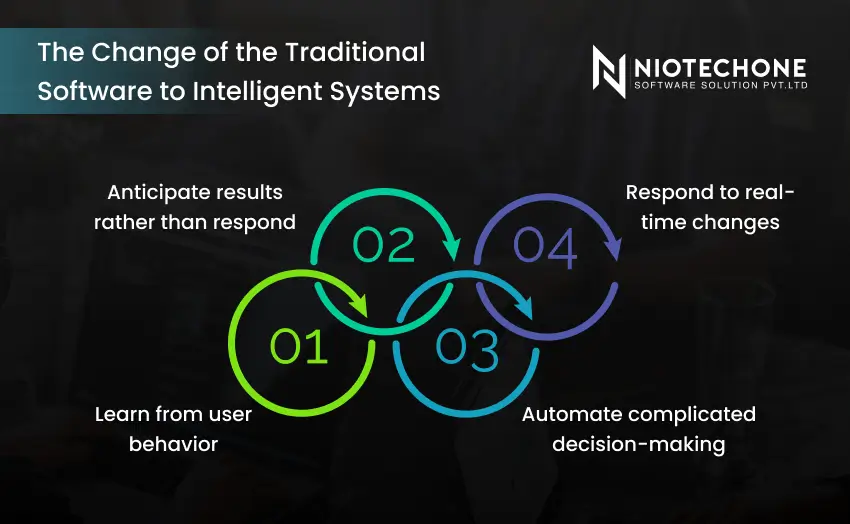
This change allows software to:
- Learn from user behavior.
- Anticipate results rather than respond.
- Automate complicated decision-making.
- Respond to real-time changes.
This development is the beginning of smart software systems in businesses, where applications are strategic assets and not fixed tools.
The way AI is transforming software development processes
The way software is created is not the only change that is going to be one of the largest in 2026. The whole software lifecycle is being transformed by AI-based application development.
AI now helps developers with:
- Code generation and optimization.
- Pre-deployment bug detection.
- Automated validation and testing.
- Performance forecasting
- Prediction of security vulnerability.
Development teams are able to work on architecture, innovation, and business logic instead of wasting a lot of time on repetitive tasks. Learn about our Custom Software Development Services and create smart, AI-enabled applications that fit your business requirements.
What Will Be Different in AI-Powered Software Applications in 2026?
In 2026, AI-based applications are contextual. They do not simply process inputs, they know intent, behavior and outcomes.
Examples include:
- Predictive customer churn CRM systems.
- eCommerce sites that customize real-time journeys.
- Diagnostic decision support software in healthcare.
- Proactive fraud detection financial systems.
- Enterprise dashboards that prescribe, not describe.
These AI-based software applications in 2026 will be developed to keep on improving, and this will provide businesses with a significant competitive edge.
Enterprise-level Intelligent Software Systems
AI is no longer a side feature used by enterprises. Rather, it is integrated into the very fabric of their systems.
The current smart software systems of businesses are concerned with:
Decision intelligence
- Process automation
- Predictive analytics
- Real-time optimization
- Scalable learning models
AI helps businesses to react more quickly to market shifts, lower operational expenses, and discover insights that were once obscured by large volumes of data. Get to know more about our Enterprise Software Development Services that are developed on the basis of scalability, security and intelligence.
The Advantages of AI-Powered Software to Businesses
The advantages of AI-based software are much more than automation. The direct effects of AI on revenue, efficiency, and customer satisfaction are evident in 2026.
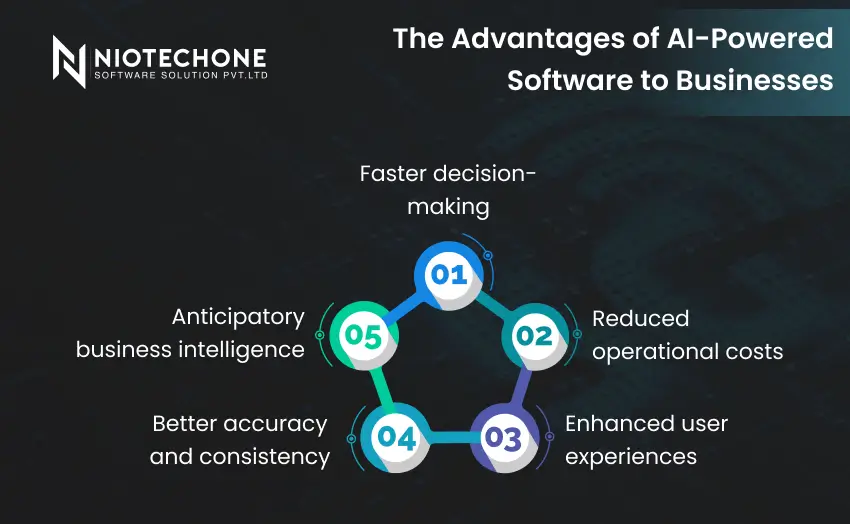
Key benefits include:
- Faster decision-making.
- Reduced operational costs.
- Enhanced user experiences.
- Better accuracy and consistency.
- Anticipatory business intelligence.
Companies that invest early in AI-powered systems are in a better position to adapt, scale, and innovate in competitive markets.
Difficulties in AI-Based Application Development
Although AI has transformative benefits, it also comes with new challenges that should be handled with caution. The quality of data is also a key consideration- intelligent systems are based on high quality, clean and representative data. Incorrect or prejudiced information may have a great impact.
Other factors are:
- Explainability: Businesses require clear AI models, particularly in regulated industries.
- Integration: AI integration with legacy systems may be complicated.
- Talent Gap: AI requires skilled professionals to develop and maintain.
Nevertheless, companies that invest in planning, architecture, and expertise can enjoy considerable benefits despite these challenges. The long-term payoff will be better automation, smarter decision-making, and better operational efficiency.
The Changing Interaction Between Humans and Intelligent Software
In 2026, AI is not about substituting humans, it is about enhancing their capabilities. The development of AI-based applications is becoming more human-centered, with intelligent software serving as a co-pilot: interpreting data, pointing out insights, and suggesting actions as humans make ultimate decisions.
The main advantages of this partnership are:
- Faster and more accurate decision-making.
- Increased use of AI-based solutions.
- Responsible and ethical use of AI.
- Increased user confidence and openness.
With human judgment and machine intelligence, organizations will be able to realize the full potential of AI-powered software applications in 2026 without sacrificing accountability and confidence.
The Future Prospect: Self-Learning, Adaptive, and Evolutionary Software
Software no longer has a fixed future. In 2026, intelligent applications are constantly learning, adapting, and optimizing themselves as the business conditions evolve. The way AI is transforming software development is not just about automation but it is changing software into a strategic, dynamic partner.
This strategy helps organizations to:
- Take active, evidence-based decisions.
- Increase speed of innovation without risking.
- Grow smartly as business grows.
- Be agile in dynamic markets.
Companies that are implementing AI-based systems today are not just enhancing efficiency, they are also establishing the foundation of intelligent software systems in businesses that will define the industry standards tomorrow.
Conclusion
By 2026, software will not be characterized by lines of code but by intelligence, flexibility, and influence. The 2026 AI-driven software applications are changing the way businesses operate, compete, and grow.
AI is transforming every tier of the digital ecosystem, whether it is smarter development workflows or intelligent enterprise software development systems. Companies that adopt AI-based application development in the present day are establishing the basis of success in the long term.
Categories
Related Articles

Frequently Asked Questions FAQs
By 2026, AI software will automate many aspects of coding including: Writing code, Automating Testing, Predicting problems that may arise and also having the ability to learn from past experiences and change accordingly.
The biggest beneficiaries of AI-driven software in the future will be: Healthcare, Finance & Banking, Retail, Manufacturing, and Logistics.
As long as they have been built correctly, AI-Powered Software Applications will improve the Security of their users by enabling quicker identification of Threats and quicker Response Times compared to Conventional Software Applications.
In contrast to the way traditional software is developed, AI-Driven Software will require significantly more money to build initially but due to its Long-Term Efficiency, Scalability, and the ability to Automate Processes, will Significantly Reduce the Total Cost of Ownership.
Yes! Now even small companies can benefit from using AI-Powered Software Applications by utilizing cloud-based AI products.


