Choosing the Right Tech Stack for Long-Term Business Growth
- Niotechone Marketing Team
Introduction
One of the most important decisions that can be made in long-term business development is the technology stack. A custom software development company that uses the incorrect stack faces the risk of scalability, high maintenance expenses, and reduced time-to-market.
When making technology decisions, organizations, particularly CTOs, startup founders, and enterprise decision-makers, should take into account .NET development, ASP.NET Core, cross-platform frameworks, cloud integration, and AI-driven solutions in 2026.
A carefully chosen stack guarantees not only functionality, but also security, scalability, maintainability, and cost-effectiveness, which are essential to sustainable growth.
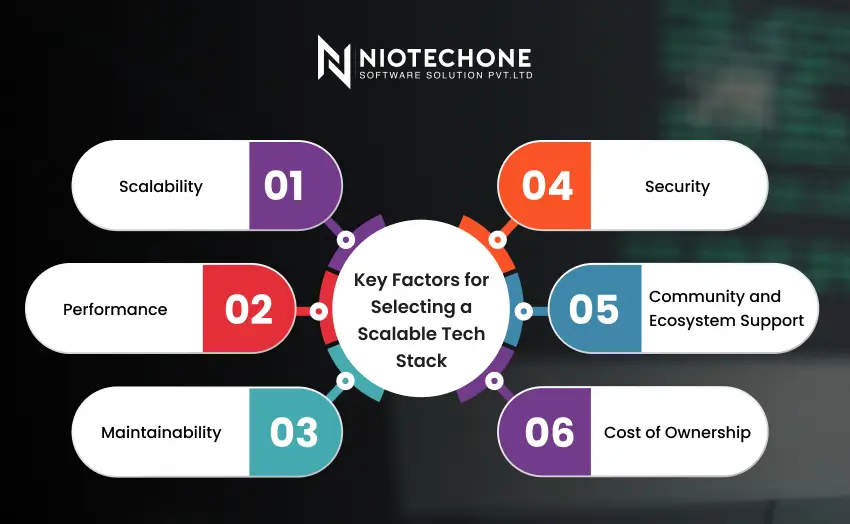
Key Factors for Selecting a Scalable Tech Stack
The selection of the appropriate stack is based on several dimensions:
Scalability
Your technology stack should be able to handle high-traffic enterprise applications. Take into account such frameworks as ASP.NET Core and .NET MAUI, which are oriented to scalable software applications.
Performance
A performant stack guarantees a quick response, particularly when the load is high. The solutions of modern .NET development companies are based on cloud optimization to ensure performance at scale.
Maintainability
Sustainable codebases are needed in the long term. The selection of custom .NET development services based on modular architecture minimizes technical debt and simplifies future upgrades.
Security
The stack should be designed to be secure. Enterprise applications require features such as role-based access control, API-level security, and identity management.
Community and Ecosystem Support
Choose popular technologies that have a vibrant developer base. This guarantees constant support, updates, and access to professional developers.
Cost of Ownership
Assess the cost of licensing, hosting, developer availability, and maintenance to make sure that the stack is affordable to operate in the long term.
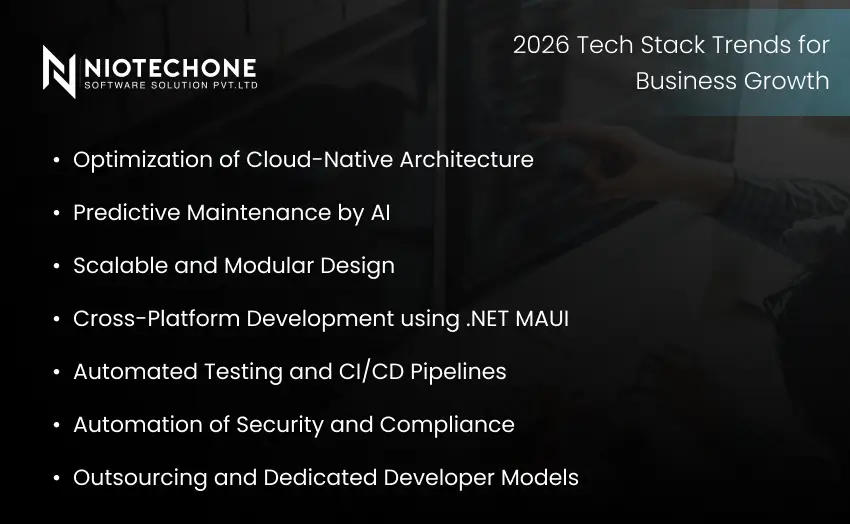
2026 Tech Stack Trends for Business Growth
The 2026 software environment is changing fast. Key trends include:
1: Optimization of Cloud-Native Architecture
Modern enterprise applications are based on cloud-first. Cloud-native architecture saves on infrastructure expenses, offers high availability, and offers scalable resource allocation.
Key Benefits:
- Application services of auto-scaling.
- Caching and managed databases.
- Simple connectivity with Azure enterprise applications.
Case study: A medium-sized fintech company has migrated its ERP to Azure cloud architecture, which has resulted in a 30 percent decrease in infrastructure expenses and enhanced system reliability.
2: Predictive Maintenance by AI
AI is also being incorporated into software monitoring and maintenance, which allows predictive detection of issues.
Key Benefits:
- Predicting system failures
- Automated regression testing.
- Optimization of resources in clouds.
Case study: Niotechone Software Solution Pvt. Ltd. deployed AI monitoring to a scalable .NET application of a client, cutting down the downtime by 25% and maintenance labor hours by 40%.
3: Scalable and Modular Design
Monolithic applications are expensive to maintain. Scalability and maintainability are enhanced by modular architecture.
Key Benefits:
- Scaling of modules independently.
- Less difficult updates and maintenance.
- Less chance of system-wide failures.
.NET-Specific Note: ASP.NET Core architecture with microservices enables long-term scalability of enterprise applications.
4: Cross-Platform Development using .NET MAUI
Cross-platform systems such as .NET MAUI enable businesses to create mobile and desktop applications using the same codebase.
Key Benefits:
- Quick development and deployment.
- Uniform user experience on devices.
- Lower maintenance costs
Case Study: Niotechone Software Solution Pvt. Ltd. assisted a retail customer in developing a cross-platform inventory application, which saved 35% of the development time.
5: Automated Testing and CI/CD Pipelines
Automation speeds up development and minimizes errors and maintenance.
Key Benefits:
- Unit and integration tests that are automated.
- Continuous delivery to safer deployments.
- Less labor-intensive quality assurance.
Case Study: Niotechone Software Solution Pvt. Ltd. deployed CI/CD pipelines on behalf of a client, which led to a 50 percent reduction in deployment failures.
6: Automation of Security and Compliance
Hackings are expensive. Automation makes enterprise software solutions secure and compliant.
Key Benefits:
- Automated vulnerability scanning.
- AI-driven threat detection.
- Regulatory compliance monitoring.
Outcome: Lower emergency patching expenses and increased user confidence.
7: Outsourcing and Dedicated Developer Models
Overhead can be minimized by hiring specialized teams or engaging a custom software development company to enhance quality.
Key Benefits:
- Availability of skilled .NET developers.
- Flexible team scaling
- Professional management of enterprise .NET application development.
Scenario: A multinational logistics company contracted Niotechone Software Solution Pvt. Ltd. to develop its ASP.NET Core API, which relieved the company of the resource load and accelerated the delivery of features.
Comparing Tech Stack Options for Enterprise Applications
Feature | .NET & ASP.NET Core | Alternative Stacks |
Scalability | High, cloud-ready | Moderate |
Cross-Platform | Supported via .NET MAUI | Limited |
Maintenance | Easier with a modular design | Often costly |
Security | Enterprise-grade | Requires extra tools |
AI Integration | Supported | Limited support |
Community | Large & active | Varies |
Tech Stack and Business Goals
The selection of the appropriate stack is not only technical:
- Plan your architecture for business expansion.
- Make sure that it is compatible with other systems and integrations.
- Focus on AI-enabled and cloud-ready frameworks.
Choose frameworks that have long-term support and an active developer community.
Example: Niotechone Software Solution Pvt. Ltd. assisted a SaaS company in aligning their .NET Core stack with Azure services, which allowed them to scale quickly, optimize costs, and release features faster.
Conclusion
The choice of the appropriate tech stack is the key to sustainable business development. Enterprises should focus on:
- Scalability and reliability solutions of the .NET development company.
- ASP.NET Core modular and maintainable apps.
- AI-based maintenance cost reduction.
- Cloud-native solutions for flexible and cost-effective operations.
By engaging a custom software development company such as Niotechone Software Solution Pvt. Ltd., you are guaranteed a future-proof stack, scalability, and alignment with long-term business objectives.
Categories
Related Articles

Frequently Asked Questions FAQs
Yes, .NET MAUI allows one codebase to be used across multiple platforms, which lowers the cost of development and maintenance.
Cloud-native stacks allow auto-scaling, reduce infrastructure expenses, and enhance reliability.
AI assists in predictive maintenance, resource allocation, and automated testing, which affects stack architecture.
Collaboration with a custom software development company guarantees experience in frameworks such as ASP.NET Core and Azure.
Standalone modules minimize downtime, ease updates, and enable scalable software applications.