Architecting Software for Multi-Region Deployment

Introduction

It is no longer sufficient to develop software in one region in 2026. SaaS solutions, enterprise applications, fintech applications, healthcare portals, and AI-based products are now used by users on all continents. There are increased performance expectations. Regulations on compliance differ across countries. Downtime is unacceptable.

When you are dealing with a .NET development company, an ASP.NET development company, or a custom software development company, multi-region deployment must be included in your architectural planning at the very beginning.

This guide will tell you how to design software to be deployed in multiple regions, what business executives need to consider, and how the appropriate software development company can assist you in creating a truly scalable global platform.

Multi-region deployment concept with cloud-based systems ensuring global availability and redundancy

What Is Multi-Region Deployment?

Multi-region deployment refers to the deployment of your application infrastructure in more than one geographic region to achieve:

  • Low latency for global users
  • High availability
  • Disaster recovery preparedness
  • Regulatory compliance
  • Business continuity

For example:

  • Indian users are linked to a region in Mumbai.
  • European users are connected to a region in Frankfurt.
  • The US users are linked to an East US region.

A well-designed, scalable software application directs traffic in an intelligent manner and synchronizes data in a secure way.

The Importance of Multi-Region Architecture in 2026

The world is becoming globalized at a rapid pace. Even startups acquire international users in a few months of operation.

In the absence of multi-region preparedness, businesses experience:

  • Slow response times
  • Compliance violations
  • Regional outages and downtime
  • Data residency conflicts
  • Revenue loss

The development of modern cloud applications and the Azure cloud architecture allows global scaling to be technically feasible, but only when properly designed.

Basic Architectural Principles of Multi-Region Deployment

1. Stateless Application Design

Distributed environments break stateful applications.

A multi-region-ready system must:

  • Store session data in distributed caches.
  • Do not be server-level dependent.
  • Authenticate with tokens (JWT).
  • Keep externalized configuration.


Stateless APIs are the norm in robust ASP.NET Core application architecture.

This enables:

  • Horizontal scaling
  • Load balancing
  • Seamless failover


2. International Traffic Routing Strategy

User experience is dictated by traffic routing.

Contemporary multi-region systems employ:

  • DNS-based routing
  • Geo-based routing
  • Latency-based routing
  • Failover routing


Azure Front Door or Traffic Manager is used in Azure cloud architecture to distribute traffic across regions automatically.

Business impact:

  • Faster load times
  • Reduced abandonment rates
  • High uptime


An effective ASP.NET Core API development company must consider resilience in routing.

3. Distributed Database Architecture

The most complicated aspect of multi-region deployment is the database layer.

You must decide between:

  • Single primary region and replicas.
  • Multi-master architecture
  • Active-passive failover
  • Geo-replication


Comparison: Database Deployment Models

Model

Pros

Cons

Single Region

Simple

High latency globally

Primary + Replicas

Read optimization

Write latency

Multi-Master

High availability

Conflict resolution complexity

Active-Passive

Reliable failover

Slight downtime during the switch

In modern .NET application development, Azure SQL Geo-Replication and Cosmos DB multi-region writes are common approaches.

4. Data Residency and Compliance Strategy

In 2026, data laws are strict.

Examples:

  • GDPR in Europe
  • HIPAA in the US
  • Compliance in various regions financially

Multi-region architecture should consider:

  • Storage of region-specific data.
  • Segregated user data
  • Encryption policies
  • Audit trails

A professional custom software development company integrates compliance into the infrastructure- not as a patch later.

5. Deployment Automation and DevOps

Regional deployment is slow and dangerous when done manually.

Modern systems require:

DevOps maturity is the key to global success in high-quality custom .NET development services.

Automation ensures:

  • Consistent deployments
  • Faster rollouts
  • Reduced downtime

Real-World Use Case: SaaS Platform Expanding Globally

A B2B SaaS company that was first launched in India with a single-region architecture.

Having spread to Europe and the US, they encountered:

  • Response times of 3-4 seconds to international users.
  • Database lag
  • Authentication timeouts
  • Compliance concerns

Following the redesign of the system with appropriate ASP.NET Core application architecture and multi-region Azure cloud architecture, the following results were achieved:

  • 60% reduction in latency
  • 99.99% uptime
  • Region-based data isolation
  • Seamless disaster recovery

The most important transformation was not cosmetic but architectural.

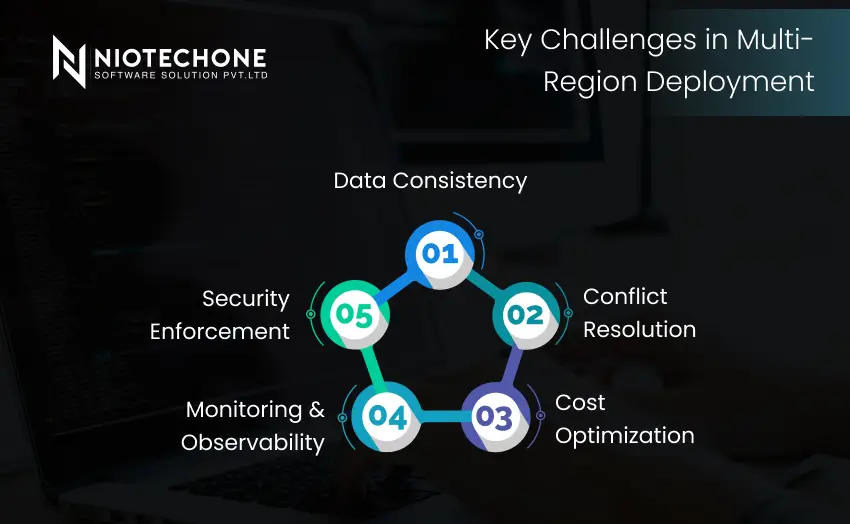
Key challenges in multi-region deployment including data consistency, conflict resolution, cost optimization, monitoring, and security enforcement.

Key Challenges in Multi-Region Deployment

Even seasoned teams have trouble with:

1. Data Consistency

Providing users with correct data in different regions.

2. Conflict Resolution

Simultaneous writes in distributed databases.

3. Cost Optimization

Operating infrastructure across different locations adds cost.

4. Monitoring & Observability

You need to monitor performance by region.

5. Security Enforcement

Security regulations should be uniform across the world.

These are some of the early issues that a good software development company or an international partner should take care of.

2026 Trends in Multi-Region Architecture

Traffic Optimization through AI

Software development AI is now used to dynamically optimize traffic routing according to load patterns.

Edge Computing Expansion

More applications handle data at edge nodes to minimize latency.

Zero-Downtime Global Deployments

Regional rolling deployments have become the norm.

Observability-First Design

Cloud platforms are designed with distributed tracing and real-time analytics.

Infrastructure Cost Intelligence

AI applications track and streamline cloud expenditures worldwide.

These standards are required by businesses that invest in global scalability of their ASP.NET development company.

When to Plan Multi-Region Deployment?

Multi-region architecture should be considered when:

  • You serve global customers.
  • You work in controlled sectors.
  • Your tolerance to downtime is close to zero.
  • You are developing a SaaS platform.
  • You are aggressive in international expansion.

It is much more costly to retrofit multi-region capability later than to design it in the first place.

Conclusion

Multi-region deployment software architecture is no longer a luxury for expanding businesses. By 2026, users around the world will demand high-speed, dependable, and secure digital experiences no matter where they are.

Multi-region readiness cannot be achieved by simply adding servers in a different country. When you are developing a global SaaS platform or enterprise system, engaging an established ASP.NET Core development company can make the difference between your product scaling gracefully or failing to scale with international expansion.

Frequently Asked Questions FAQs

Reduced latency to users worldwide and enhanced availability in case of regional outages.

Not necessarily in the short term, but early planning of the architecture lowers the cost of migration in the future.

Azure offers global traffic routing, geo-replication, distributed databases, and high-availability tools.

Ask about:

  • Actual multi-region case studies.
  • Azure architecture diagrams.
  • Database replication plan.
  • Deployment automation strategy.
  • Disaster recovery planning

Yes, but it minimizes the risk of downtime and enhances global performance, which can easily justify the investment.