AI-Powered Autonomous Operations

Introduction

Artificial Intelligence has advanced well past chatbots and other conversational boundaries. What started as basic rule-based assistants who could answer pre-set questions has become autonomous business systems; intelligent entities that could make decisions, learn, and function without supervision.

For today’s businesses that are looking for speed, scalability, and accuracy, these types of systems are the next step of digital transformation. Companies today don’t just want a tool that’s reactive; they want an AI that predicts business needs, automates workflows, and optimizes performance; minute-by-minute.

Sitting at the top this evolution is Niotechone Software Solution Pvt. Ltd., a Premier Software Development Company in Rajkot – India. Through AI-enabled software development, .NET Core application development, and Azure Cloud Solutions, empowers organizations to move beyond chatbots – built intelligent, self-learning systems that redefine efficiency.

Why Traditional Chatbots Are Insufficient

Chatbots can be helpful but are inherently limited. They follow rigid protocols, offer basic support, and depend on user-based prompts.

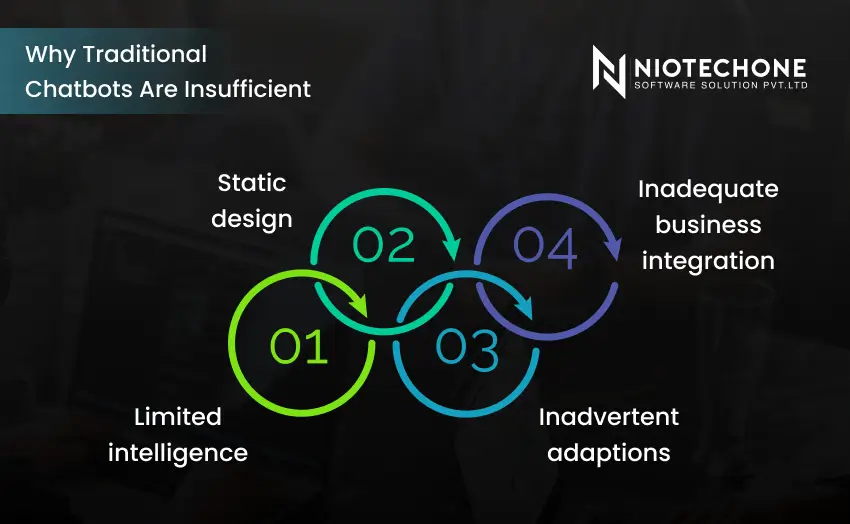
The limitations of traditional chatbots are:

  • Limited intelligence: They cannot interpret complicated or multi-step interactions.
  • Static design: Changes or advancements require updates to the chatbot.
  • Inadvertent adaptations: They lack awareness and understanding of context, sentiment and can struggle to respond to unexpected occurrences.
  • Inadequate business integration: Chatbots generally work with enterprise systems at the outermost limitation of the API surface.


As more organizations shift toward being data-driven, the limitations mentioned above are prohibitive to scaling. This is where autonomous business processes that are AI-driven can add value by making intelligent decisions, injections of adaptability, and real-time optimization.

How AI Creates Actual Autonomy Within Organizations

These systems rely on a powerful combination of technologies. These technologies incorporate machine learning, predictive analytics, cognitive computing, and process automation to make intelligent objective decisions, not just following rules.

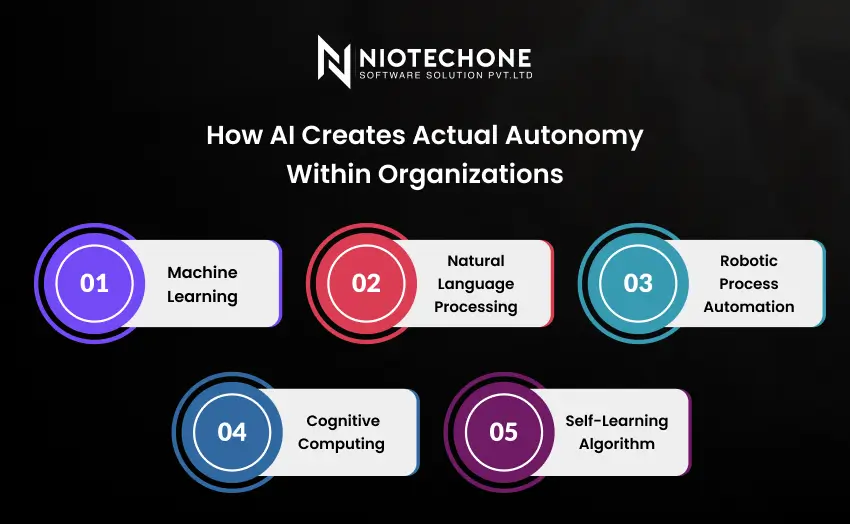
Autonomous systems rely on five pillars:

  1. Machine Learning: Continuous analysis of data to spot trends, forecast outcomes, and make real-time recommendations.
  2. Natural Language Processing (NLP): Allows the system to understand and interpret human language in context.
  3. Robotic Process Automation (RPA): Performs repetitive business processes, such as billing or data entry, with no human action.
  4. Cognitive Computing: Emulates human processes to make decisions based on context.
  5. Self-Learning Algorithms: Learn from experience and improve performance based on feedback, reducing the need for human checks.


Unlike traditional software that needs to be updated regularly, these capabilities use a learn-by-doing approach that increases their accuracy and efficiency over time.

Security and Ethics: Leading with Responsible AI

With autonomy must come accountability. AI-powered systems are powerful, but they come with questions around data security, transparency, and ethics.

Niotechone is embedding responsible AI principles with every stage of development:

  • Data privacy: Safeguarding sensitive client and user data.
  • Transparency: Ensuring the models used to make decisions are subject to audit.
  • Fairness: Preventing algorithmic bias.
  • Human oversight: Retaining governance of high-risk automation.


By defining the AI we design, we can be more effective and trust AI in business utterances, rather than relying on AI as an efficient operational tool.

Advantages of AI-Based Autonomous Systems

The utilization of AI autonomy brings tangible benefits across the business sectors: 

  • Operational Efficiency: Greater streamlined workflows with reduced manual involvement.
  • Real-Time Insights: Continuous data monitoring processes that expedite data-driven decisions.
  • Cost Efficiency: Lower risk of human error while the operational overhead decreases.
  • Predictive Precision: More intelligent forecasting and analytics through continuous data learning.
  • Improved Customer Experience: Context specific, personalized engagement.
  • Business Agility: Fast adaptation to changing market conditions. 

For enterprises, this is not merely a technology shift, but strategic rediscovery.

The Function of Predictive Intelligence in Autonomous Decision-Making

Predictive intelligence serves as the core of authentic autonomy. It gives AI systems the ability to anticipate potential outcomes, assess risks, and then make informed decisions.

Unlike standard automation, which simply occurs after an event occurs, predictive models look at historical and real-time data to understand future trends.

For example, within enterprise finance systems, AI may be able to predict fluctuations in cash flows, and take precautions beforehand. In retail settings, AI software would also be able to predict product demand weeks in advance based on market behaviors.

With the integration of Azure Machine Learning and .NET Core, companies could build predictive engines that:

  • Simultaneously review millions of data points.
  • Deliver immediate and actionable insights.
  • Leverage feedback loops to improve the predictive analysis.


The outcome? Cognizant enterprises that take intelligence-driven action prior to issues occurring, rather than react to them after.

Digital Twins: The Silent Enablers of Autonomy

One of the most exciting recent developments in enterprise AI is the emergence of Digital Twin technology — a virtual version of a business process, machine, or system that learns and unfolds in real time.

Digital twins enable autonomous systems to electronically simulate scenarios before they interact with the real-world for decision making. 

For example:

  • A manufacturing facility may run production scenarios based on various factors.
  • A logistics network may run alternative delivery routes while also running the delivery services.
  • To forecast bottlenecks, a software company is able to reproduce app activity during a high traffic scenario.


When digital twins are paired with AI-powered analytics tools, organizations can mitigate risk, improve accuracy, and provide 360° operational visibility – transforming insights into autonomous action.

AI Ethics and the Responsible Automation of Processes

As organizations begin to adopt autonomy, using ethical AI becomes of paramount importance. Autonomous systems must be transparent, fair, and secure.

Niotechone embeds ethicalities into their approach to enabling responsible AI:

  • Transparency: All decisions made by AI should be understandable.
  • Privacy: Processing personal data should comply with GDPR and ISO standards, using end-to-end encryption wherever possible.
  • Fairness: Algorithms should not exhibit bias when making decisions.
  • Human Control: Humans should remain in control of critical mission outcomes on critical operations.


Responsible AI promotes trust, compliance, and a focus on long-term sustainability in an organization’s digital transformation journey.

Conclusion: Moving Past Chatbots

Chatbots, once the pioneers of conversational AI, will now be outpaced by a new autonomous technology that will completely transform the business world. 

By combining AI intelligence, the best engineering in .NET Core, and the scalability of Azure Cloud, companies can begin building business systems that will think, decide, and grow autonomously. 

At Niotechone, we assist organizations with that transformation — changing conventional processes into autonomous intelligent ecosystems. This could entail custom software development, mobility solutions for enterprise, or integrating AI automation into business processes- we assist organizations in moving past chatbots into full autonomy!

Frequently Asked Questions FAQs

An autonomous business system is a platform powered by artificial intelligence, able to independently evaluate information and make decisions about the process without direct human management involved.

Chat bots are communication devices which will respond to human indirect command, whereas an autonomous business system would independently make decisions and automate business workflow.

More finance, healthcare, logistics, and retail are advanced in adopting these solutions considering their strong reliance on applying and accessing data and the automation of operating processes.

Azure provides robust access to AI Technology Services, cognitive usable APIs, and learning pipelines to assist enterprise customers automate at a scalable level. 

With experienced and skilled developers in Rajkot, Clients can utilize effective services for using .Net cloud and AI technology and processes.