AI-Powered API Ecosystems

Introduction

APIs have been the foundation of digital systems since the beginning, allowing software applications to communicate with each other without issues. However, nowadays APIs are becoming much more powerful. As artificial intelligence is directly integrated into API frameworks, we are moving into the age of AI-driven API ecosystems, where integrations are quicker, smarter, autonomous, and adaptive.

APIs are no longer passive connectors in this new landscape. They are informed by data, anticipate system behavior, optimize performance, avoid failures, improve security, and even make real-time decisions. This change is altering the way businesses develop software, automate operations and scale digital ecosystems.

A full-scale exploration of the functionality of AI-powered APIs, their importance, and how businesses are leveraging this new architecture is provided below.

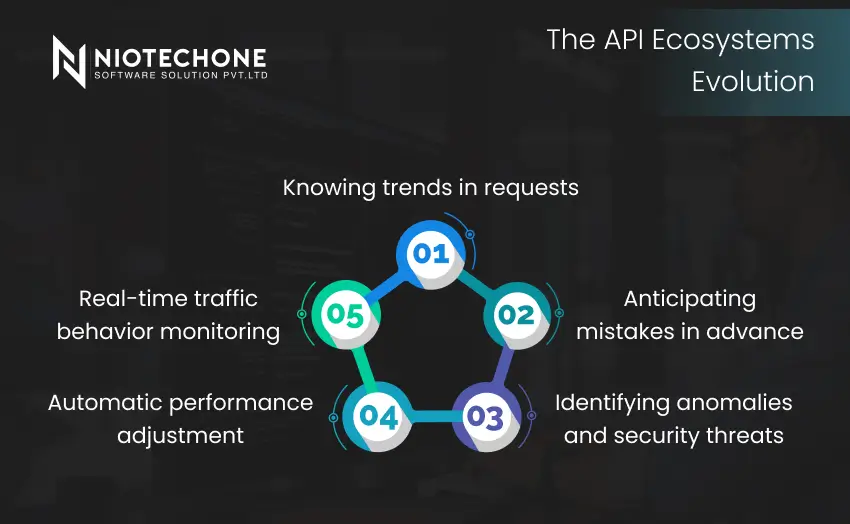
Infographic showing the evolution of API ecosystems with five key insights and circular numbered design.

The API Ecosystems Evolution

APIs began as fixed data pipes, simple endpoints that either received or sent information. They facilitated microservices, cloud applications, mobile systems, and massive enterprise architectures over time. However, traditional APIs continued to rely on developers to observe performance, secure endpoints, optimize routing, resolve failures, and maintain integrations manually.

AI-based APIs can:

  • Knowing trends in requests.
  • Anticipating mistakes in advance.
  • Identifying anomalies and security threats.
  • Automatic performance adjustment.
  • Real-time traffic behavior monitoring.


The system does not respond to problems, but rather enhances itself. This is the start of smart integrations within organizations.

Banner showing a futuristic robot on a computer screen with the text “What Makes an API AI-Powered?”

What Makes an API “AI-Powered”?

An AI-based API ecosystem consists of APIs that are augmented with machine learning, natural language processing, predictive analytics, and autonomous decision logic.

These APIs can:

  • Learn from historical data
  • Process requests rather than processing them.
  • Identify intent and act contextually.
  • Maximize routes to enhance speed and reliability.

As an example, an AI-enhanced API gateway can predict peak traffic times and pre-allocate resources. Or a security API can identify suspicious activity on thousands of requests and block malicious activity in real time. Simply put, AI transforms APIs into intelligent agents instead of fixed points.

Autonomous Integrations: A New Enterprise Connections

Conventional integrations involve developers to create, test, deploy, and maintain all workflows. Hundreds of systems interact every day in large enterprises, which complicates and makes it costly to integrate them manually. This is made easy by AI-driven API ecosystems.

What independent integrations would appear within a business:

  • APIs identify new data sources automatically and propose integration paths.
  • When one endpoint fails, AI automatically reroutes traffic.
  • The API flows are automatically updated according to the changing business processes.
  • Integrations are self-healing and reconnecting in case of failures.


This results in:

  • More rapid introduction of new features
  • Fewer integration error
  • Less reliance on manual coding
  • Lower maintenance costs


Businesses receive a system that is self-improving as it operates.

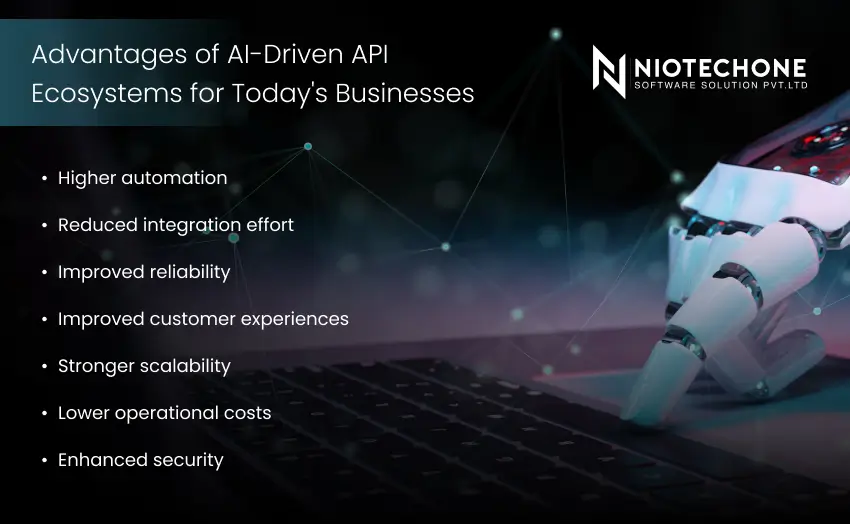
Advantages of AI-Driven API Ecosystems for Today's Businesses

Higher automation

AI is used to perform repetitive work and maintain workflows without human intervention.

Reduced integration effort

Smart connectors automatically identify data patterns and streamline system mapping.

Improved reliability

APIs are self-optimizing, predictive and minimize downtime.

Improved customer experiences

The responses are responsive to user behavior, which makes the interactions smoother.

Stronger scalability

AI predicts traffic and optimizes resources.

Lower operational costs

Reduced manual maintenance and accelerated development saves on long term costs.

Enhanced security

AI tracks requests and prevents suspicious or dangerous behavior.

AI-Powered API Governance: Control in a Complex Ecosystem

With hundreds of APIs being implemented by enterprises on various platforms, they are harder to manage. The API governance assists in ensuring consistency, security, and compliance. With the introduction of AI to the governance systems, businesses will be able to gain much better control with a lot less manual work.

Governance tools based on AI automatically classify APIs, trace changes, monitor usage, and impose rules on all services. Rather than teams going through documentation or access control manually, AI constantly checks to see that APIs are adhering to company standards. This assists large organizations, particularly those collaborating with a software development company in Rajkot or custom software development teams in India, to have a clear visibility throughout their whole digital ecosystem.

The essential AI Governance Capabilities:

Automated Policy Enforcement

AI authenticates security policies, request quotas, access controls, and data-sharing guidelines.

Ongoing Compliance Control

The APIs are scanned on the fly to comply with industry standards such as GDPR, PCI-DSS, or HIPAA.

Intelligent Versioning Recommendations

AI identifies breaking changes and suggests the need to update APIs with a version.

Such a degree of automated governance is critical when businesses increase in size.

Observability of API with AI: Viewing More, Resolving Faster

Enterprises that depend on distributed systems have become a significant requirement of observability. AI-based observability tools automatically analyze logs, metrics, traces, latency, and error patterns to provide businesses with a better understanding of system behavior in various conditions.

To provide an example, when an API begins to slow down, AI can tell whether it is a particular microservice that is causing the issue, a database bottleneck, or a sudden traffic surge. This saves development teams hours of manual debugging and helps in making decisions faster.

What AI Observability Enhances:

  • Failure mode and effects analysis.
  • Early identification of abnormal trends.
  • Faster incident resolution
  • Maximization of API performance.

It is particularly applicable to cloud-based systems that are developed based on Azure cloud application development, ASP.NET Core development, or large-scale .NET Core application development.

The Economic Implication of AI-powered API Ecosystems

In addition to technical advantages, API ecosystems powered by AI generate high business value. Firms that embrace intelligent APIs have shorter release cycles, reduced failures and more efficient operations. This will help in enhancing revenue prospects and long-term digital expansion.

Economic benefits are:

  • Quickened integration of new digital services.
  • Reduced downtime costs
  • Reduced integration and maintenance costs.
  • Increased development team productivity.
  • Better customer lifetime value.

Companies that adopt AI-based integrations are set to operate in the future and become more agile in a competitive market.

The role of AI-Powered APIs in Digital Transformation

Digital transformation is not merely about the utilization of new technologies, but making systems smarter to work together. This is made possible by AI-driven APIs that bridge the gap between old and new systems, automate decision-making, and provide real-time insights.

Indian and global enterprises are using intelligent API architectures to modernize operations, enhance customer experience, and build a more scalable organization. In the case of companies collaborating with a software development firm in Rajkot or implementing AI in software development in Rajkot, AI-driven APIs will be the driving force of digital expansion.

Conclusion

The introduction of AI-driven API ecosystems is a significant shift in the way business interrelates systems, automates processes, and provides digital experiences. Enterprises can achieve freedom, real-time intelligence, enhanced security, and accelerated innovation by integrating artificial intelligence with API infrastructures.

As AI keeps developing, APIs will cease to be mere connectors and will become the decision-makers in the operation of the enterprise. Companies that embrace smart APIs today will be the first to embrace the digital revolution.

Frequently Asked Questions FAQs

An API-based system that learns, adapts, optimizes performance, and automates workflows through artificial intelligence.

Yes, AI is able to forecast heavy traffic, reroutes, and resource allocation in real-time.

Not anymore. The low-code AI tools simplify creation and management significantly.

Absolutely. AI is quicker than human surveillance in identifying threats and implements dynamic security controls.

The cost is a matter of scale, and in the vast majority of instances, automation and less manual work save money in business.