AI-First Dev Teams: Building Software with Automation from Day One

Introduction:

In the modern digital world, the software development process is not merely about writing code anymore, it is about speed, quality, flexibility, and the adoption of intelligent systems at the very core. To be a leader, not a follower, an AI-first mindset implies that workflows, tools, and culture are structured around automation, data-driven insights, and intelligent augmentation. To a .NET development company in Rajkot, the difference between creating software that feels modern and responsive, and being left behind, can be the adoption of AI-first principles.

We will discuss in this blog what it requires to create software with automation on the first day, the advantages of doing so, how to establish AI-first development teams, and what technologies and practices can make it work, particularly in areas such as web development, custom software development, Azure cloud application development, and AI in software development in Rajkot.

What is AI-First to a Dev Team?

AI-first does not imply that all the code lines should be created by AI or that humans will be replaced. Rather, it’s a paradigm shift:

  • Considering how AI/ML, automation, intelligent agents, and data can enhance efficiency, quality, and user experience at the beginning.
  • Integrating automation into development pipelines, not as an add-on, but as a layer.
  • Making sure that systems are constructed in such a way that they are observant, capable of learning, adapting and evolving automatically where necessary.

In the case of a software development company in Rajkot, that is to say when you start a project, be it a new web application, enterprise mobility solution, or a custom software system, you plan:

  • Automated testing, such as unit tests, integration tests, and performance tests.
  • Continuous integration / continuous deployment (CI/CD) pipelines.
  • AI code review, bug detection, performance optimization.

Monitoring and instrumentation to enable you to identify problems (bugs, performance bottlenecks, user-behavior anomalies) in real-time and hopefully enable adaptive behavior.

Why Automate Software at the Start

Automation, data, and AI should be made core and not added on afterwards, and there are numerous reasons to do so. Here are some of the biggest:

Better Quality and Reduced Bugs

Many issues are detected early by automation (testing, linting, security scanning). AI-based tools may be used to predict bugs or code smells, propose refactorings, or detect design anti-patterns. Once you have these in place when you begin a project, the codebase remains cleaner. This is important in ASP.NET Core development in Rajkot or .NET Core application development: clean architecture contributes to maintainability, scalability, and less technical debt.

Faster Time to Market

Automation accelerates tedious or repetitive work: builds, deployments, environment provisioning. AI tools may be used to aid in code scaffolding, generation or template suggestions. You will achieve delivery milestones earlier, iterate quicker as a .NET development company in Rajkot or a web development firm.

Scalability and Reliability

By creating automation at the start, you are more likely to have systems that are ready to grow. Azure cloud application development provides you with elastic infrastructure; deployment and monitoring is automated, which makes scaling up or scaling down easier. In addition, enterprise mobility software solutions enjoy stable, scalable backends and deployment pipelines.

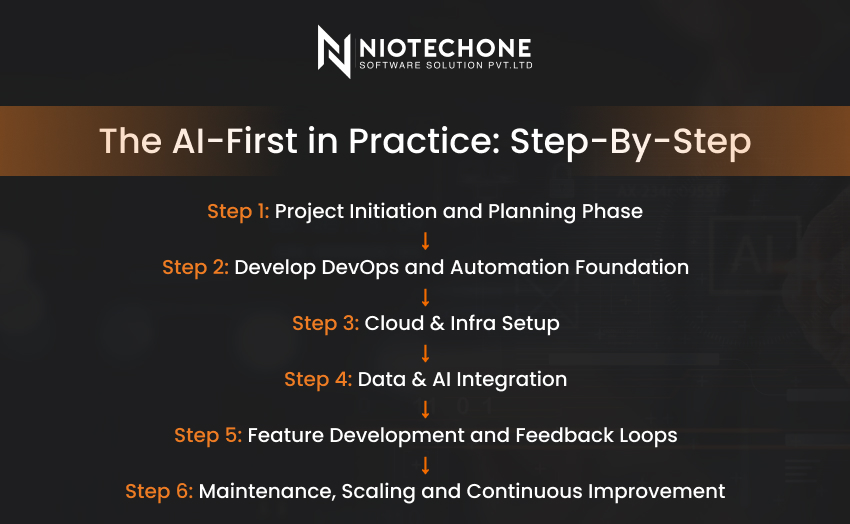
The AI-First in Practice: Step-By-Step

The following is a realistic roadmap that a custom software development team or ASP.NET core development in Rajkot,  can use to incorporate automation and AI at the very beginning.

Step 1: Project Initiation and Planning Phase

  • Define vision and KPIs: What business results? E.g. cut bug rate by half, cut deployment time, increase user retention by X%.
  • Stakeholder alignment: Reach consensus on automation objectives, AI integration, data gathering, security, cloud integration.
  • Define architecture pattern: e.g. microservices vs monolith, API-first, clean layers.
  • Establish environments and deployment plan: dev / test / staging / production; determine CI/CD tools.


Step 2: Develop DevOps and Automation Foundation

Install version control (Git), and branching policy.

  • Build CI pipeline: each commit will cause a build + unit tests + static analysis.
  • Install CD pipeline: deployments to dev/staging are automatic, perhaps manual gate to prod.
  • Code reviews and code quality tools: perhaps use AI tools that propose improvements; style enforcement.


Step 3: Cloud & Infra Setup

When you are taking Azure cloud application development, configure your cloud environment in advance. Provision resources via IaC. Consume Azure services such as App Services, Azure Functions, Azure Kubernetes Service (AKS), storage, identity.

Make decisions on containerization / serverless where necessary.

Be secure and compliant at the beginning: identities, roles, encryption, network security.

Step 4: Data & AI Integration

  • Infrastructure: user events, logs, telemetry (e.g. Application Insights, or similar).
  • Define metrics & dashboards: configure observability to be able to measure performance, reliability, user behavior, errors.
  • Privacy & ethical considerations: guarantee privacy, adherence to laws (e.g. GDPR where applicable), anonymization.


Step 5: Feature Development and Feedback Loops.

  • Apply agile: sprints / iterations, including demo, retrospectives.
  • Add automated feedback loops: monitor usage, errors, performance after every feature. Adjust accordingly.
  • AI-based or assisted code review: apply tools that propose improvements.

The most important Technologies and Tools to adopt in an AI-First Stack

Some technologies are particularly useful when developing software that is automated at the very beginning. These are highly applicable to .NET / ASP.NET Core / Azure-centric development.

Addressing the Obvious Obstacles.

Even in the case of experienced teams, the transition to an AI-first, automation-first-day-one strategy is not easy. Knowing and anticipating them is beneficial.

Resistance to Change

Individuals are accustomed to conventional procedures. The implementation of automation, testing, and AI tools implies new habits. Training-induced, demonstrating value early (quick wins), engaging everyone in decision-making.

Upfront Investment

The establishment of automation and AI pipelines is time-consuming. However, ROI is a reality: fewer bugs, quicker delivery, reduced maintenance costs. Being a web development or custom software development company, you can develop this as a service offering, which will add more value to the clients.

Future Trends: What to Expect and How to be ahead

To stay competitive in the delivery of AI-first software, the following trends should be observed and how a company in Rajkot or any other company in the .NET development business should prepare is as follows:

Additional AI Support / Generative AI Code Assistance.

We will have more powerful generative AI tools that can write modules, propose optimizations, even refactor code. They will require dev teams to safely integrate them, manage such problems as code trust, license, and quality.

Low-Code / No-Code + AI Hybrids

Certain software components can be created using low-code software development tools but enhanced by AI. These hybrid solutions might speed up delivery, particularly in the case of internal tools, dashboards, or enterprise mobility apps.The integration of low-code and ASP.NET Core backends may be in greater demand by NET teams.

Edge / IoT + AI

With the addition of more devices (mobile, sensors) to workflows (to manufacturing, agriculture, logistics), applications will require edge computing and AI inference on the device. This is a huge opportunity in the case of enterprise mobility software solutions.

Conclusion

In the current competitive software environment, developing an AI-first team is no longer a matter of experimenting with automation, but rather a matter of establishing a long-term innovation base. Automation teams that begin on day one do not merely save time, but they keep on improving the quality of the product, increasing collaboration, and making sure that the product is scalable at the very bottom.

The AI-first mindset enables developers to be creative and strategic in their problem-solving, whereas intelligent systems do repetitive tasks and predictive decision-making. It can be in the development of an application in .NET Core, in solutions based on Azure, or in enterprise mobility projects, automation and integration of AI will make each release faster, smarter, and more reliable.

Frequently Asked Questions FAQs

AI-First refers to the creation of software teams, processes, and products that are built around artificial intelligence and automation. It entails the incorporation of smart tools to code, test, deploy and make decisions instead of incorporating them subsequently.

Early automation guarantees cleaner code, quicker deployments, and reduced bugs. It is also useful in creating scalable architectures, ensuring quality consistency, and facilitating continuous delivery without human intervention.

AI tools are used in code generation, bug detection, code optimization, and documentation. They minimize repetitive work and enable developers to work on complex issues and create superior user experiences.

The most important enablers are cloud computing (such as Azure), DevOps pipelines (CI/CD), machine learning frameworks (ML.NET, TensorFlow), automated testing tools, and AI-assisted assistants built into IDEs, such as Visual Studio or VS Code.

Absolutely. AI-first practices are even more advantageous to smaller teams since automation offsets the lack of manpower. It enhances efficiency, minimizes errors, and allows scaling faster as the business expands.

Â