
10 Metrics All CEOs Should Track in Software Projects
- Niotechone Marketing Team
Introduction
In the current competitive and technology-driven business world, CEOs cannot risk making software project decisions on the basis of deadlines or budgets. Software projects are complicated, with several teams, technologies, and deliverables. Measuring the right things keeps the projects on track, on budget and on business objectives.
Indian businesses, particularly in cities such as Rajkot, tend to outsource the services of a .NET development company in Rajkot or collaborate with professional companies in custom software development to handle important software development projects. Nevertheless, no matter what technology partner is chosen, CEOs should be proactive in tracking key metrics to determine the health, productivity, and ROI of the project.
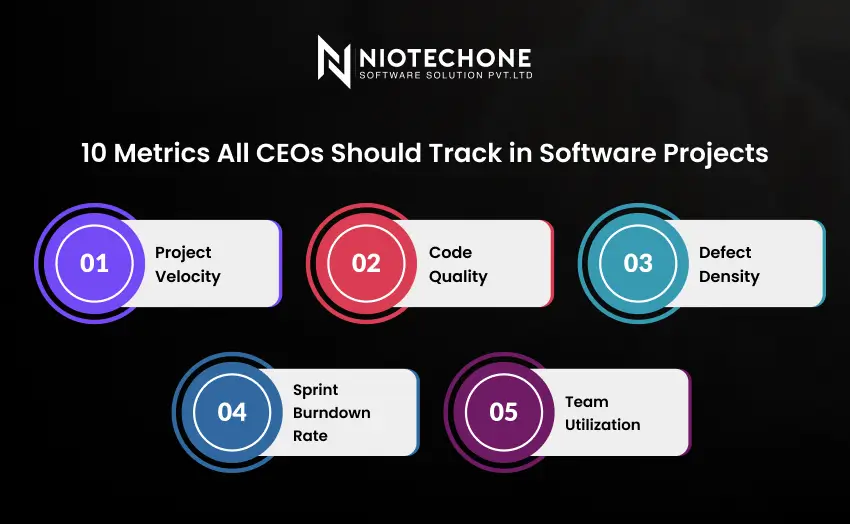
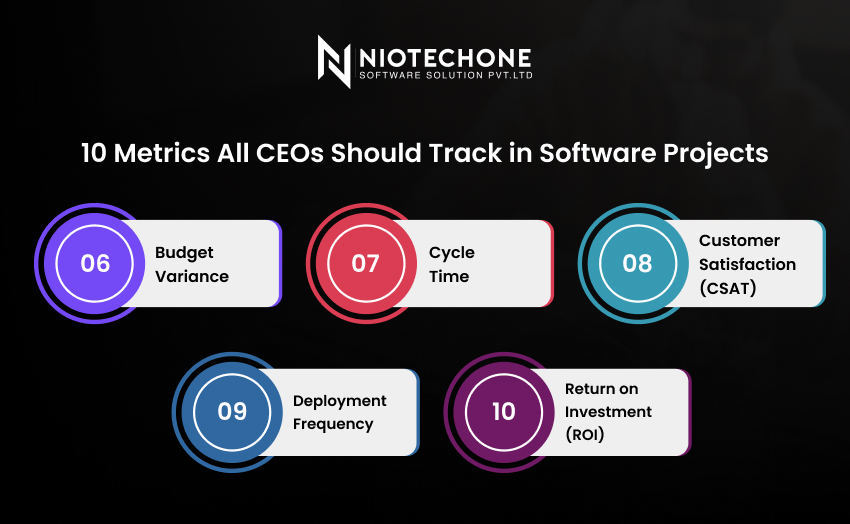
This guide provides 10 key metrics that every CEO must monitor in software projects, practical insights, real-life examples, and advice on how to use these metrics to achieve success.
10 Metrics All CEOs Should Track in Software Projects
1. Project Velocity
Definition:
Velocity is used to measure the work done by a development team during a sprint or iteration. It is commonly measured in story points, tasks, or features.
Why it Matters for CEOs:
- Assists in estimating project schedules.
- Identifies productivity patterns and bottlenecks.
- Plans resource utilization in subsequent sprints.
Practical Tip:
Measure velocity across multiple sprints to determine trends instead of using one sprint.
Example:
An average of 60 story points is completed by a travel portal development team in Rajkot in a sprint. The CEO can predict when the product will be ready to launch and when it may slow down, thereby avoiding delays that impact deadlines, by tracking velocity trends.
2. Code Quality
Definition:
Code quality measures maintainability, readability, reliability, and adherence to coding standards.
Why CEOs Should Monitor It:
- Poor code results in increased defect rates and technical debt.
- Affects long-term maintenance expenses.
- Provides scalability to future development.
Tools for Monitoring:
- SonarQube
- Code Climate
- .NET Core application development Static code analysis.
Example:
A company in India contracted a company specialising in .NET development to create a cloud-based system. The CEO was able to review code quality metrics regularly, which allowed him to make sure that the application could be easily updated without significant rework or security threats.
3. Defect Density
Definition:
Defect density is the count of defects found per thousand lines of code (KLOC) or per module.
Why it Matters:
- Defect density is high, which means that there may be quality problems.
- Promotes early intervention before expensive rework.
- Helps give priority to QA resources.
Example:
A defect density of 8 defects per KLOC in a custom ERP system led the project manager to introduce automated testing, which enhanced quality and minimized downtime.
Tip:
Integrate defect density and severity ratings to concentrate on the critical issues that have a direct impact on business operations.
4. Sprint Burndown Rate
Definition:
The burndown rate monitors the progress of accomplishing scheduled tasks within a sprint.
Why CEOs Should Care:
- Indicates the progress of teams towards achieving sprint goals.
- Early identification of bottlenecks and scope creep.
- Enhances future sprint planning.
Example:
An example of a software project in Rajkot that applied the Azure cloud application development involved the use of daily burndown charts to make resource adjustments to ensure that the sprint was completed on time.
Pro Tip:
Add burndown tracking to dashboards that CEOs can use to get a quick status update.
5. Team Utilization
Definition:
Team utilization is a measure of the ratio of time that team members are engaged in productive work to idle or non-billable work.
Why CEOs Should Monitor:
- Maximizes resource allocation
- Prevents overworking staff
- Determines training or workload problems
Example:
One of the custom travel portal projects realized that junior developers were not fully utilized. The project was able to reallocate tasks and achieve 20 percent efficiency without incurring costs.
Tip:
Monitor team and individual productivity using team utilization dashboards.
6. Budget Variance
Definition:
Budget variance is used to monitor the variance between the planned project costs and the actual costs.
Why CEOs Should Monitor:
- Prevents cost overruns
- Facilitates financial forecasting
- Ensures profitability
Example:
A custom enterprise mobility software company in India monitored weekly budget variance. In cases where the actual expenditure was higher than the planned costs because of extra cloud services, the CEO authorized the reallocation of resources to manage costs.
Pro Tip:
Add indirect expenses, such as cloud hosting (Azure or AWS), to the variance calculations to have a real financial image.
7. Cycle Time
Definition:
Cycle time is the time taken to complete a task.
Why CEOs Should Care:
- Exposes process bottlenecks.
- Helps streamline workflow to deliver faster.
- Promotes ongoing enhancement.
Example:
The original cycle time per feature in a cloud-based SaaS project was 15 days. Cycle time was cut to 7 days after automated testing was implemented, which increased the speed of product release.
8. Customer Satisfaction (CSAT)
Definition:
CSAT measures the satisfaction of end-users with software features, performance, and usability.
Why CEOs Should Track:
- Reflects software business impact
- Guides UX/UI improvements
- Improves adoption and retention
Example:
In India, a healthcare application scored 92% CSAT score following the incorporation of feedback in the development of custom software, which enhanced patient satisfaction and retention.
Tip:
Gather CSAT at each release, especially of critical enterprise applications.
9. Deployment Frequency
Definition:
Measures the frequency of updates, patches, or new features being deployed to production.
Why CEOs Should Care:
- Agility is exhibited by high frequency.
- Low frequency means that there are bottlenecks in the QA or deployment pipelines.
- Favors continuous delivery and iterative development.
Example:
An automated CI/CD pipeline enabled a software development company in Rajkot to shorten release cycles and enhance responsiveness to market demands.
10. Return on Investment (ROI)
Definition:
ROI is a calculation of financial and operational returns in comparison to the cost of software projects.
Why CEOs Should Track:
- Quantifies business impact
- Assists in making investment decisions in the future.
- Measures efficiency gains
Example:
A custom CRM system created by a retail chain saved 40 percent of manual processing, which saved the company 100,000 a year and provided a high ROI.
Pro Tip:
Include indirect ROI, including productivity gains, customer retention, and downtime.
CEO Dashboard Metrics Recommended
CEOs need a visual dashboard that integrates:
- Velocity trends
- Budget and cycle time measures.
- Code quality metrics
- Customer satisfaction ratings
- Deployment frequency
This provides a comprehensive perspective of project health at a glance.
Conclusion
In the case of CEOs managing software projects, it is important to track key metrics to be successful. These KPIs give a complete picture of project performance, including project velocity and defect density, ROI, and CSAT, which allows making informed decisions and taking proactive measures.
Rajkot and other organizations in India can use the services of .NET development Companies or specialists in custom software development to deploy metrics tracking systems, dashboards, and cloud solutions to achieve optimal productivity, quality, and profitability.
With these 10 metrics, CEOs can minimize risks, maximize efficiency, and make sure software projects provide real business value.
Categories
Related Articles

Related Tags
Frequently Asked Questions FAQs
They give an understanding of the project's health, resource allocation, quality, and ROI to make informed decisions.
Yes, even SMEs can use monitoring velocity, defect density, and ROI to enhance project results.
Cloud applications enhance the frequency of deployment, cycle time, and scalability.
Commonly used are Jira, Trello, Azure DevOps, and automated code quality tools.
Tailor-made solutions enable CEOs to combine dashboards, AI analytics, and cloud monitoring to obtain real-time insights.


