Qwen AI – Smart AI for Teams: Everything You Need to Know
- Niotechone Marketing Team
Introduction
The original slides included information on Qwen’s features, model ecosystem, use cases for each team, benefits, and drawbacks. In the following, we have distilled all of this information into a readable blog post, explaining what Qwen AI is, how it benefits developers, QA teams, DevOps, business, and customer support, and more.
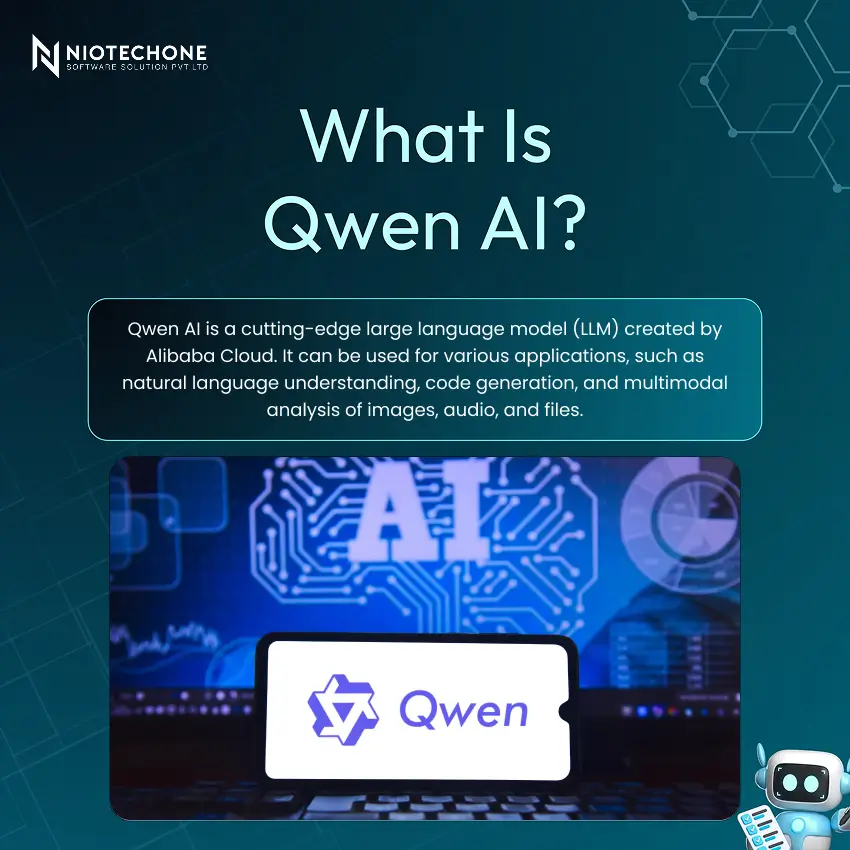
At a glance, the following are key capabilities:
- Answer questions and generate content
- Write, review, and debug code
- Interpret pictures, sound, and text
- Automate team workflows
Qwen is open-source, multi-modal, fast, cost-effective, and enterprise-ready, featuring built-in API integration and multi-language support.
Qwen provides a complete toolkit for all team functions:
- AI Chat Assistant – Chat interface for immediate answers, summarization, and research.
- Code Generation – Write, explain, debug, and translate code between the major programming languages.
- Bug Detection – Find logic bugs and vulnerabilities directly from the source code.
- Document Analysis – Summarize reports, extract insights, and answer questions from uploaded files.
- Automation Support – Create scripts and pipelines to minimize repetitive manual tasks.
- Multilingual Support – Communicate and create content in dozens of languages.
Types of Qwen Models
Qwen offers a family of specialized models, allowing teams to choose the appropriate tool for the job:
Model | Primary Use | Best For |
Qwen Chat | General-purpose Q&A and content | Business, Support |
Qwen Coder | The generation, review, and debugging of code | Developers, DevOps |
Qwen-VL | Visual language understanding from images | QA, Product Teams |
Qwen-Audio | Understanding spoken and written words | Support, Operations |
Qwen Math | Advanced mathematical reasoning | Data, Finance |
Teams can use the API to combine models to create custom workflows that fit their stack.
Qwen AI for QA Teams
Qwen greatly accelerates the quality assurance process by automatically generating full test suites based on a single requirement or user story.
What Qwen produces for QA:
- Positive test cases (happy-path scenarios)
- Negative test cases (invalid inputs and error conditions)
- Edge case scenarios (boundary and stress conditions that are typically not considered by hand)
- Log analysis with root cause suggestions
The QA Workflow:
- The tester states a requirement or user story.
- Qwen creates a comprehensive test suite in a flash.
- Team reviews, refines, and implements
The result: Coverage that is faster, gaps that are fewer, and much less manual work.
Qwen AI for Developers
Qwen can help developers enhance productivity throughout the coding process:
- Generate Code Fast – Scaffold functions, classes, and APIs from a plain language description
- Debug & Explain – Paste broken code and Qwen will find the problem and explain how to fix it.
- Convert Between Languages – Migrate logic from Python to Java, JavaScript to TypeScript, and more.
- Write SQL & APIs – Generate optimized SQL & RESTful API definitions on demand.
It supports Java, Python, JavaScript, React, Node.js, and SQL.
Qwen AI for DevOps Teams
Qwen speeds up DevOps workflows by creating the scripts, configs, and pipeline definitions that slow teams down the most.
Key areas covered:
- CI/CD Pipelines – Jenkins, GitHub Actions, and GitLab CI scripts
- Container & Orchestration – The commands used in Dockerfiles and the YAML configuration used in Kubernetes.
- Cloud Deployment – Infrastructure-as-code for AWS, Azure, and GCP.
Outcome: Accelerated deployments, reduced human errors, and repeatable infrastructure at scale.
Advantages of Qwen AI
Key Advantages:
- Open-Source Support – Flexible, transparent models with deep customization and community-driven improvements
- Cost-Efficient – Saves a lot of money without sacrificing performance when compared to proprietary AI solutions.
- Excellent Coding Capability – Exceptional ability to create, test, and interpret complex code in multiple languages
- Wide Language Support – communicate effectively in a wide range of human languages
Technical Advantages:
- Easy API integration into current applications and processes.
- Flexible deployment — both cloud and on-premises options available
- Designed for high performance and low latency.
Challenges and Limitations
As with all AI platforms, there are some things to be aware of with Qwen:
- Needs Good Prompts – The quality of the output is directly related to the clarity and detail of the input
- Sensitive Data Needs Security Controls – Robust data governance protocols in place that ensure security controls are in place.
- API Usage Cost at Scale – When using APIs for large-scale operations, it is important to monitor usage costs, as they can add up.
Best Practice: Always check AI-generated output before using it in production to ensure accuracy and standards.
Conclusion
Qwen AI is a robust, enterprise-grade platform that can help teams across an organization to speed up and improve their performance, whether they’re in QA, development, DevOps, business, or customer support. Qwen AI is a promising option for businesses seeking to leverage AI in their daily operations, thanks to its open-source flexibility, multimodal capabilities, and dedicated model ecosystem.
Categories
Related Articles


Related Tags
Frequently Asked Questions FAQs
Yes, Qwen models are freely available and customizable, making them suitable for enterprise teams that need flexibility and control over their AI infrastructure.
Qwen offers several specialized models: Qwen Chat (general use), Qwen Coder (coding), Qwen-VL (visual), Qwen-Audio (speech), and Qwen Math (mathematics and finance).
Yes, Qwen supports Selenium, Cypress, Playwright, and API/unit testing frameworks. It can generate full test scripts from a plain-language description of the scenario.
Yes, Qwen has broad multilingual support, allowing teams to communicate and generate content across dozens of languages without additional localization effort.
Absolutely, Qwen can generate CI/CD pipeline scripts, Dockerfile commands, Kubernetes YAML configs, and infrastructure-as-code for AWS, Azure, and GCP.