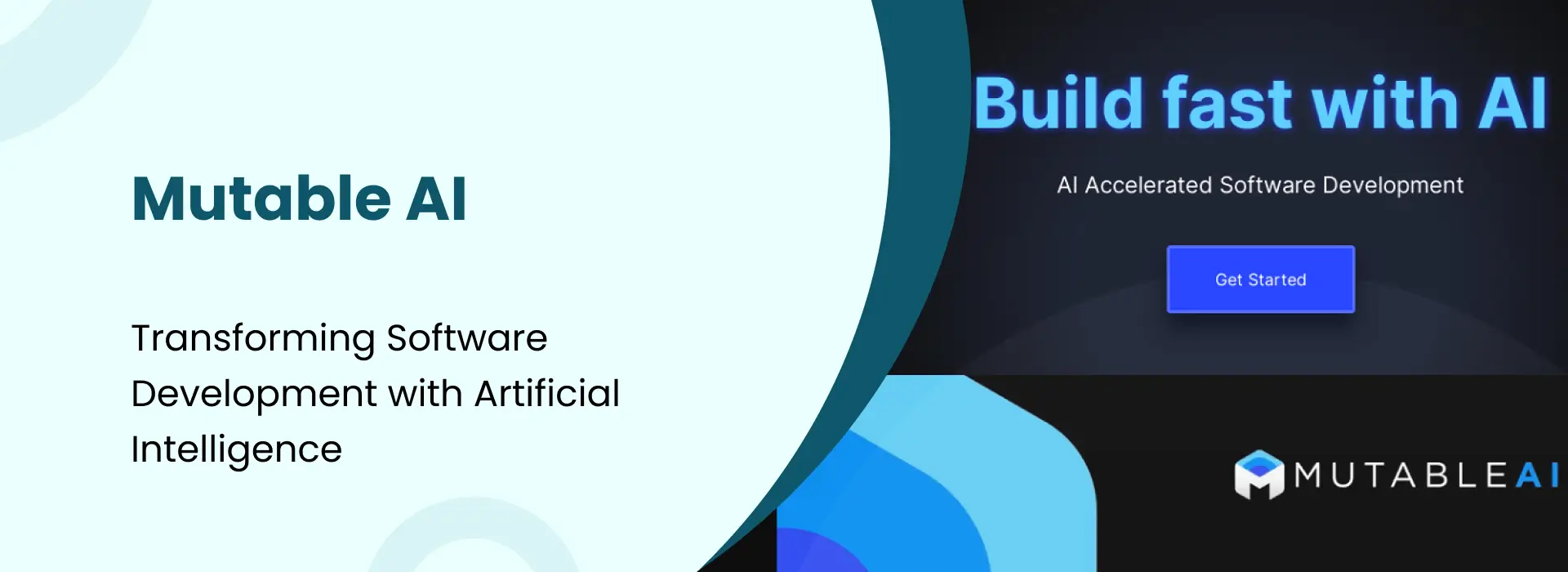
Mutable AI: Transforming Software Development with AI
- Niotechone Marketing Team
Introduction
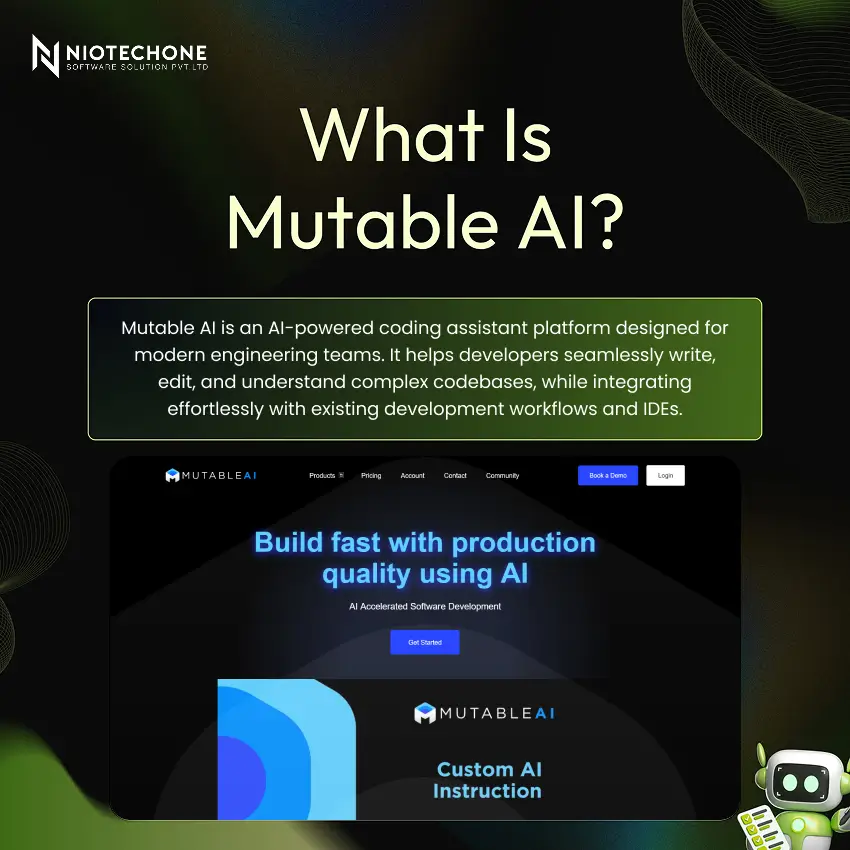
The software development environment is evolving rapidly. Teams are being pressured to deliver faster, cleaner code, and more complex systems – simultaneously. Mutable AI is designed to address this challenge precisely. It is an AI-based coding assistant platform that is designed to support modern engineering teams in writing, editing, and understanding complex codebases with much less friction. Mutable AI is a perfect fit in your existing workflows and IDEs to make every developer on your team more productive.
Why Mutable AI Matters
There are four fundamental pain points of modern software development that Mutable AI directly solves:
Complexity of the System – To navigate the contemporary software systems, smarter tools of comprehension are required.
Increased Cycles – Teams are under intense pressure to deliver faster and have a shorter time-to-market.
Code Quality – It is important to reduce the number of bugs introduced by humans and enhance the overall quality of the code.
High-Value Focus – Developers need to shift from writing boilerplate to focusing on strategic, high-value work.
Key Features of Mutable AI
Mutable AI is a single platform that combines five powerful capabilities:
AI-Powered Code Generation — Instantly translates natural language prompts into functional, clean code snippets.
Refactoring and Optimization – Automatically restructures messy code to enhance efficiency without altering external behavior.
Automated Documentation – Produces correct inline comments and structural documentation with ease.
Deep Codebase Knowledge – Visualizes complex dependencies to give context-sensitive responses about your repository.
Smart Suggestions – Provides real-time, proactive code completion that predicts the next action of the developer.
How Mutable AI Works
Mutable AI is based on advanced large language models (LLMs) that are trained on billions of lines of high-quality code. This training enables the AI to gain a profound insight into the context, architecture, and unique logic of your particular codebase. It operates in the background continuously, implying structural improvements in real time and dynamically learning through developer input to become more accurate in the future.
Benefits to Engineering Teams
Velocity and Quality
- Reduced Development Time – Significantly reduces the number of hours spent on routine coding activities.
- Better Code Quality – Ensures consistency and best practices throughout the repo.
- Less Manual Work – Removes the boilerplate writing of repetitive boilerplate.
Culture and Scalability
- Improved Cooperation – Unifies code structures, which facilitates peer reviews and makes them quicker.
- Simpler Onboarding – New developers can ask the AI to immediately learn about legacy systems.
- Less Burnout – Makes developers work on creative problem-solving instead of typing.
Strategic Use Cases
Mutable AI is particularly bright in three high-impact situations:
Migration and Upgrades – Accelerates complex migrations by automatically converting old syntax to modern framework standards.
Refactoring Legacy Code – Cleanup of technical debt and re-writing of large legacy systems into modular, maintainable components.
Debugging and Documentation – Immediately creates detailed documentation and offers AI-based support to isolate difficult bugs.
Mutable AI vs. Traditional Development
Development Aspect | Traditional Approach | With Mutable AI |
Workflow Efficiency | Little to no automation | Intelligent robots to perform routine jobs |
Code Quality | Higher risk of human error | Reduced errors, standardized outputs |
Coding Method | Manual, line-by-line coding | Generation and editing with the help of AI |
Delivery Speed | Time-consuming, prone to bottlenecks | Reduced delivery and iteration times |
Challenges and Limitations
No tool is perfect. Mutable AI has a couple of significant caveats that teams should be aware of:
Accuracy: AI-generated code is not necessarily completely accurate and needs to be carefully reviewed by humans.
Security and Privacy: Sensitive code should be treated with high security and privacy levels.
Learning Curve: Teams require time and training to effectively utilize the AI.
Over-dependence Risk: Junior developers can be over-reliant on AI suggestions and fail to have the opportunity to develop core coding skills.
Conclusion
AI is transforming the way development work is done – and Mutable AI is leading the charge. The platform enhances productivity and team efficiency and serves as the ultimate assistant, not a replacement, to developers. In the future, Mutable AI will be more tightly integrated with IDEs, smarter automation, and more autonomous testing capabilities. Teams that embrace AI-assisted development today will be much better placed to meet the engineering challenges of tomorrow.
Categories
Related Articles


Related Tags
Frequently Asked Questions FAQs
Mutable AI is used to help software development teams write, edit, refactor, and document code faster using AI-powered assistance integrated directly into their existing workflows and IDEs.
No. Mutable AI is designed to work as an assistant, not a replacement. It handles repetitive and boilerplate tasks so developers can focus on more strategic, creative, and high-value work.
By standardizing outputs, reducing human error, and ensuring best practices are applied consistently across the repository, Mutable AI helps teams maintain higher-quality code at scale.
There is a learning curve involved. Teams need time and proper training to integrate the tool effectively into their workflow, but the productivity gains after adoption are significant.
The roadmap points toward tighter IDE integration, smarter automation of complex tasks, and more autonomous testing capabilities — making AI an even deeper part of the software development lifecycle.