Lovable: Use Cases, Working, Benefits, and Limitations
- Niotechone Marketing Team
Introduction
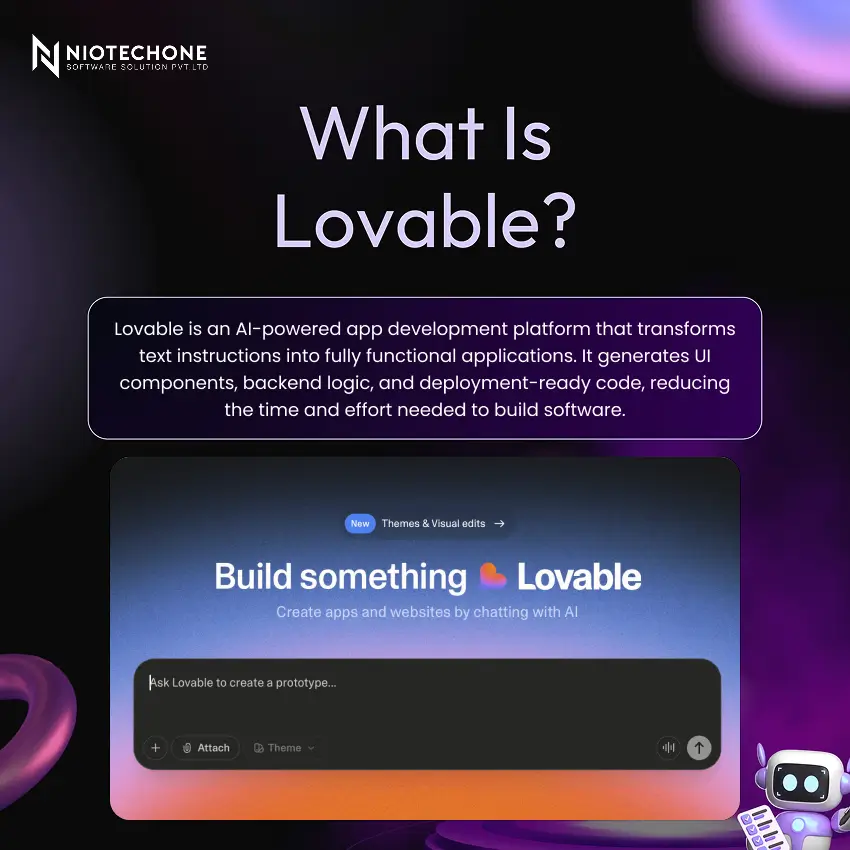
Traditionally, it takes weeks to plan and weeks to write code that works for a software application, and there is a great deal of repetitive coding involved. In the case of start-ups, small teams, and businesses that have to get things done quickly, this is a hurdle that has never been overcome. Lovable is a platform for app development that utilizes AI to make a difference in this equation.
Working Mechanism: How Lovable Builds Applications
Lovable follows a clean 4-stage process to get your idea from a description to a deployed application:
1) User Inputs — You write your requirement for an application, feature, or component in simple, natural language. The more it is written, the clearer and more detailed the description will be, which will in turn produce a better output.
2) AI Processing — Lovable’s AI component will evaluate your input, your intent, context, and requirements, and plan the best architecture and component structure.
3) Code Generation — Code generation provides instant, structured application code: UI layouts, components, interaction logic, and backend scaffolding.
4) Deploy — The resulting application is instantly deployable (no additional configuration, complicated setup, or manual deployment steps).
Use Case: Rapid Internal Tool Development
One of Lovable’s biggest and most ready use cases is to create internal tools that an organization requires quickly, but often isn’t willing to invest a great deal of developer time in.
- Admin Dashboards — Create robust monitoring dashboards with real-time system metrics and intuitive visual data about overall system health, without the long build time.
- Employee Portals — Develop complete HR management solutions covering everything from leave tracking to performance evaluations and visual organizational hierarchy views, in mere hours—not months—compared to the months it would take to build traditionally.
- Data Entry Apps — Create intuitive data collection forms, add validation rules, lookup fields, and automated workflows to simplify and standardize data entry among teams.
How Lovable Accelerates Development
Lovable is truly unique from traditional development methods in four key ways:
1. Days Not Weeks — Develop working applications in days, not months. Previously, a week’s worth of team effort, this can be produced in a fraction of that time without compromising functionality.
2. Write Less Code — Concentrate on logic, not boilerplate. Lovable takes responsibility for all the repetitive scaffolding and setup code, letting developers focus on the business items that really matter.
3. Easy to Modify — Update and change application features, using simple prompts. No big codebases to scour or sweeping structural changes — just a description of the update, and Lovable will apply it.
4. Ready to Deploy — These applications are engineered for deployment, and teams can deploy without further configuration, environment setup, or pre-launch engineering.
Benefits for Developers
Lovable offers practical, measurable advantages for the development team:
- Development Speed — Speeds application scaffolding from hours to minutes, allowing teams to spend more time coding business logic and less time on repetitive scaffolding and boilerplate.
- Productivity Boost — Eliminates repetitive front-end coding completely, leaving engineers to focus on more important and sophisticated backend coding and core system functionality that requires their expertise.
- API Integration — Connects seamlessly generated user interfaces to existing systems. Standard, consistent integration protocols for .NET Core services, allowing it to easily be integrated with well-known backend architectures, via frontends generated by Lovable.
Limitations of Lovable
Knowing the limitations of Lovable can help teams use it strategically and have the right expectations when implementing it in production workflows:
- Prompt Dependency — Output is only as good as the input. The quality of the output is much higher when the prompts are clear and have well-defined technical requirements.
- Complex Logic Gaps — Manual development and dedicated engineering effort are still needed for complex business rules, advanced algorithms, and specialized computations. Lovable handles structure and UI very well — deep business logic remains the developer’s responsibility.
- Debugging Challenges — Understanding and debugging AI-generated code can take additional time compared to handwritten code. Developers might need to learn some of the patterns and structural conventions created by AI before they can efficiently debug.
Conclusion
Lovable is a real step change in creating software applications quickly and efficiently with the help of AI. It eliminates the most time-consuming aspects of development, such as scaffolding, generating front-end, building components, and boilerplate coding, allowing developers to dedicate all their time to the logic and functionality that generates real business value.
Categories
Related Articles

Related Tags
Frequently Asked Questions FAQs
Yes, Lovable generates deployment-ready applications that can be launched immediately. However, for production use, teams should follow the recommended implementation practices — including secure authentication with JWT or OAuth 2.0, clean API architecture, and scalable containerised deployment.
You do not need coding skills to generate initial applications and prototypes with Lovable. However, for production-level applications with complex business logic, security requirements, and developer expertise are still required to review, refine, and maintain the generated code.
Lovable is well-suited for building admin dashboards, employee portals, HR management systems, automated reporting tools, data entry applications, web application frontends, and rapid prototypes.
Lovable generates user interfaces that can be seamlessly connected to existing backend services, including .NET Core APIs, using standard integration protocols. The platform supports clean RESTful API connectivity as part of its generated output.
The four key limitations are UI customisation constraints for highly specific brand requirements, heavy dependency on prompt quality for good output, limited capability for complex business logic and algorithms, and added complexity when debugging AI-generated code patterns.