LangChain AI: Build Applications with Large Language Models
- Niotechone Marketing Team
Introduction
While powerful as AI models can be, they all have hit a ceiling when it comes to remembering a conversation, accessing current information, or taking action in the real world.
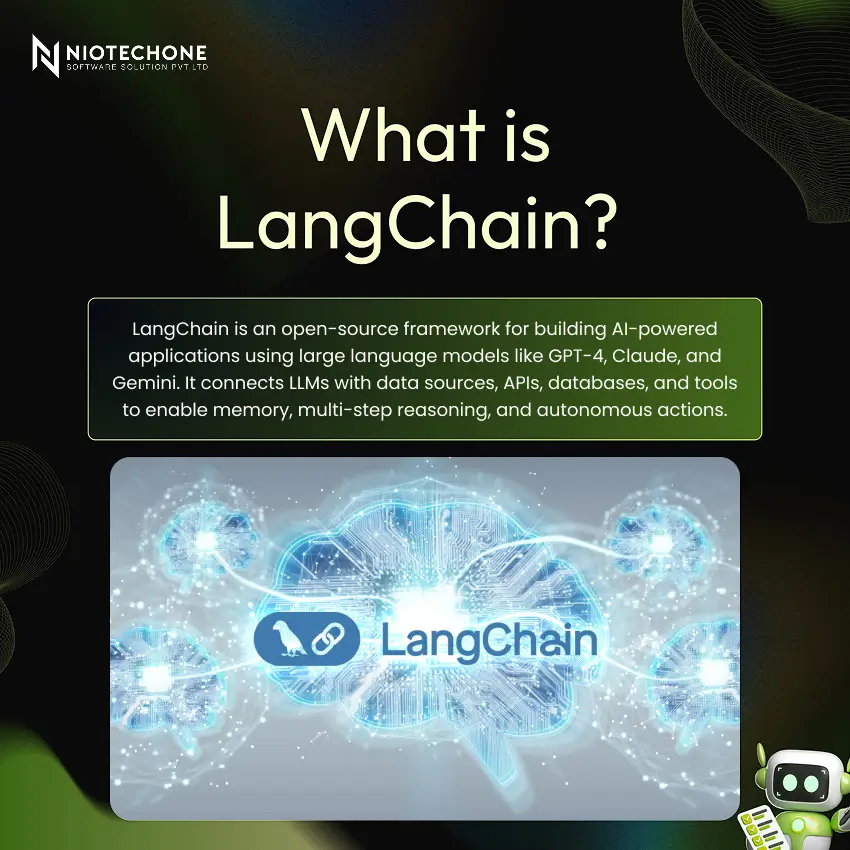
The Six Core Components of LangChain
LangChain is designed around six core components, addressing distinct problems in AI application development:
Models — Connects all major LLMs, such as GPT-4, Claude, and Gemini. Change providers with minimal code changes.
Prompts — Manages and optimizes prompt templates to ensure your AI receives well-structured and consistent instructions each time.
Chains — Links multiple AI steps in sequence, enabling complex workflows where each step builds on the output of the previous one.
Memory — Gives AI the ability to remember conversations, maintaining context, preferences, and history across interactions.
Agents — AI that thinks, decides, and takes autonomous action, not just generating text.
Tools — Links AI to web search, calculator, databases, APIs, and any other system it must use to complete a task.
How LangChain Works: The Architecture
LangChain provides a seamless pipeline, from user input to intelligent processing to a response that is contextual and enhanced by tools. The flow goes through four phases:
1. User Input — A query, goal, or question comes into the pipeline and is fed into the LangChain orchestration layer.
2. Prompt and LLM — The input is broken down into an optimized prompt and passed to the chosen large language model for reasoning.
3. Memory and Tools — The model accesses memory for context and uses external tools — databases, APIs, search engines — to retrieve real-world information.
4. Output Returned — A full, contextual, tool-supported response is returned to the user, much richer than any standalone model could provide.
Supported AI Models
LangChain is compatible with all major LLM providers, and switching between models only involves changing one line of code, giving development teams the flexibility without re-architecting their application.
OpenAI GPT-4 — Industry-leading reasoning and language generation for the most demanding tasks.
Anthropic Claude — Safe, reliable, and very capable, performs well on nuanced and complex instructions.
Google Gemini — Google’s most powerful multimodal model, which can understand text, images, and audio.
Meta LLaMA — Open-source and self-hosted, offering maximum flexibility for teams that need full control over their model.
Mistral AI — A high-performance, efficient European LLM with impressive performance on less compute.
Core Features: Chains and Memory
Two of LangChain’s most powerful features combine to create AI that can think in steps and remember what’s important. Chains and Memory are the backbone of any serious LangChain application.
Chains — Orchestrate Workflows: Break large, complex jobs into simple, sequential steps for faster, more reliable execution. Chains transform a single intimidating prompt into a dependable, organized process with each step meaningful and measurable.
Memory — Preserve Context: Maintain preferences, history, and intent throughout interactions. Unlike traditional messaging, Memory ensures the AI always remembers what has previously been said, making each response more relevant and personalized.
The Result — Deliver Smarter Experiences: A combination of structure and recall to build AI that is seamless and adaptive. Chains and Memory applications don’t simply react; they comprehend, recall, and enhance with each interaction.
Conclusion
LangChain is more than just an AI library; it’s the blueprint for the future of intelligent applications. LangChain is designed to bridge the gap between large language models and real-world data, thereby redefining what AI can achieve in a production application. From creating a customer support bot to a document intelligence tool, a research assistant, LangChain offers the building blocks and model-agnostic architecture to build it right.
Categories
Related Articles
Related Tags
Frequently Asked Questions FAQs
A raw LLM loses conversation context, cannot fetch live data, cannot call APIs or tools, and breaks down on complex multi-step tasks. LangChain solves all four of these limitations — giving models memory, real-time data access, tool integration, and the ability to chain tasks into intelligent workflows.
LangChain supports all major LLM providers, including OpenAI GPT-4, Anthropic Claude, Google Gemini, Meta LLaMA, Mistral AI, and thousands of community models via Hugging Face. Switching between providers requires changing just one line of code.
A LangChain Agent is an autonomous AI component that can think, plan, and use tools to complete multi-step tasks independently. It receives a user query, breaks it into a plan, executes tools to gather information, and delivers a final answer — all without requiring step-by-step human instruction.
Yes, Microsoft's Semantic Kernel SDK brings LangChain's core concepts — Agents, Chains, Memory, and Tools — directly to C# and ASP.NET. This allows .NET developers to integrate AI capabilities into their existing stack without switching languages or frameworks.
LangChain powers a wide range of applications, including AI-powered customer support chatbots, document question-answering systems, web research agents, and medical information assistants — across virtually every industry vertical.