Google Antigravity: Agentic AI for Software Engineering
- Niotechone Marketing Team
Introduction
If you are a .NET developers or engineering team lead who want to use AI to automate code generation, refactoring, testing, and migrations, and covers everything from how Antigravity works to its real-world capabilities and limitations.
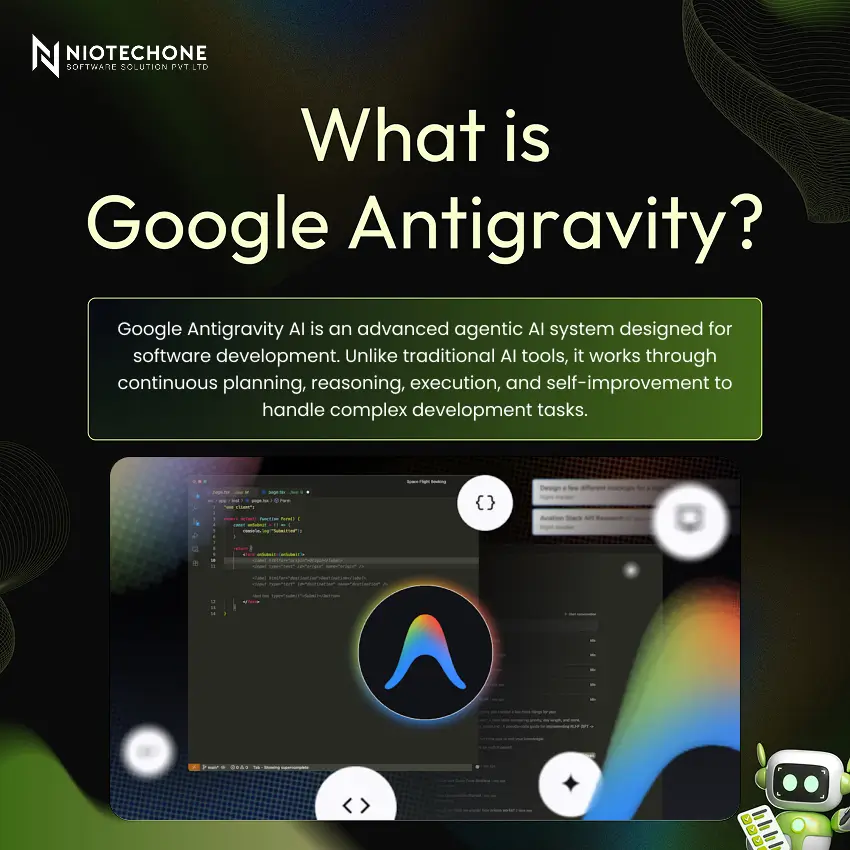
How It Works
The Antigravity AI workflow follows a structured loop:
- User enters a prompt.
- AI makes the necessary plans.
- AI performs the tools as required.
- AI keeps going and improving.
- The final output is returned to the user.
This is an iterative process in which the agent continues to refine its answer until it is correct, rather than providing a one-shot answer.
Working in .NET Core
Antigravity is designed for .NET development environments. It has the following main features.
- C# Code Generation: Generate classes, controllers, and services in an idiomatic C# way.
- .NET CLI Integration: Runs dotnet build, dotnet test, and NuGet commands directly from within the agent.
- NuGet and Project Files: Reads .csproj files and automatically suggests compatible NuGet packages.
- Async and LINQ Optimization: Refactors synchronous methods to async/await patterns and optimizes LINQ queries for better performance.
Automated Code Refactoring
One of Antigravity’s most impressive capabilities is its ability to modernize legacy codebases. It refactors old code to clean and modern code using Gemini 3.1 analysis and planning.
Specifically, Antigravity:
- Converts legacy ADO.NET data access code to Entity Framework Core is provided.
- Converts synchronous methods to async/await
- Breaks down large monolithic methods into smaller testable methods
This allows developers to update legacy applications without having to do everything manually.
Unit Test Generation
Antigravity automates test creation for .NET projects. It examines C# classes and creates full test cases, such as:
- Test classes using xUnit or NUnit attributes.
- Moq dependency injection mocks
- Arrange-Act-Assert structure for .NET Core Web APIs
This eliminates one of the most time-consuming aspects of development — writing comprehensive unit tests from scratch.
Real-Time Debugging and Log Analysis
Antigravity is easy to use for debugging. Developers may copy any ASP.NET Core exception or stack trace directly into the agent.
Antigravity then:
- Determines the cause of the mistake
- Identifies problems such as misconfigured middleware, dependency injection lifetime mismatches, etc.
- Returns actionable code diffs that fix the problem
This turns hours of debugging into a matter of seconds.
.NET Framework Migration
Antigravity is capable of full framework migration projects. It is compatible with legacy .NET applications (including WebForms with web.config) to .NET 8 or .NET 9.
The migration process consists of:
- Evaluating, prioritizing, and developing a comprehensive migration timeline
- Converting WebForms to Blazor or MVC.
- To convert web.config to appsettings.json,
- Automatically dealing with breaking API changes
This is especially useful for businesses that are still using older .NET Framework applications that require a roadmap to the modern .NET.
Workflow Example
Antigravity supports structured commands to trigger different modes of operation:
- Use /plan to structured planning (For example: /plan Create a REST API endpoint in C# with DTOs, service layer, and xUnit tests)
- Use @ Mention to reference specific files or classes in your project.
- Use / Workflows to trigger structured planning modes.
- Ask anything in free-form for general .NET Questions and tasks.
This gives developers flexibility — whether they want guided, structured outputs or quick answers to ad-hoc questions.
Limitations to Know
Antigravity is strong, but it’s not flawless. Some of the drawbacks to consider:
- Sometimes it recommends wrong or obsolete NuGet package versions.
- It is not fully aware of your company’s business rules or internal processes.
- Always need to review any AI-generated code before deployment to production.
Like all AI development tools, Antigravity is a co-pilot, not a replacement for developer judgment.
Conclusion
Google Antigravity is a major advancement in agentic AI for software development. It integrates planning, execution, and self-refinement into a single loop, offering more than just code completion. For .NET developers, it provides practical, production-relevant features, such as scaffolding new APIs, migrating legacy systems, and more, all within your familiar IDE and project structure.
With the continued evolution of AI tools, systems such as Antigravity are becoming the benchmark for developer productivity in a modern engineering workflow.
Categories
Related Articles

Related Tags
Frequently Asked Questions FAQs
Its primary focus and feature set are built around .NET Core and C# development, including CLI integration, NuGet, EF Core, and ASP.NET Core.
Yes, it generates complete xUnit or NUnit test classes with Moq setups and an Arrange-Act-Assert structure for .NET Core Web APIs.
No, the presentation explicitly states that human review is always required before using any AI-generated code in production.
Yes, it can plan and execute a full migration roadmap from legacy .NET (including WebForms) to .NET 8 or .NET 9, including config file conversion and handling breaking API changes.
It may suggest incorrect NuGet package versions, does not understand company-specific business logic, and always requires human review before production use.