CodeRabbit: AI Code Reviews for Faster Engineering Teams
- Niotechone Marketing Team
Table of Contents
- Introduction
- What Is CodeRabbit?
- The Problem: Traditional Code Review Bottlenecks
- How CodeRabbit Works: The Workflow
- Intelligent Features
- System Architecture
- Why Teams Love CodeRabbit
- Real-World Example: Catching a SQL Injection
- How CodeRabbit Compares
- Who Should Use CodeRabbit?
- Challenges and Limitations
- The Future of AI-Powered Code Review
- Conclusion
Introduction
Whether you’re facing slow pull request cycles, missed bugs, or inconsistent review standards, this guide has you covered and explains why CodeRabbit is becoming a must-have for modern software development.
It is becoming a must-have for modern software development, and this guide explains how it helps teams overcome slow pull request cycles, missed bugs, and inconsistent review standards.
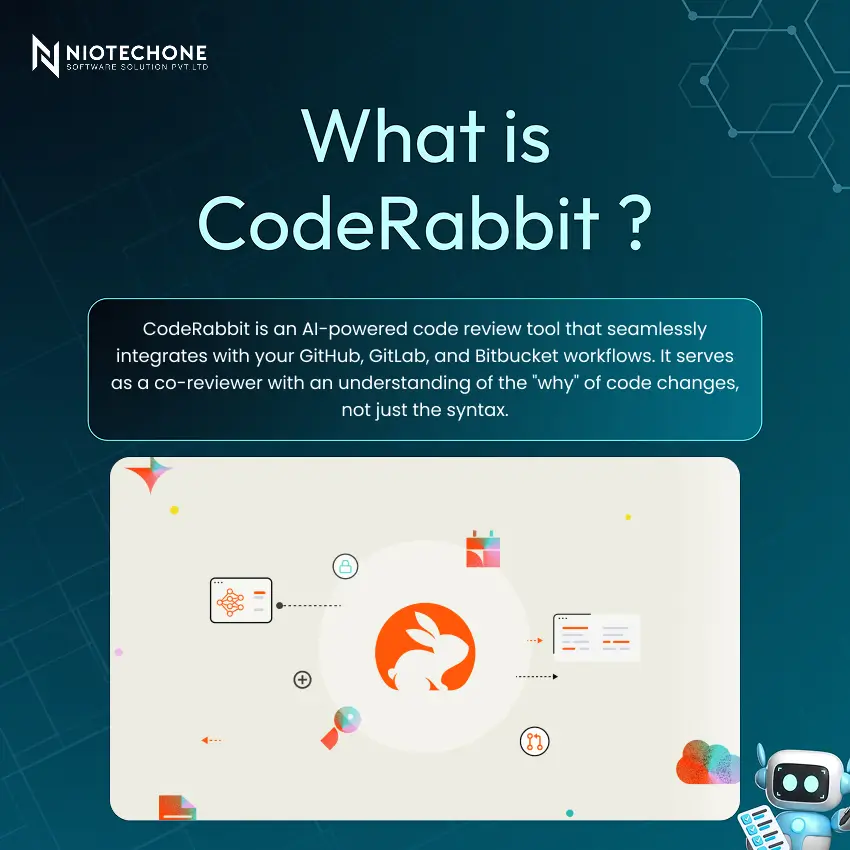
Key capabilities include:
- Automated Pull Request (PR) Summarize
- Context-Aware Inline Suggestions
- One-Click Committable Fixes
- Agentic Chat Interaction for Developers
The Problem: Traditional Code Review Bottlenecks
It’s important to understand the pain points CodeRabbit addresses before you grasp why it matters.
Time Drains: Human reviewers can take 24 to 48 hours to give the first round of feedback, slowing down deployment velocity.
Cognitive Overload: When reviewers are overwhelmed by large, complex PRs, they may end up rubber-stamping without noticing important bugs.
Human Error: Technical debt and production incidents due to inconsistent standards and missing edge cases.
How CodeRabbit Works: The Workflow
It workflow is straightforward and quick:
- The developer pushes code and makes a PR on GitHub or GitLab.
- CodeRabbit is triggered by a webhook and clones the repository.
- Analysis and summary with inline comments are posted immediately with AI.
- Developer applies fixes and merges with confidence.
This entire cycle takes only seconds. CodeRabbit re-evaluates the changes every time a new commit is pushed.
Intelligent Features
Smart Summarize: Automatically creates a high-level summary of PR changes, minimizing context switching for reviewers.
Security and SAST: Connects to 40+ static analysis tools to detect vulnerabilities and exposed secrets in real time.
Agentic Chat: Developers can chat directly with the bot on a PR to request unit tests, documentation generation, or explanations.
System Architecture
CodeRabbit is designed on a production-grade AI infrastructure:
- Ephemeral Sandboxes for isolated deep analysis.
- Orchestration Engine coordinating LLMs (GPT-4 / Claude) and SAST tools
- Contextual Memory, which learns from team coding guidelines and previous PRs
- Real-time reactive triggers with GitHub Webhooks.
Importantly, code is executed in ephemeral containers and never used to train external AI models.
Why Teams Love CodeRabbit
- 70% faster PR cycles
- No reviewer fatigue — 100% focus on each line, each time.
- Mentorship for junior developers at the senior level, with explanations of fixes.
- Enforcement of style and logic standards throughout the organization.
Real-World Example: Catching a SQL Injection
In the presentation, a classic example is presented where CodeRabbit is able to detect a SQL injection vulnerability. The original code was using string interpolation in a database query. It was flagged by CodeRabbit and recommended to use parameterized queries, which was done in one click, thus immediately mitigating the vulnerability.
How CodeRabbit Compares
Feature | Human Review | Traditional SAST | CodeRabbit AI |
Speed | Hours to Days | Minutes | Seconds |
Contextual Awareness | Very High | Low (pattern matching) | High (LLM-powered) |
Fix Suggestions | Manual | Rarely | One-Click Committable |
Conversational | Yes | No | Yes (Agentic) |
Who Should Use CodeRabbit?
Startups: Do no harm, move quickly. Grow your engineering team without hiring several senior reviewers at once.
Enterprises: Ensure compliance, security, and global coding standards across 1000+ developers.
Open Source Maintainers: Automate baseline feedback and linting to handle a large number of incoming PRs.
Challenges and Limitations
No tool is perfect. There are a couple of things to keep in mind when using CodeRabbit:
- Business Logic: AI might not be able to handle complex business rules that are not explicitly programmed.
- Review Noise: It can be verbose out of the box and may require configuration to tune the signal-to-noise ratio.
- Access Permissions: Needs repository read/write access, which may be challenging for highly regulated industries.
The Future of AI-Powered Code Review
The presentation is moving towards an agentic engineering era, where AI is not just reviewing but actively participating:
- Self-contained debugging and healing code.
- AI pair programming is the new standard of development.
- Predictive maintenance — catching bugs before they are even typed.
- Automated documentation and test case generation.
Conclusion
CodeRabbit AI is not a bug catcher. It’s about enabling developers to concentrate on what matters most: solving complex problems and creating great products. As the final takeaway from the presentation puts it: AI code review is no longer optional for high-performing engineering teams.
Categories
Related Articles

Related Tags
Frequently Asked Questions FAQs
CodeRabbit integrates with GitHub, GitLab, and Bitbucket.
No. Code is processed in ephemeral containers and is not used to train global AI models.
No. CodeRabbit is a co-reviewer, not a replacement. Human oversight remains essential for high-level architectural decisions and complex business logic.
It can be verbose initially. Teams are encouraged to configure it to tune the feedback signal-to-noise ratio to their preferences.
Yes, it is particularly useful for maintainers managing a high volume of pull requests, automating baseline feedback and linting checks.