
No Code, No Problem: Can You Really Build Apps?
- Niotechone Marketing Team
Table of Contents
- Introduction
- What Is No-Code App Development?
- The reason why No-Code Platforms are increasing at such a rapid rate
- What are the Real Apps You Can Build with No-Code?
- The Hidden Limitations of No-Code Platforms
- No-Code vs. Custom Software Development
- No-Code Makes Sense to Businesses
- The Future of No-Code and Low-Code Development
- Conclusion
Introduction
The idea of developing an application without writing code is almost unbelievable. Over the years, software development has been linked to the employment of developers, the creation of complex code and the months of waiting before a working product is created. That story is being changed today by no-code platforms. They provide rapid application development using visual tools instead of programming languages.
The advent of digital tools, remote work, and online services has forced companies to create apps faster than ever. Applications have become a critical component of daily business, internal or customer-facing. This is where no-code platforms claim to help. But the real question is, can you really build reliable and scalable apps without writing any code?

What Is No-Code App Development?
No-code app development allows users to create applications through visual interfaces instead of writing code. These platforms provide drag-and-drop components, pre-built templates, and simple logic builders. Users connect screens, define workflows, and set rules through visual steps. This approach makes app creation accessible to non-technical individuals.
Most no-code tools manage technical layers in the background. They handle hosting, databases, and basic security. Users focus mainly on design and functionality. This approach appeals to startups and business teams that want fast results without hiring a full development team.
However, no-code does not remove logic. Users still need to understand processes, data flow, and user experience. No-code reduces coding effort, but it does not remove the need for planning. This distinction becomes critical as applications grow larger and more complex.
The reason why No-Code Platforms are increasing at such a rapid rate
No-code platforms are increasing due to the desire of businesses to be fast. Markets are dynamic, and companies cannot afford to take too long to develop all ideas. These tools enable teams to prototype ideas fast and deploy simple applications within weeks rather than months.
Another major reason is cost. It may be costly to hire developers, designers, and testers. No-code platforms minimize initial investment and enable companies to test before investing in full-scale development. This can be useful to startups and internal teams with small budgets.
Digital transformation is also supported by no-code. Departments such as HR, sales, and operations can develop tools without having to wait for IT teams. This autonomy enhances efficiency and minimizes internal bottlenecks. Nevertheless, speed and convenience have their own trade-offs that companies should be aware of.
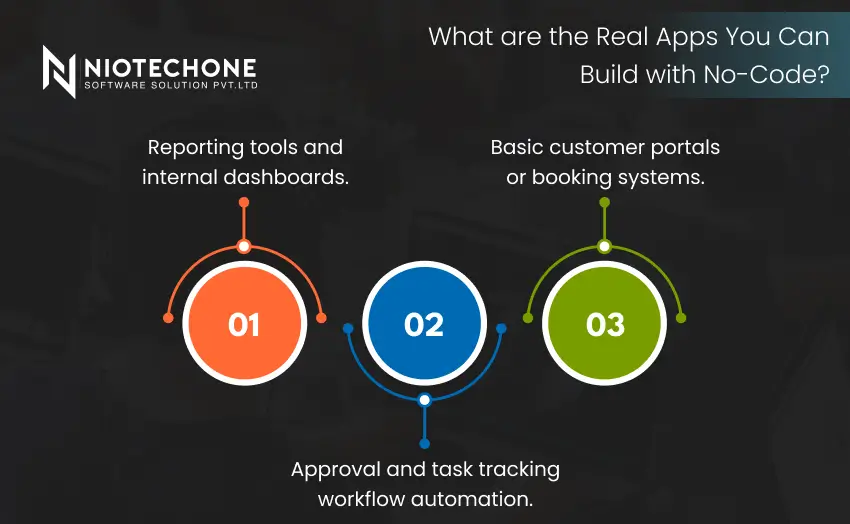
What are the Real Apps You Can Build with No-Code?
These platforms are most effective with straightforward and clear-cut applications. These are the best tools when the requirements are well defined, and the changes are minimal. No-code is used by many businesses to operate internally and meet short-term requirements.
Common use cases include:
- Reporting tools and internal dashboards.
- Approval and task tracking workflow automation.
- Basic customer portals or booking systems.
These applications tend to be based on simple logic and standard integrations. No-code tools are effective in this situation. But as applications need more complex business rules, more advanced security, or more integrations with the system, no-code platforms begin to reveal their weaknesses. This is where conventional development is required.
The Hidden Limitations of No-Code Platforms
These platforms do not fully replace traditional software development, even though they offer strong capabilities. Customization remains a major limitation. Many no-code tools cannot support the unique workflows that businesses need. Users often adapt their processes to the platform rather than the platform adapting to their needs.
Scalability also presents a challenge. No-code apps may struggle as the user base grows. Most platforms limit database size, API usage, or advanced logic. These restrictions can slow business growth.
Platform dependency creates another risk. Businesses rely heavily on the no-code provider’s infrastructure and rules. Migration later can become costly and complex. Many teams overlook this risk during initial adoption.
No-Code vs. Custom Software Development
No-code and custom software development serve different purposes. No-code focuses on speed and simplicity. Custom software offers flexibility, control, and long-term value. Businesses can understand this difference to make better decisions.
The development of custom software enables complete control of architecture, security, and performance. Business needs are the basis of solutions, rather than platform constraints. A software development company in Rajkot can create systems that can expand with the business and can be easily integrated with the existing tools.
It is effective in testing ideas and short-term solutions. Custom development is most effective with core business systems, customer-facing platforms, and enterprise applications. Most companies nowadays combine the two methods.
No-Code Makes Sense to Businesses
This is an intelligent option under certain circumstances. It enables companies to operate fast without investing heavily. It provides high value when applied appropriately.
It works best when:
- Testing a new product concept or MVP.
- Developing in-house applications with a few users.
- Designing short-term solutions.
Speed is more important than customization in such situations. Businesses are not to stop planning for future growth and understand when to transition to custom development.
The Future of No-Code and Low-Code Development
These platforms are the most accessible ever in terms of app development. They assist companies to go quickly, experiment, and enhance internal productivity. Nevertheless, they are not a panacea. Their inability to be customized, scaled, and controlled restricts their applicability to most long-term projects.
The most intelligent thing to do is to select the appropriate tool for the appropriate job. No-code is great when you need a fast answer. Core business systems require custom software development. Collaborating with a reputable software development company in India will make businesses develop future-ready applications with confidence.
Conclusion
Startup apps in 2026 are successful because they are not trendy but rather basic. Long-term success is characterized by clear value, high performance, easy onboarding, and scalable architecture.
These seven mistakes can be avoided, and this will greatly enhance the survival and growth of your app. In case you need a trusted custom software development company in Rajkot or India that has experience in the development of .NET, collaborating with a team of experienced people can assist you in developing a future-proof application.
Good products are created by making wise choices- and knowing what not to create is as important as knowing what to create.
Categories
Related Articles

Frequently Asked Questions FAQs
No-code app development enables users to create applications with visual tools rather than programming code.
Yes, they are capable of creating simple and internal business applications, but more complicated systems may need to be developed.
No-code is not scalable and secure in most cases, which restricts its use by enterprises.
Core systems, customer-facing applications, and long-term expansion are best developed custom.
Indian companies provide a talented workforce, economical and experience in international software development.


