
7 Mistakes Killing Most Startup Apps in 2026
- Niotechone Marketing Team
Introduction
Starting a startup app is no longer the most difficult part in 2026. The actual problem is how to retain users once they have interacted a few times. The markets are saturated, the competition is fierce, and the patience of the users is very low. Even the well-financed startup apps fail annually due to the repetition of the same strategic and technical errors.
Being a software development company in Rajkot and India that collaborates with startups and expanding businesses, we frequently look through applications that have issues with retention, performance, or scalability. Failure is not, in most cases, a result of a bad idea. Rather, it is a result of preventable choices in the planning, development, and initial growth phases.
7 Mistakes Killing Most Startup Apps in 2026
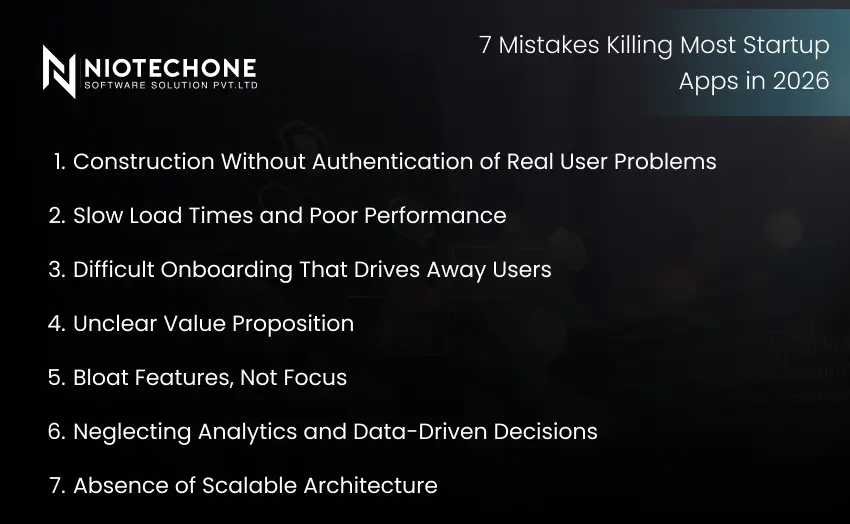
1. Construction Without Authentication of Real User Problems
Most startup applications fail due to the fact that they are developed based on assumptions and not actual user requirements. Founders tend to create features according to internal views, competitor analysis, or personal preferences. Nevertheless, users do not embrace products that do not address a definite and immediate issue.
In 2026, users are quick to drop apps that seem irrelevant or too complex. Startups that do not conduct adequate user research waste time and money on features that do not add much value. This leads to a decline in engagement and retention.
Good custom software development begins with validation. Products that are built by teams that perform user interviews, test early prototypes, and iterate on feedback create products that are consistent with real-world usage.
This error normally results in:
- Low user engagement
- Poor retention rates
- Wasted development effort
- Difficult pivots later
2. Slow Load Times and Poor Performance
Performance is now a product requirement. Users anticipate that in 2026, apps will load fast and respond immediately. Even minor delays cause frustration and decrease trust.
Most startup applications have problems with unoptimized APIs, inefficient database queries, and heavy front-end components. These issues are usually concealed in the initial testing but become severe as the user base increases.
A good .NET development company in India will focus on performance at the outset. Clean architecture, optimized backend logic, and scalable infrastructure assist startups in providing consistent speed with increasing load.
The consequences of poor performance are usually:
- High uninstall rates
- Negative app store reviews
- Reduced conversions
- Higher infrastructure expenses.
3. Difficult Onboarding That Drives Away Users
Success or failure is determined by first impressions. Most startup apps continue to bombard users with complicated onboarding processes that require registrations, permissions, and tutorials before they can see any value.
Conversely, users in 2026 will be able to browse apps instantly. In cases where onboarding is a pain, users abandon the product without knowing it.
Modern custom software development is concerned with progressive onboarding. The user is only guided when necessary, and flexible authentication enables the user to explore the app before committing.
The consequences of poor onboarding are usually:
- Large drop-off in initial sessions.
- Low activation rates
- Weak user adoption
4. Unclear Value Proposition
Many startup apps fail surprisingly because users do not have a clear understanding of what the app does. When users fail to understand the value in a few seconds, they switch to alternatives.
In 2026, clarity is essential. Apps should convey their intent instantly through design, message, and functionality.
A software development company in Rajkot frequently assists founders in polishing their value proposition early. Clear positioning affects feature priorities, UX choices, and long-term growth strategy.
A vague value proposition results in:
- Low conversion rates
- Poor user retention
- Poor marketing campaigns
5. Bloat Features, Not Focus
Most startup teams are of the opinion that more features will bring more users. But feature bloat tends to add complexity and decrease usability.
Successful apps in 2026 are about doing less but doing it very well. Products with too many features are confusing to users, slow to develop, and costly to maintain.
Feature bloat often causes:
- Confusing user interfaces
- Higher bug rates
- Slower product updates
- Increased technical debt
6. Neglecting Analytics and Data-Driven Decisions
Startups are run on assumptions without data. Numerous applications continue to be released without adequate analytics, and it is hard to comprehend user behavior or gauge success.
Data-driven development is necessary in 2026. Startups need to monitor onboarding flow, feature usage, retention, and performance metrics from the very beginning.
An Indian software development company is a professional company that incorporates analytics into the architecture, allowing teams to make informed decisions rather than guessing.
Lack of analytics leads to:
- Poor product decisions
- Ineffective updates
- Lost growth opportunities.
7. Absence of Scalable Architecture
Startup apps are silently killed by technical debt. Most founders are in a hurry to launch with poorly designed code that cannot scale as users increase.
Scalability should be incorporated into the foundation in 2026. Applications must be able to grow without significant rewrites or system crashes.
An experienced .NET development company will develop applications that are modular, cloud-ready, and maintainable over time.
Poor scalability results in:
- Frequent downtime
- Rising maintenance costs
- Slow feature delivery
- Limited growth potential
The Importance of Removing Bad Features over Adding New Ones
In modern app development, advancement is not achieved by introducing additional functionality. Rather, it is a result of enhancing clarity, performance, and usability. Redundant features cause confusion, slowness, and overhead in maintenance.
Eliminating low-value features assists teams in concentrating on what users require. It also enhances performance, minimizes technical debt, and makes the overall user experience easier.
Eliminating bad features assists in:
- Improve stability and speed
- Reduce long-term costs
- Increase user retention
- Strengthen product focus
Conclusion
Startup apps in 2026 are successful because they are not trendy but rather basic. Long-term success is characterized by clear value, high performance, easy onboarding, and scalable architecture.
These seven mistakes can be avoided, and this will greatly enhance the survival and growth of your app. In case you need a trusted custom software development company in Rajkot or India that has experience in the development of .NET, collaborating with a team of experienced people can assist you in developing a future-proof application.
Good products are created by making wise choices- and knowing what not to create is as important as knowing what to create.
Categories

Frequently Asked Questions FAQs
The majority of startup applications fail due to the lack of a clear user problem. Failure is also caused by poor performance, weak onboarding, unclear value propositions, and unscalable architecture.
Performance is critical. Users want apps to be fast and responsive. Even minor delays can raise the uninstall rates and decrease the confidence in the product.
The overloading of features bewilders users and raises maintenance expenses. Unnecessary features decrease usability and slow down development and scaling instead of adding value.
Yes, Custom software development enables startups to create scalable, secure, and user-friendly applications that meet their unique business objectives rather than imposing generic solutions.
Yes, the current .NET frameworks are high-performance, secure, and scalable. A lot of startups prefer to use .NET to develop a stable backend system and enterprise-level applications.


